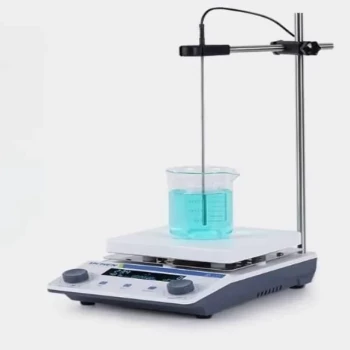
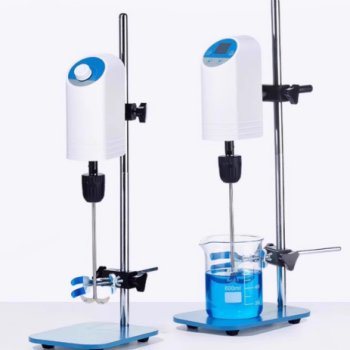
The constant temperature heating and stirring device serves as the critical control unit during the initial liquid-phase stage of sol-gel synthesis. Its primary function is to maintain a precise thermal environment of 70.0°C while providing continuous mechanical agitation to ensure the uniform blending of chromium trioxide precursors, ethanol, and tetraethyl orthosilicate (TEOS).
By strictly stabilizing the reaction environment, this device ensures the synchronization of hydrolysis and polycondensation reactions. This uniformity is the fundamental requirement for generating a high-quality sol, which directly dictates the chemical homogeneity of the final chromium oxide nanoparticles.
The Mechanics of Homogeneity
The quality of a nanoparticle is often determined long before the material solidifies. The heating and stirring device manages the two variables that define the success of the "sol" phase: physical distribution and thermal activation.
Achieving Precursor Uniformity
The synthesis relies on the interaction of three distinct components: chromium trioxide, ethanol, and TEOS.
Without continuous mechanical agitation, these components may not interact evenly. The device forces these elements into a homogeneous solution, ensuring that the reactants are distributed strictly on a molecular level.
Synchronizing Chemical Reactions
Sol-gel synthesis involves complex hydrolysis and polycondensation reactions.
The stirring mechanism ensures these reactions occur simultaneously throughout the entire solution volume. This synchronization prevents localized reaction zones, which leads to inconsistent material properties.
The Role of Thermal Stability
Temperature is the catalyst that drives the reaction kinetics. The device’s ability to hold a specific set point is just as vital as its mixing capability.
Maintaining the 70.0°C Standard
The process requires a stable environment of exactly 70.0°C.
This specific temperature provides the necessary energy for the precursors to react efficiently without degrading. The device acts as a thermal anchor, preventing fluctuations that could accelerate or stall the reaction unpredictably.
Establishing Chemical Homogeneity
The result of this controlled heating is a chemically uniform "sol."
This initial uniformity is critical because any chemical inconsistencies introduced at this stage will be locked into the material during later processing. The device essentially standardizes the chemical composition of the final nanoparticles.
Distinguishing Process Stages
It is vital to understand where the function of the heating and stirring device ends and where subsequent processing steps begin. Conflating these stages can lead to process errors.
Sol Formation vs. Crystallization
The heating and stirring device is responsible only for creating the initial sol and gel network at 70.0°C.
It does not perform the final crystallization of the material. That requires a much higher energy input, specifically a high-temperature calcination process.
Mechanical Mixing vs. Phase Transformation
While the stirrer ensures chemicals are mixed, it does not dictate the final crystal structure or remove all organic residues.
The transformation of amorphous matter into a rhombohedral phase crystalline structure happens later, in a muffle furnace at 400.0°C. The stirring device prepares the ingredients; the furnace "bakes" the final structure.
Making the Right Choice for Your Goal
To optimize your synthesis of chromium oxide nanoparticles, you must apply strict control at the correct stage of the process.
- If your primary focus is chemical consistency: Prioritize the stability of the 70.0°C heating and the rigor of the mechanical agitation to ensure synchronized hydrolysis.
- If your primary focus is crystal phase and size: Ensure your subsequent calcination step is held precisely at 400.0°C for 4.0 hours to achieve the rhombohedral structure and 24.0 nm particle size.
True nanoparticle quality is achieved when precise liquid-phase mixing lays the foundation for accurate solid-phase crystallization.
Summary Table:
| Feature | Role in Sol-Gel Synthesis | Impact on Final Product |
|---|---|---|
| Precise 70.0°C Heating | Provides consistent thermal energy for precursors | Prevents reaction stalls or degradation |
| Mechanical Agitation | Forces molecular-level mixing of precursors | Ensures chemical homogeneity |
| Reaction Synchronization | Manages simultaneous hydrolysis and polycondensation | Eliminates localized reaction zones |
| Thermal Anchoring | Stabilizes the liquid-phase reaction environment | Sets foundation for uniform 24nm particles |
Elevate Your Material Synthesis with KINTEK
Precision at the liquid phase is the secret to high-quality nanoparticles. KINTEK specializes in advanced laboratory equipment designed for rigorous scientific standards. Whether you need high-performance magnetic stirrers and heaters to ensure chemical homogeneity or precision muffle furnaces for the final calcination of rhombohedral structures, we have the solution.
Our extensive portfolio supports every stage of your research, including:
- High-Temperature Furnaces: Muffle, tube, and vacuum systems for flawless crystallization.
- Material Processing: Advanced crushing, milling, and hydraulic pellet presses.
- Specialized Labware: PTFE products, ceramics, and high-purity crucibles.
Ready to achieve superior chemical consistency? Contact KINTEK today to discover how our high-precision tools can optimize your laboratory workflow.
References
- Poonam Sangwan, Harish Kumar. SYNTHESIS, CHARACTERIZATION AND ANTIBACTERIAL ACTIVITIES OF CHROMIUM OXIDE NANOPARTICLES AGAINST KLEBSIELLA PNEUMONIAE. DOI: 10.22159/ajpcr.2017.v10i2.15189
This article is also based on technical information from Kintek Solution Knowledge Base .
Related Products
- Laboratory Small Constant Temperature Heated Magnetic Stirrer Heater and Stirrer
- High Temperature Constant Temperature Heating Circulator Water Bath Chiller Circulator for Reaction Bath
- 10L Heating Chilling Circulator Cooling Water Bath Circulator for High and Low Temperature Constant Temperature Reaction
- 20L Heating Chilling Circulator Cooling Water Bath Circulator for High and Low Temperature Constant Temperature Reaction
- 5L Heating Chilling Circulator Cooling Water Bath Circulator for High and Low Temperature Constant Temperature Reaction
People Also Ask
- What role does a magnetic stirrer with heating play in ZnO nanoparticle synthesis? Precision Control for Quality Results
- What role does a constant temperature heating magnetic stirrer play in MFC-HAp synthesis? Achieve Material Homogeneity
- What is the function of a laboratory magnetic stirrer in Ni–Cr–P electrodeposition? Optimize Ion Transport & Coating
- Why is a laboratory magnetic stirrer required for benzoic acid esters? Boost Reaction Speed & Yield with High RPM
- What role does a laboratory magnetic stirrer play in TiO2 and TiO2-Ag sol preparation? Master Chemical Kinetics