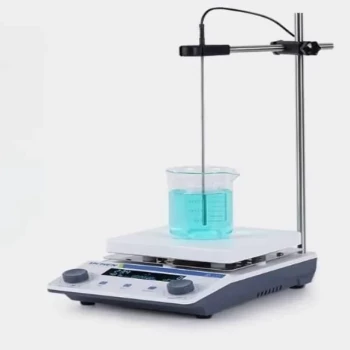
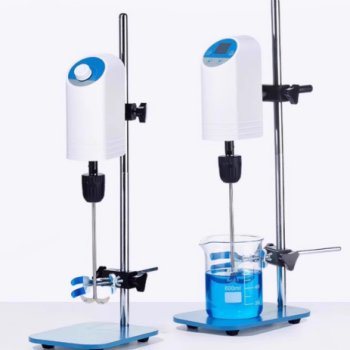
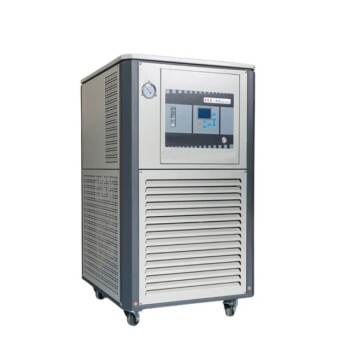
The heating magnetic stirrer functions as the primary driver of homogenization during the precursor preparation stage. It simultaneously heats the solvent to specific set points, such as 90°C, while mechanically agitating the raw materials—Zinc Sulfate (ZnSO4·7H2O) and Sodium Sulfide (Na2S·9H2O)—to ensure rapid and complete dissolution in distilled water.
Core Takeaway The physical act of mixing is only part of the equation; the device's true value lies in establishing a uniform chemical stoichiometry throughout the solution. This uniformity is the absolute prerequisite for synthesizing pure-phase Zinc Sulfide (ZnS) powders once the mixture acts as the feed for the high-pressure reactor.
Establishing Chemical Uniformity
Accelerating Material Dissolution
The introduction of thermal energy significantly impacts the solubility of your raw materials. By maintaining a temperature around 90°C, the stirrer ensures that the solid Zinc Sulfate and Sodium Sulfide crystals dissolve efficiently into the distilled water.
Without this simultaneous heating, the dissolution process would be slower and potentially incomplete. Incomplete dissolution leads to sediment, which disrupts the concentration ratios needed for the reaction.
Achieving Stoichiometric Balance
Agitation creates a consistent distribution of ions throughout the liquid volume. The stirrer ensures that every milliliter of the solution contains the correct ratio of reactants.
This prevents the formation of localized "hotspots" where the concentration of one reactant might be higher than intended. A uniform starting solution is essential for consistent results in the subsequent hydrothermal stage.
The Foundation for Nucleation
Preparing for High-Pressure Synthesis
The precursor stage sets the baseline for the entire experiment. The mixed solution is eventually transferred to a high-pressure reactor (autoclave), where the actual synthesis occurs.
If the precursor is not thoroughly mixed, the conditions inside the reactor will vary spatially. This inconsistency can lead to defects in the final crystal structure.
Ensuring Phase Purity
The ultimate goal of using the stirrer is to guarantee pure-phase Zinc Sulfide. If the chemical stoichiometry is uneven before the solution enters the reactor, the final nanopowder may contain impurities or unwanted secondary phases.
Proper agitation ensures that the chemical reaction proceeds exactly as calculated, yielding high-quality powder.
Understanding the Trade-offs
The Risk of Inadequate Agitation
If the stirring speed is too low, heavier salts may settle at the bottom of the beaker. This creates a concentration gradient where the top of the solution is dilute and the bottom is saturated.
Using such a gradient in a hydrothermal reactor will result in nanopowders with inconsistent particle sizes and varying chemical properties.
Temperature Control Precision
While heating accelerates dissolution, it must be precise. Deviating significantly from the target temperature (e.g., 90°C) can alter the pre-reaction kinetics or cause premature precipitation.
Reliable equipment is required to maintain the liquid at a stable temperature without overshooting, which could evaporate the solvent and skew concentration calculations.
Making the Right Choice for Your Goal
If your primary focus is Phase Purity: Ensure the stirrer runs long enough to achieve total visual clarity and chemical homogeneity before transferring the solution to the reactor.
If your primary focus is Process Efficiency: Utilize the heating function to reduce the time required to dissolve the salts, but never sacrifice mixing time for speed.
If your primary focus is Particle Consistency: Maintain a constant, vigorous stirring speed to prevent sedimentation and ensure a uniform concentration foundation for nucleation.
The quality of your final Zinc Sulfide nanopowder is directly proportional to the uniformity of the precursor solution created in this initial stage.
Summary Table:
| Feature | Role in ZnS Precursor Preparation | Impact on Final Nanopowder |
|---|---|---|
| Thermal Energy (90°C) | Accelerates dissolution of ZnSO4 and Na2S | Prevents sediment and ensures consistent concentrations |
| Mechanical Agitation | Eliminates concentration gradients and hotspots | Guarantees stoichiometric balance and phase purity |
| Homogenization | Creates a uniform liquid feed for the autoclave | Ensures consistent particle size and crystal structure |
| Precision Control | Maintains stable kinetics without solvent loss | Prevents premature precipitation and skewed calculations |
Elevate Your Material Synthesis with KINTEK
Precision in the precursor stage is the foundation of high-performance nanomaterials. KINTEK specializes in premium laboratory equipment designed for the rigorous demands of chemical research. From high-stability heating magnetic stirrers and homogenizers to our industry-leading high-temperature high-pressure reactors and autoclaves, we provide the tools you need to ensure 100% phase purity in your Zinc Sulfide synthesis.
Whether you are refining battery research, developing advanced ceramics, or scaling up hydrothermal processes, KINTEK offers a comprehensive range of solutions including:
- Advanced Reaction Vessels: High-pressure autoclaves, CVD, and vacuum furnaces.
- Sample Preparation: Crushing, milling, and hydraulic pellet presses.
- Precision Cooling: ULT freezers and freeze dryers for sensitive materials.
Ready to optimize your lab's consistency and yield? Contact our technical experts today to find the perfect equipment configuration for your specific research goals.
Related Products
- Laboratory Small Constant Temperature Heated Magnetic Stirrer Heater and Stirrer
- Custom PTFE Teflon Parts Manufacturer for Magnetic Stirring Bar
- High Performance Laboratory Stirrers for Diverse Applications
- Custom PTFE Teflon Parts Manufacturer for PTFE Stirring Bar Recovery Rod
- 10L Heating Chilling Circulator Cooling Water Bath Circulator for High and Low Temperature Constant Temperature Reaction
People Also Ask
- What role does a magnetic stirrer with heating play in ZnO nanoparticle synthesis? Precision Control for Quality Results
- What role does a constant temperature heating magnetic stirrer play in MFC-HAp synthesis? Achieve Material Homogeneity
- What is the function of a laboratory magnetic stirrer in Ni–Cr–P electrodeposition? Optimize Ion Transport & Coating
- Why is a laboratory magnetic stirrer required for benzoic acid esters? Boost Reaction Speed & Yield with High RPM
- What role does a laboratory magnetic stirrer play in TiO2 and TiO2-Ag sol preparation? Master Chemical Kinetics