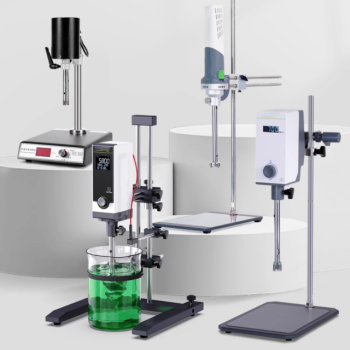
High-efficiency stirring systems primarily address solvent viscosity by providing the intense mechanical force necessary to overcome the natural resistance of ionic liquids. By forcing the thick solvent to mix thoroughly with biomass particles, these systems ensure the physical contact required for chemical reactions to occur, a process that would otherwise be stalled by the fluid's high viscosity.
The inherent thickness of ionic liquids limits proton transfer and mixing; high-efficiency stirring bridges this gap, enabling cellulose dissolution and restructuring even at reduced operating temperatures.
The Challenge: Viscosity as a Barrier
Limitations on Proton Transfer
Ionic liquids are characterized by high viscosity. This physical property restricts the mobility of ions within the fluid.
As a result, the proton transfer required for chemical reactions is significantly impeded. Without intervention, the chemical potential of the solvent cannot be fully utilized.
The Problem of Static Mixing
High viscosity also limits natural material mixing. In a low-shear environment, the solvent stays distinct from the biomass rather than integrating with it.
This lack of homogeneity prevents the solvent from effectively penetrating the biomass structure.
The Solution: Mechanical Intervention
Strong Mechanical Mixing
A high-efficiency stirring system acts as a kinetic bridge. It applies strong mechanical mixing to the reactor.
This external force overcomes the viscous resistance of the fluid. It ensures the solvent is physically driven to circulate and interact with the solid biomass.
Ensuring Thorough Contact
The ultimate goal of this mechanical force is thorough contact. The system forces the ionic liquid to surround and penetrate individual biomass particles.
This contact is the fundamental prerequisite for the dissolution process. Without it, the solvent merely coats the outer surface rather than treating the bulk material.
Impact on Chemical Efficiency
Breaking Hydrogen Bonds
Once thorough contact is achieved, the chemical mechanics take over. The environment promotes the breakage of cellulose hydrogen bonds.
Disrupting these bonds is critical for breaking down the rigid crystalline structure of the biomass.
Facilitating Dissolution and Restructuring
The stirring system enables the dissolution of the biomass components into the solvent.
This leads to efficient cellulose restructuring. The material is transformed into a state suitable for further conversion or utilization.
Understanding the Trade-offs
Mechanical Energy vs. Thermal Energy
High viscosity is often managed by heating a fluid to thin it out. However, high-efficiency stirring allows the process to work at lower temperatures.
This presents a strategic trade-off: you invest mechanical energy (stirring) to reduce the need for thermal energy.
The Risk of Inadequate Mixing
If the stirring system is inefficient, the process becomes diffusion-limited. The solvent remains too thick to interact with the biomass effectively, leading to incomplete pretreatment regardless of the time invested.
Making the Right Choice for Your Goal
To optimize your ionic liquid pretreatment process, consider how mechanical limitations impact your specific objectives:
- If your primary focus is Energy Efficiency: Utilize high-efficiency stirring to maintain reaction rates at lower temperatures, reducing your thermal energy costs.
- If your primary focus is Process Speed: Rely on aggressive mechanical mixing to overcome proton transfer limitations and accelerate the dissolution of cellulose.
High-efficiency stirring transforms the barrier of viscosity into a manageable variable, unlocking the full potential of ionic liquids without the need for excessive heat.
Summary Table:
| Challenge of Viscosity | Stirring System Solution | Impact on Pretreatment |
|---|---|---|
| Limited Proton Transfer | Provides strong mechanical shear | Accelerates chemical reaction rates |
| Poor Material Mixing | Ensures thorough solvent-biomass contact | Facilitates deep biomass penetration |
| High Thermal Demand | Replaces heat with kinetic energy | Enables effective processing at lower temperatures |
| Hydrogen Bond Rigidity | Forces molecular interaction | Efficiently breaks down cellulose structures |
Maximize Your Pretreatment Efficiency with KINTEK
Don't let solvent viscosity stall your research. KINTEK specializes in advanced laboratory solutions designed for the most demanding chemical processes. Whether you are working on biomass pretreatment with ionic liquids or complex material synthesis, our precision-engineered high-temperature high-pressure reactors and autoclaves—equipped with high-torque, high-efficiency stirring systems—ensure optimal mixing and thermal uniformity.
From crushing and milling systems to specialized reactors and electrolytic cells, KINTEK provides the tools needed to overcome mechanical barriers and accelerate your path to discovery.
Ready to optimize your lab’s performance?
Contact KINTEK Today to Find Your Solution
References
- Wai Yan Cheah, Jo‐Shu Chang. Pretreatment methods for lignocellulosic biofuels production: current advances, challenges and future prospects. DOI: 10.18331/brj2020.7.1.4
This article is also based on technical information from Kintek Solution Knowledge Base .
Related Products
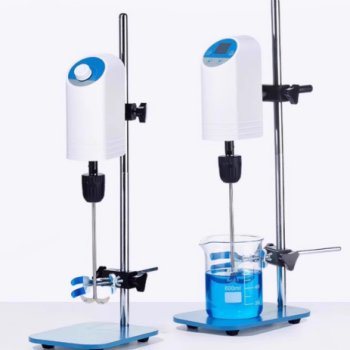
- High Performance Laboratory Stirrers for Diverse Applications
- Laboratory Small Constant Temperature Heated Magnetic Stirrer Heater and Stirrer
- Custom PTFE Teflon Parts Manufacturer for Magnetic Stirring Bar
- High-Speed Desktop Centrifuge for Blood Sample Processing
- Benchtop High Speed Small Lab Centrifuge for Serum Separation and Low Temperature Dehydration
People Also Ask
- How does a laboratory stirrer influence MOF product quality? Master Precision in Non-Solvothermal Synthesis
- What critical role does a Laboratory Stirrer play during leaching? Enhance Titanium-Magnesium Waste Recovery
- What is the primary function of laboratory stirring equipment in the preparation of compost leachate? Optimize Extraction
- What is a laboratory mixer? A Guide to Achieving Perfect Sample Homogeneity
- What is a laboratory mixer used for? Choose the Right Tool for Liquids or Solids