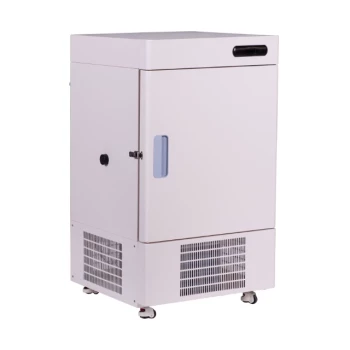
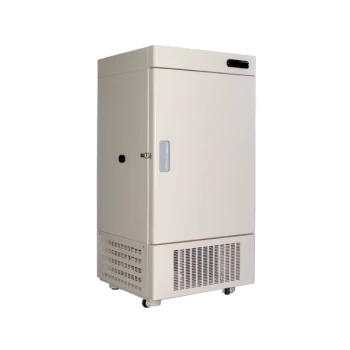
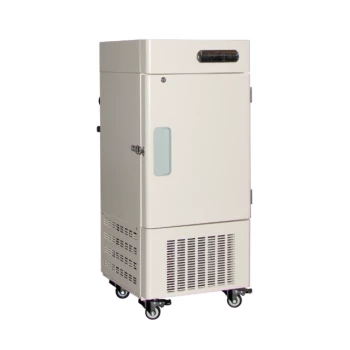
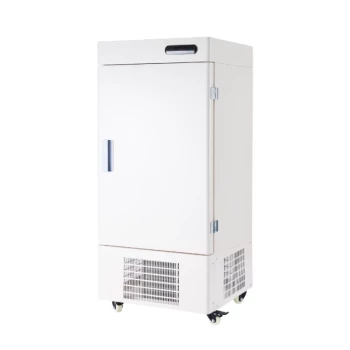
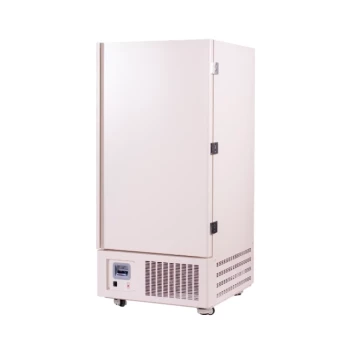
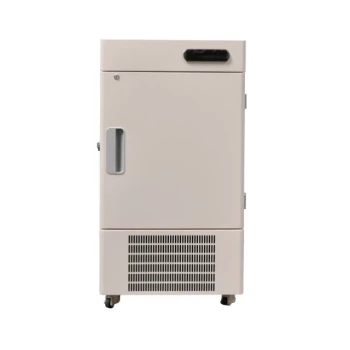
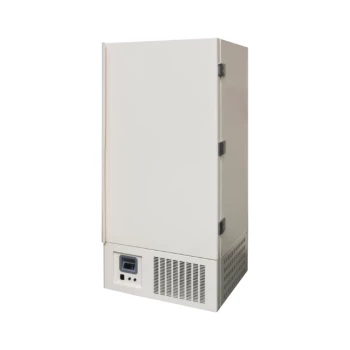
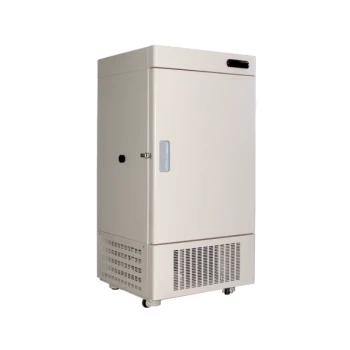
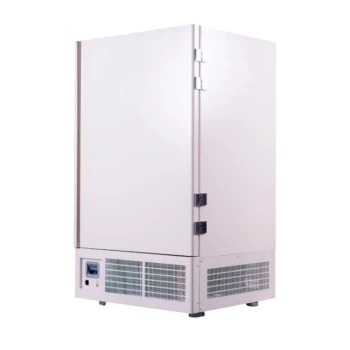
The Ultra-Low Temperature (ULT) freezer acts as the structural architect for double-layered photo-driven hydrogel composites. It drives the critical freeze-thaw cycles necessary to physically cross-link polyvinyl alcohol (PVA) chains. By rapidly lowering the temperature to extreme levels, the freezer forces polymer aggregation, creating a stable, insoluble network without the need for potentially toxic chemical agents.
Core Insight: The ULT freezer eliminates the need for chemical cross-linkers by utilizing the physics of ice crystal formation to lock polymer chains together. This process engineers a specific honeycomb-like microporous architecture that is essential for the material's mechanical stability, nanoparticle integration, and rapid photothermal response.
The Mechanism of Physical Cross-Linking
The primary function of the ULT freezer is to transform a liquid polymer solution into a solid, structured hydrogel through physical manipulation rather than chemical bonding.
The Exclusion Effect
When the ULT freezer rapidly cools the PVA solution, water molecules begin to crystallize into ice.
As these ice crystals grow, they repel the polymer chains, forcing them into high-density regions. This is known as the exclusion effect.
Forming Crystalline Junctions
Crowded into these high-density regions, the PVA polymer chains come into close contact.
This proximity allows them to form crystallites, which act as physical cross-linking points. These "knots" hold the network together, ensuring the hydrogel remains stable even after the ice melts.
Eliminating Chemical Agents
Because the ULT freezer uses temperature to induce this structure, the process requires no chemical cross-linking agents.
This results in a purer material, free from chemical residues that might interfere with sensitive applications.
Engineering the Microstructure
Beyond simply solidifying the material, the ULT freezer dictates the internal geometry of the hydrogel.
Creating a Honeycomb Architecture
Upon thawing, the ice crystals melt away, leaving behind void spaces in the polymer matrix.
This results in a distinct honeycomb-like microporous structure. The size and distribution of these pores are directly influenced by the freezing conditions controlled by the ULT freezer.
Facilitating Nanoparticle Loading
This porous framework provides a stable spatial arrangement for embedding functional elements, such as gold (Au) nanoparticles.
The structure ensures these particles are loaded uniformly, which is vital for the composite's performance as a photo-driven material.
Enhancing Response Speed
The microporous structure allows water to move freely in and out of the hydrogel.
This enables rapid swelling and shrinking kinetics, significantly improving the material's photothermal response speed when exposed to light.
Understanding the Trade-offs
While the freeze-thaw method offers significant advantages, it relies heavily on precise process control.
Dependence on Thermal Cycling
The quality of the hydrogel is strictly tied to the consistency of the ULT freezer.
Inconsistent freezing rates or temperature fluctuations can lead to irregular pore sizes, which compromises the structural integrity and response speed of the final composite.
Mechanical Strength vs. Porosity
There is an inherent balance between the number of freeze-thaw cycles and material properties.
More cycles generally increase mechanical strength by creating more cross-linking points, but excessive crystallization could alter the desired swelling characteristics.
Making the Right Choice for Your Goal
The freeze-thaw synthesis method is a tunable process. Depending on your specific application requirements, you should prioritize different aspects of the ULT freezer's operation.
- If your primary focus is Rapid Response: Prioritize freezing protocols that maximize the honeycomb microporous structure to allow for faster water exchange and swelling kinetics.
- If your primary focus is Material Purity: Leverage the ULT freezer's ability to form stable networks purely through physical cross-linking, eliminating the need for any chemical additives.
- If your primary focus is Structural Stability: Increase the number of freeze-thaw cycles to enhance the density of crystalline cross-linking points, resulting in a more robust hydrogel matrix.
Ultimately, the ULT freezer is not just a storage device; it is a synthesis tool that defines the fundamental performance characteristics of the hydrogel composite.
Summary Table:
| Feature | Role of ULT Freezer in Synthesis | Impact on Hydrogel Composite |
|---|---|---|
| Cross-Linking | Induces physical aggregation of polymer chains | Creates a stable network without toxic chemicals |
| Mechanism | Promotes ice crystal formation (Exclusion Effect) | Forms crystalline junctions and physical "knots" |
| Microstructure | Dictates pore size and distribution | Produces a honeycomb-like microporous architecture |
| Functionality | Provides a stable spatial arrangement | Facilitates uniform loading of Au nanoparticles |
| Performance | Enables rapid swelling/shrinking kinetics | Significantly increases photothermal response speed |
Elevate Your Materials Synthesis with KINTEK Precision
Unlock the full potential of your hydrogel research with KINTEK’s high-performance ultra-low temperature (ULT) freezers. Designed for the rigorous demands of freeze-thaw synthesis, our equipment ensures the precise thermal cycling required to engineer perfect honeycomb microstructures and superior mechanical stability.
Beyond cooling solutions like ULT freezers, cold traps, and freeze dryers, KINTEK specializes in a comprehensive range of laboratory equipment including:
- High-Temperature Furnaces: Muffle, tube, and vacuum furnaces for advanced material processing.
- Synthesis Tools: CVD/PECVD systems and high-temperature high-pressure reactors.
- Sample Preparation: Crushing, milling, and hydraulic presses (pellet, hot, isostatic).
- Electrochemistry: Specialized electrolytic cells and electrodes for battery research.
Ready to optimize your lab’s efficiency and material purity? Contact us today to find the perfect solution for your research!
References
- Avgustina Danailova, Velichka Strijkova. Characterization and degradation of natural polysaccharide multilayer films. DOI: 10.21175/rad.abstr.book.2023.3.2
This article is also based on technical information from Kintek Solution Knowledge Base .
Related Products
- 938L Vertical Ultra Low Temperature Freezer for Advanced Laboratory Storage
- 108L Vertical Ultra Low Temperature ULT Freezer
- 208L Advanced Precision Laboratory Ultra Low Temperature Freezer for Cold Storage
- 28L Compact Upright Ultra Low Temperature Freezer for Laboratory
- 158L Precision Vertical Ultra Low Freezer for Laboratory Applications
People Also Ask
- What features should be considered when choosing an ultra low temperature freezer? Secure Your Samples with Precision
- How is the interior of an ultra low temperature freezer designed for optimal storage? Maximize Sample Integrity with Smart Design
- How is temperature controlled in ultra low temperature freezers? A Guide to Stable -80°C Storage
- What is an ultra-low temperature freezer? Protect Your Most Valuable Biological Samples
- What is cryopreservation and how do ultra low temperature freezers facilitate this process? Preserve Your Samples for the Long Term