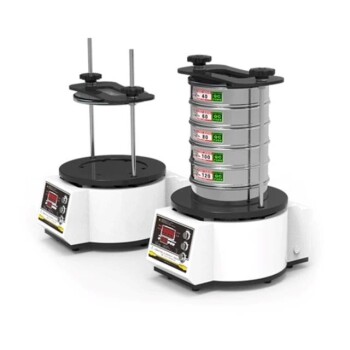
To ensure accurate sieve analysis results, you must take specific precautions before, during, and after the test. The most critical steps involve preparing a representative and properly sized sample, meticulously cleaning and weighing your sieves, and standardizing the sieving time and intensity to guarantee repeatability. Ignoring these controls is the primary source of error in this fundamental technique.
The accuracy of a sieve analysis is not determined by the mechanical shaking process itself, but by the disciplined preparation and measurement that bookend it. Meticulous control over your sample and equipment is the only way to generate trustworthy particle size data.
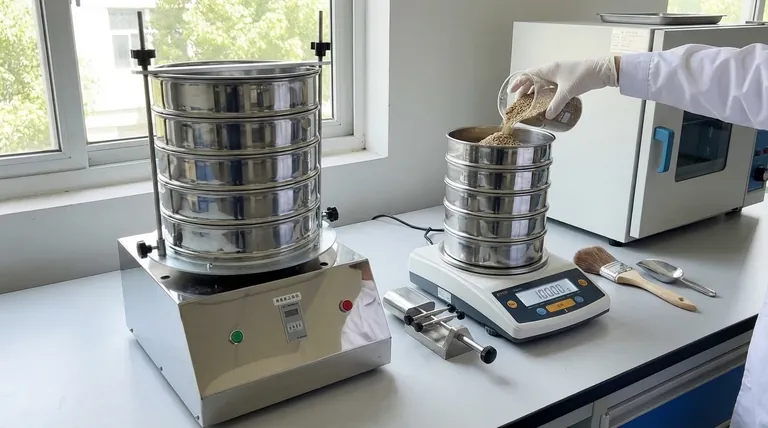
Foundational Precautions: Before You Begin
The most common errors in sieve analysis occur before the sample is even placed in the top sieve. Diligent preparation is non-negotiable for reliable results.
Choose the Right Method and Sieves
First, ground your procedure in an established standard, such as an ASTM or ISO method relevant to your material. This governs the entire process.
Based on the expected particle size range, select a stack of test sieves with appropriate mesh sizes. A standard stack typically has a maximum of eight sieves, which defines the resolution of your final particle size distribution.
Prepare Your Sieves Correctly
Before every test, thoroughly clean each sieve. Inspect the mesh against a light source to check for clogged apertures (blinding) or any tears and distortions in the wire cloth, as damaged sieves will produce invalid results.
After inspection, use a high-precision balance to weigh each empty sieve and the bottom pan. Record these weights meticulously, as they form the baseline for your final calculations.
Ensure a Representative Sample
The small sample used for analysis must accurately reflect the entire batch of material. Use a standard sampling technique like coning and quartering or a riffle splitter to reduce a larger bulk sample down to a manageable and representative size.
The Critical Factor: Sample Size and Preparation
The single greatest source of procedural error is using an incorrect amount of material. This directly compromises the ability of the sieve mesh to do its job.
Avoid Overloading the Sieves
A sample that is too large is the most common mistake. It overloads the mesh surface, preventing individual particles from having the opportunity to pass through the openings. This results in an inaccurate and skewed distribution where particles are retained on a coarser sieve than they should be.
A general guideline recommends a sample size between 25 and 100 grams.
Determine the Optimal Sample Weight
To establish the correct sample size for a new material, run a simple experiment. Use a sample splitter to create samples of varying weights (e.g., 25g, 50g, 100g).
Run the sieve analysis on each one. The optimal sample weight is the largest weight that still produces the same results as the smaller samples, indicating that you have not yet overloaded the sieves.
Pre-Condition Your Sample
Sieve analysis is only effective for dry, free-flowing particles. If your sample contains moisture, it must be dried in an oven until it reaches a constant weight. Any clumping or agglomeration will prevent particles from being sized correctly.
Procedural Discipline: During and After Sieving
Once the prep work is complete, maintaining consistency through the final steps ensures your results are repeatable.
Standardize the Sieving Process
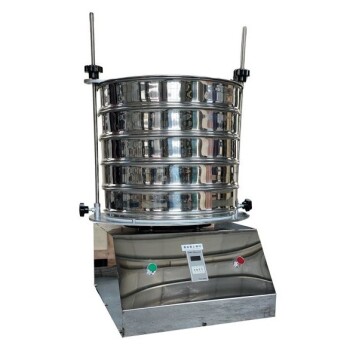
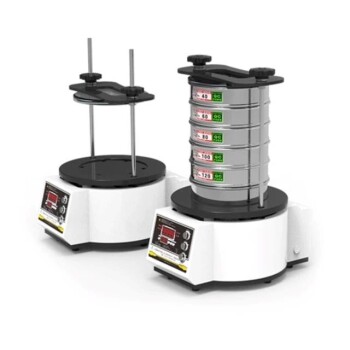
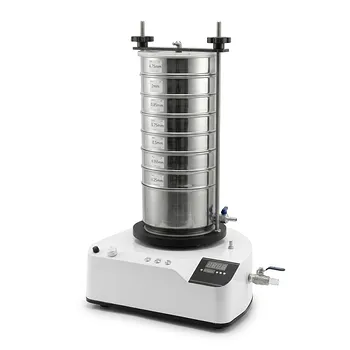
For consistent and comparable results, use a mechanical sieve shaker. Set a fixed time and amplitude for the shaking process and use these exact settings for every subsequent test of that material. Manual sieving is highly dependent on the operator and is not recommended for generating reliable data.
Execute a Meticulous Weighing Protocol
After the shaking is complete, weigh each sieve again—this time with its retained fraction of material. Handle the sieves carefully to avoid losing any sample.
Calculate the net weight of the material on each sieve by subtracting the initial empty sieve weight.
Verify Your Results with a Mass Balance
As a final quality check, sum the weights of all the fractions retained on each sieve and in the pan. This total should be very close to your initial starting sample weight. A significant difference (typically more than 1-2%) indicates a loss of material during handling or an error in weighing, and the test should be considered invalid.
Understanding the Inherent Limitations
Being precise also means understanding the boundaries of the technique itself. Sieve analysis is powerful, but it is not universally applicable.
Limited Data Resolution
With a maximum of around eight sieves per stack, your final particle size distribution curve is based on a small number of data points. This provides a good overview but lacks the high resolution of other methods like laser diffraction.
Minimum Particle Size
Sieve analysis becomes impractical and inaccurate for very fine powders. The effective minimum measurement limit is around 50 micrometers (µm). For sub-sieve particles, alternative methods are required.
Material Type Constraints
The method is fundamentally designed for dry powders. It will not work for materials that are sticky, oily, or tend to agglomerate. It is also unsuitable for materials that can change shape or break down during the agitation process.
Making the Right Choice for Your Goal
The level of precaution depends on your objective. Use these guidelines to focus your efforts.
- If your primary focus is routine quality control: Concentrate on maintaining absolute consistency in your starting sample weight and shaker settings to ensure your results are comparable run-to-run.
- If your primary focus is new material characterization: Invest the most time in method development, especially in determining the optimal sample weight and the most effective sieve stack for the expected distribution.
- If your primary focus is high-accuracy reporting: Emphasize procedural verification, including pre-test sieve inspection, meticulous weighing on a calibrated balance, and performing a mass balance check on every result.
Ultimately, trustworthy sieve analysis data is the direct result of a disciplined and meticulous approach.
Summary Table:
| Precaution Category | Key Action | Purpose |
|---|---|---|
| Before Sieving | Select correct sieves, clean & weigh them, ensure representative sample | Prevent bias, establish baseline for calculation |
| Sample Prep | Use optimal sample weight (25-100g typical), ensure material is dry | Avoid overloading sieves, ensure free-flowing particles |
| During/After Sieving | Use mechanical shaker, standardize time/amplitude, verify mass balance | Ensure repeatability, validate test accuracy |
| Limitations | Understand minimum size (~50µm), limited resolution, material constraints | Know when sieve analysis is/is not appropriate |
Achieve Unmatched Precision in Your Particle Analysis
Generating reliable particle size data is critical for your product quality and research integrity. KINTEK understands the meticulous demands of sieve analysis. We provide high-quality test sieves, mechanical sieve shakers, and lab balances designed for accuracy and durability, ensuring your procedures meet ASTM/ISO standards.
Let our expertise in lab equipment support your commitment to precise results. Contact our team today to discuss your specific application and find the perfect solution for your laboratory's needs.
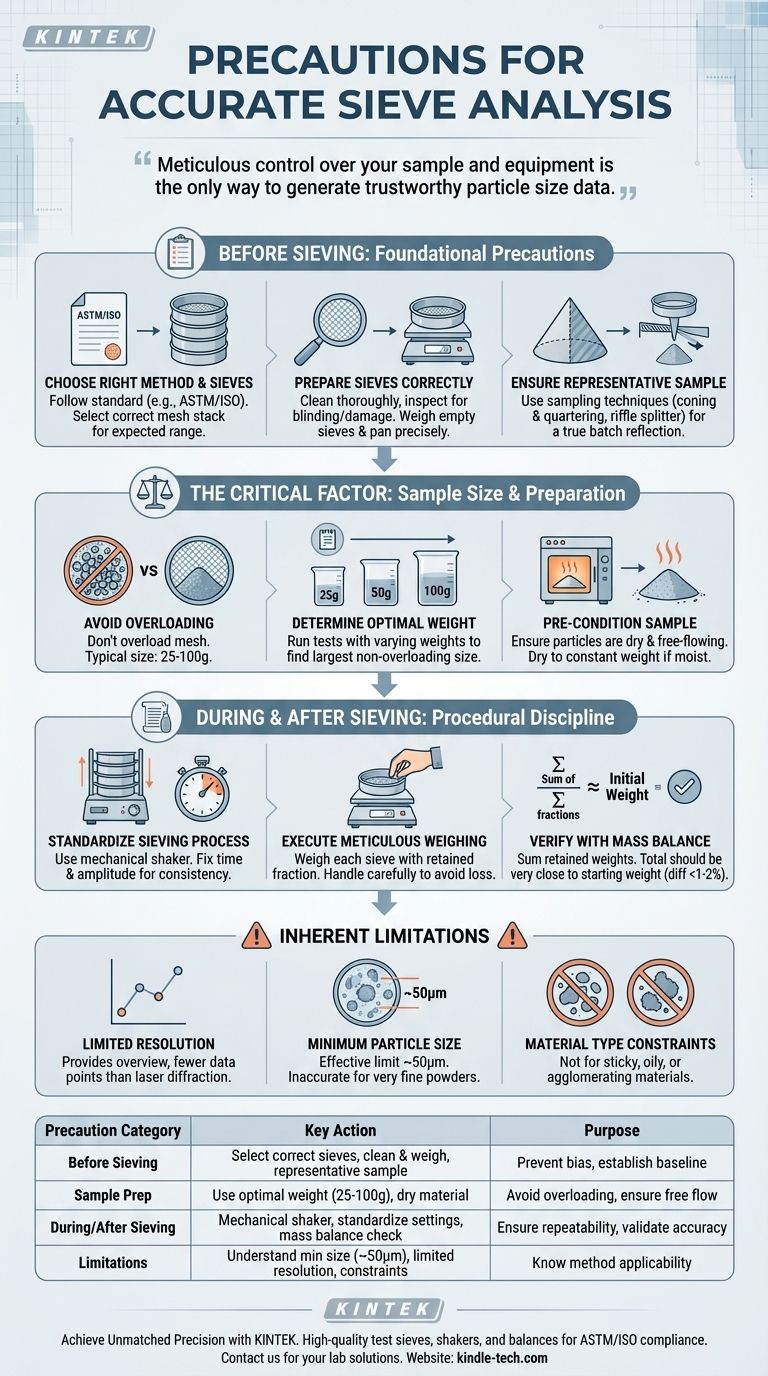
Visual Guide
Related Products
- Laboratory Test Sieves and Vibratory Sieve Shaker Machine
- Laboratory Test Sieves and Sieving Machines
- Laboratory Vibratory Sieve Shaker Machine Slap Vibrating Sieve
- Vibratory Sieve Shaker Machine Dry Three-Dimensional Vibrating Sieve
- Laboratory Vibratory Sieve Shaker Machine for Dry and Wet Three-Dimensional Sieving
People Also Ask
- How do you use a sieve shaker? Master Particle Size Analysis for Quality Control
- How is a standard sieve shaker utilized in pure mineral flotation tests for magnesite? Achieve Reliable Lab Results
- How is a vibratory sieve shaker used in the particle size analysis of mechanically alloyed powders? Expert Guide
- Why use a vibratory sieve shaker for PET powder? Achieve Precise Particle Size Control for Chemical Research
- How does a laboratory vibratory sieve shaker facilitate the microstructural study of gas-atomized alloy powders?