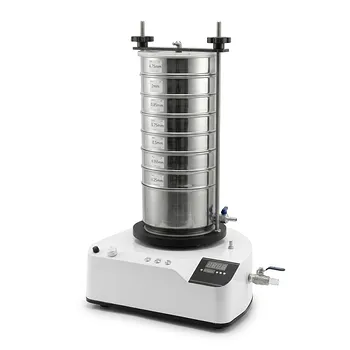
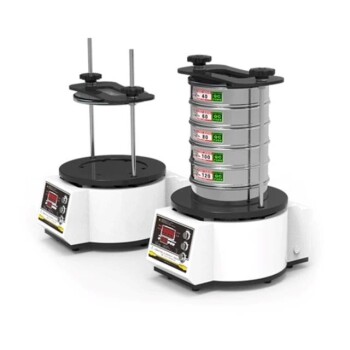
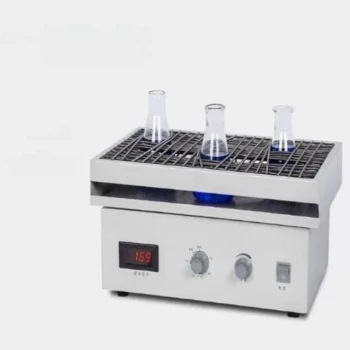
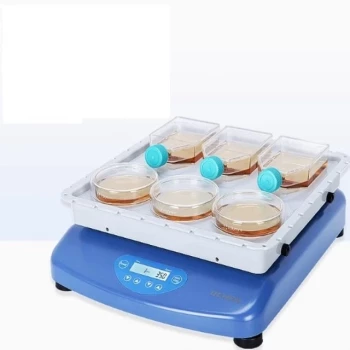
A standard sieve shaker is utilized to precisely grade mineral samples into specific particle size fractions following the crushing and grinding stages. In the context of pure mineral flotation tests for magnesite, this device isolates a narrow size range—typically between 23 and 74 micrometers—to ensure the starting material is mechanically uniform.
Core Takeaway In pure mineral flotation, particle size variations can mimic or mask chemical effects, leading to biased data. The standard sieve shaker eliminates this variable, ensuring that any observed changes in flotation performance are due to reagent conditions, not inconsistent feed material.
The Role of Sizing in Experimental Design
Positioning in the Workflow
The sieve shaker is introduced immediately after the initial comminution (crushing and grinding) phases.
Its function is to classify the comminuted material, separating the "ground" product into distinct size classes before any chemical conditioning takes place.
Targeting the Specific Fraction
For pure mineral flotation tests, you are rarely testing the entire bulk sample.
Instead, the shaker is used to isolate a specific fraction, such as 23 to 74 micrometers. This specific range is often chosen to maximize liberation while minimizing the interference of ultra-fine slimes or coarse, unfloatable particles.
Why Precise Sizing is Critical for Magnesite
Eliminating Variables
The primary purpose of using a standard sieve shaker is to eliminate particle size as a variable.
In flotation, coarse particles may fail to float due to mass, while fine particles may float non-selectively due to entrainment. If the feed size varies, the test results become ambiguous.
Bias Prevention
By strictly controlling the size fraction, you ensure that the results reflect the true interaction between the magnesite surface and the flotation reagents.
This prevents the data from being biased by physical factors that are irrelevant to the chemical study at hand.
Ensuring Reproducibility
Reliability in scientific testing relies on the ability to repeat an experiment under identical conditions.
The standard sieve shaker guarantees consistency across multiple test runs, ensuring that the "feed" for every single flotation test is physically identical to the last.
Understanding the Constraints
Equipment Calibration
While the shaker ensures consistency, the accuracy is dependent on the condition of the sieves.
Worn or damaged mesh can allow oversized particles to pass, reintroducing the very variables you are trying to eliminate. Regular inspection is required to maintain the integrity of the 23 to 74 micrometer cut point.
The Risk of Agglomeration
In finer ranges (near 23 micrometers), static or moisture can cause particles to agglomerate during shaking.
This can result in inaccurate grading, where fines are carried over into the coarse fraction, potentially altering the surface area available for reagent adsorption.
Making the Right Choice for Your Goal
To maximize the value of your flotation tests, apply the sieving process based on your specific objective:
- If your primary focus is Reagent Testing: Isolate the 23-74 micrometer fraction strictly to ensure any change in recovery is caused by the chemical, not the particle mass.
- If your primary focus is Process Reproducibility: Establish a rigid protocol for shaking time and amplitude to guarantee every sample batch has the exact same size distribution profile.
Precise classification is the only way to transform a geological sample into a reliable scientific baseline.
Summary Table:
| Feature | Specification/Role in Magnesite Flotation |
|---|---|
| Target Size Fraction | 23 to 74 micrometers (typical) |
| Primary Function | Mechanical classification post-comminution |
| Goal | Eliminate particle size as an experimental variable |
| Benefit | Prevents data bias from mass or entrainment effects |
| Maintenance | Regular mesh inspection to prevent oversized passage |
| Risk Mitigation | Controls static/moisture to prevent agglomeration |
Optimize Your Mineral Research with KINTEK Precision
Don't let inconsistent particle sizes compromise your flotation data. KINTEK specializes in high-performance laboratory equipment designed for rigorous mineralogy and material science applications. From our precision sieving equipment and crushing and milling systems to advanced high-temperature furnaces and hydraulic presses, we provide the tools you need for absolute reproducibility.
Whether you are conducting flotation tests on magnesite or developing new battery materials, our comprehensive portfolio—including PTFE consumables, ceramics, and cooling solutions—ensures your lab operates at peak efficiency.
Ready to elevate your experimental accuracy? Contact KINTEK today to discover how our tailored laboratory solutions can support your next breakthrough!
Related Products
- Laboratory Vibratory Sieve Shaker Machine for Dry and Wet Three-Dimensional Sieving
- Laboratory Test Sieves and Vibratory Sieve Shaker Machine
- Laboratory Wet Three-Dimensional Vibratory Sieve Shaker Machine
- Laboratory Vibratory Sieve Shaker Machine Slap Vibrating Sieve
- Vibratory Sieve Shaker Machine Dry Three-Dimensional Vibrating Sieve
People Also Ask
- How does a laboratory vibratory sieve shaker facilitate the microstructural study of gas-atomized alloy powders?
- What role does a laboratory vibrating sieve shaker play in the LiFePO4 powder processing workflow? Ensure Batch Quality
- Why use a vibratory sieve shaker for PET powder? Achieve Precise Particle Size Control for Chemical Research
- What is the principle of vibratory sieve shaker? Achieve Accurate Particle Size Analysis
- What is the function of a vibratory sieve shaker? Achieve Precise Particle Size Analysis