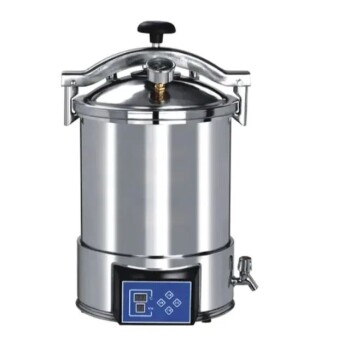
A high-pressure hydrothermal autoclave acts as a forcing function for material synthesis, creating a sealed environment that generates the heat and pressure necessary to drive reactions that are impossible at atmospheric conditions. Specifically for graphene-metal oxide hybrids, this process facilitates the in-situ growth of inorganic nanomaterials directly onto the 3D graphene structure, ensuring a level of integration and uniformity that simple physical mixing cannot achieve.
Core Insight: The primary value of the hydrothermal autoclave is not just heating; it is the creation of strong interfacial connections. By growing active components directly on the graphene lattice under pressure, you transform two separate materials into a cohesive unit, significantly enhancing both catalytic efficiency and long-term mechanical stability.
Optimizing the Growth Environment
Promoting In-Situ Growth
The autoclave provides a confined, high-temperature, and high-pressure setting. This environment forces precursor solutions (such as nitrates dissolved in ammonia) to fully interact with the graphene substrate. Instead of merely coating the surface, the metal oxides nucleate and grow directly on the graphene sheets.
Ensuring Uniform Loading
One of the most critical challenges in catalyst synthesis is preventing the aggregation of active particles. The hydrothermal process facilitates the uniform distribution of active components, such as manganese dioxide or metal sulfides, throughout the graphene foam. This maximizes the surface area available for catalytic reactions.
Enhancing Structural and Electronic Properties
Stronger Interfacial Connections
The high-pressure environment promotes the formation of robust chemical and physical bonds between the metal oxide and the graphene. This strong interfacial connection is superior to the weak Van der Waals forces typical of other synthesis methods. It ensures the catalyst remains intact even under mechanical stress or during complex reactions.
Improved Crystallinity and Morphology
The sealed environment allows for self-produced pressure, which significantly enhances the crystallinity of the active components. Furthermore, the process offers precise control over nucleation kinetics, enabling the formation of specific morphologies—such as nanosheets, nanorods, or nanowires—that are optimized for specific electrochemical tasks.
Efficient Charge Transfer
Because the metal oxides are grown directly onto the conductive graphene carrier, there is tight physical contact and electronic coupling. This reduces the distance electrons must travel, thereby improving charge transfer efficiency. This is particularly vital for maintaining high performance during demanding applications like carbon dioxide hydrogenation.
Understanding the Trade-offs
Sensitivity to Process Parameters
While the autoclave allows for precise control, the process is highly sensitive. Slight deviations in temperature or time can alter the nucleation kinetics, leading to the growth of undesired crystal phases or morphologies. Achieving the specific "alpha" phase of a metal oxide, for example, requires rigorous adherence to validated protocols.
Batch Process Limitations
Hydrothermal synthesis is inherently a batch process constrained by the volume of the autoclave. While it produces superior quality materials, scaling up for mass production requires significantly more infrastructure compared to continuous flow atmospheric synthesis methods.
Making the Right Choice for Your Goal
To maximize the benefits of this synthesis method, align your process parameters with your specific performance targets:
- If your primary focus is Long-Term Stability: Prioritize higher pressure and temperature settings to maximize the interfacial bonding strength, ensuring the catalyst survives harsh environments like seawater or extended charge-discharge cycles.
- If your primary focus is Catalytic Activity: Focus on controlling the nucleation kinetics to produce high-aspect-ratio morphologies (like nanowires), which significantly increase the electrochemical active surface area.
- If your primary focus is Electronic Efficiency: Ensure the precursor fully dissolves and reacts to maximize crystallinity, which facilitates faster electron transport between the oxide and the graphene.
By leveraging the high-pressure hydrothermal environment, you move beyond simple mixtures to create robust, high-performance hybrid materials capable of withstanding rigorous industrial demands.
Summary Table:
| Benefit Category | Process Advantage | Impact on Catalyst |
|---|---|---|
| Structural | In-situ nucleation & growth | Ensures uniform loading and prevents particle aggregation |
| Mechanical | High-pressure bonding | Creates strong interfacial connections for long-term stability |
| Electronic | Direct electronic coupling | Reduces electron travel distance for efficient charge transfer |
| Morphological | Kinetic control | Enables precise formation of nanosheets, nanorods, or nanowires |
| Crystallinity | Self-produced pressure | Enhances crystallinity and phase purity of active components |
Elevate Your Catalyst Synthesis with KINTEK Precision
Unlock the full potential of your graphene-metal oxide research with KINTEK’s high-performance high-pressure reactors and autoclaves. Our laboratory solutions are engineered to provide the rigorous pressure and temperature control necessary for superior in-situ growth and robust interfacial bonding.
Whether you are developing advanced hybrid catalysts or next-generation battery materials, KINTEK offers a comprehensive range of equipment—from hydrothermal autoclaves and high-temperature furnaces (CVD, PECVD) to crushing systems and pellet presses.
Ready to achieve superior material integration? Contact our laboratory specialists today to discover how KINTEK’s precision equipment and essential consumables can streamline your R&D and ensure industrial-grade performance.
References
- Wan Nor Roslam Wan Isahak, Ahmed A. Al‐Amiery. Oxygenated Hydrocarbons from Catalytic Hydrogenation of Carbon Dioxide. DOI: 10.3390/catal13010115
This article is also based on technical information from Kintek Solution Knowledge Base .
Related Products
- High Pressure Laboratory Autoclave Reactor for Hydrothermal Synthesis
- Mini SS High Pressure Autoclave Reactor for Laboratory Use
- Stainless High Pressure Autoclave Reactor Laboratory Pressure Reactor
- Laboratory High Pressure Horizontal Autoclave Steam Sterilizer for Lab Use
- Customizable High Pressure Reactors for Advanced Scientific and Industrial Applications
People Also Ask
- What role does a high-pressure reactor (autoclave) play in the synthesis of NiCuFe-LDH? Master Hydrothermal Growth
- What Role Does a High-Pressure Reactor or Autoclave Play in HA Catalyst Synthesis? Achieve High Surface Area Materials
- What equipment is required for hydrothermal synthesis of Ga0.25Zn4.67S5.08? Optimize Your Semiconductor Production
- What is the function of a high-pressure reactor in the hydrothermal synthesis of boehmite? Expert Process Insights
- What role does an autoclave play in the synthesis of MnO2 nanofibers? Mastering Hydrothermal Growth