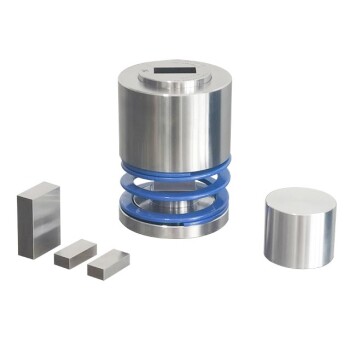
In the hydrothermal synthesis of sodium iron phosphate carbonate ($Na_3FePO_4CO_3$), the high-pressure reactor—often referred to as an autoclave—serves as the critical vessel for creating a sealed, liquid-phase reaction environment. By sustaining temperatures around 120°C within a closed system, it facilitates the dissolution of raw materials and their subsequent recrystallization into specific precipitates, a process that acts as the core mechanism for low-temperature liquid-phase crystal growth.
Core Takeaway: The autoclave is not simply a heating vessel; it is an enabler of solubility. It forces solid precursors to dissolve and recrystallize into $Na_3FePO_4CO_3$ at relatively low temperatures by generating a high-pressure environment that exceeds the solvent's natural boiling point.
The Mechanics of Hydrothermal Synthesis
Creating the Reaction Environment
The primary function of the high-pressure reactor is to provide a strictly sealed environment.
Unlike open-air heating, this isolation allows the internal system to achieve conditions that are impossible at atmospheric pressure.
Facilitating Dissolution and Recrystallization
The synthesis of $Na_3FePO_4CO_3$ relies on a specific "dissolve-recrystallize" mechanism.
The reactor creates conditions where solid raw materials, which might be insoluble or poorly soluble at room temperature, can effectively dissolve into the solvent.
Once dissolved, these materials reach supersaturation and precipitate out of the solution. This results in the reformation of the materials into the desired $Na_3FePO_4CO_3$ crystalline structure.
Enabling Low-Temperature Crystal Growth
A defining characteristic of this process is its ability to achieve crystal growth at "low" temperatures (e.g., 120°C).
While this is hot relative to room temperature, it is significantly lower than the temperatures required for solid-state synthesis methods. The reactor allows for this energy-efficient crystal formation by leveraging liquid-phase dynamics rather than solid-state diffusion.
The Physics of the Reactor
Surpassing Atmospheric Boiling Points
In a standard open beaker, water (or other solvents) cannot exceed its boiling point (100°C for water).
The sealed nature of the autoclave creates a closed system. As the temperature rises to 120°C, the solvent attempts to boil but is constrained by the vessel.
Generating Autogenous Pressure
This constraint generates autogenous pressure—pressure created by the substance itself as it heats up.
This increased pressure raises the boiling point of the liquid phase. It ensures the solvent remains liquid even at temperatures that would normally cause it to vaporize.
This superheated liquid state is highly reactive and significantly accelerates the kinetics of the chemical reaction.
Understanding the Trade-offs
Process Kinetics vs. Throughput
While the high-pressure reactor effectively accelerates reaction rates compared to ambient conditions, hydrothermal synthesis is generally a batch process.
The time required to heat the massive steel vessel, hold the reaction time, and safely cool it down can limit high-volume throughput compared to continuous flow methods.
Sensitivity to Parameters
The closed nature of the system means you cannot easily adjust the reaction mid-process.
If the initial ratio of precursors or the fill volume of the reactor is incorrect, the resulting pressure may deviate from the target.
This can lead to inconsistent crystal morphologies or incomplete recrystallization of the $Na_3FePO_4CO_3$ precipitates. Precision in the setup phase is non-negotiable.
Making the Right Choice for Your Goal
To maximize the effectiveness of the high-pressure reactor in your synthesis:
- If your primary focus is Crystal Purity: Ensure the reactor temperature is maintained strictly at the target (e.g., 120°C) to guarantee complete dissolution before recrystallization begins.
- If your primary focus is Reaction Safety: Always calculate the expected autogenous pressure based on the solvent's fill volume; never overfill the autoclave liner.
- If your primary focus is Particle Uniformity: precise control of the heating ramp rate is essential to regulate the nucleation speed of the precipitates.
The high-pressure reactor is the foundational tool that transforms raw chemical potential into structured, crystalline reality through controlled pressure and heat.
Summary Table:
| Feature | Function in Na3FePO4CO3 Synthesis |
|---|---|
| Sealed Environment | Prevents solvent evaporation; maintains system purity |
| Autogenous Pressure | Raises boiling point; enables liquid-phase reactions at 120°C |
| Reaction Mechanism | Facilitates 'dissolve-recrystallize' kinetics for crystal growth |
| Temperature Advantage | Low-temperature synthesis compared to solid-state methods |
| Resulting Product | High-purity crystalline sodium iron phosphate carbonate |
Elevate Your Material Research with KINTEK
Precise hydrothermal synthesis requires equipment that can withstand rigorous pressure while maintaining absolute thermal stability. KINTEK specializes in high-performance laboratory solutions, offering premium high-temperature high-pressure reactors and autoclaves specifically designed for advanced battery research and chemical synthesis.
Whether you are developing next-generation energy materials like Na3FePO4CO3 or exploring complex crystal growth, our comprehensive range—from muffle and vacuum furnaces to crushing systems and hydraulic presses—ensures your lab has the reliability it needs.
Ready to optimize your synthesis results? Contact our technical experts today to find the perfect reactor or consumable solution for your specific application.
Related Products
- Customizable Laboratory High Temperature High Pressure Reactors for Diverse Scientific Applications
- Customizable High Pressure Reactors for Advanced Scientific and Industrial Applications
- Stainless High Pressure Autoclave Reactor Laboratory Pressure Reactor
- Visual High-Pressure Reactor for In-Situ Observation
- Mini SS High Pressure Autoclave Reactor for Laboratory Use
People Also Ask
- How do high-pressure and high-temperature reactors ensure the effective treatment of lignocellulosic wastewater in WAO?
- What equipment is required for high-pressure high-temperature reactions? Master Extreme Chemistry Safely
- How do you control high pressure in a reactor? A Guide to Safe & Stable Operation
- How does initial oxygen pressure affect the wet oxidation of pharmaceutical sludge? Master Your Oxidation Depth
- Why is argon better than nitrogen for inert atmosphere? Ensure Absolute Reactivity & Stability