The autoclave acts as a specialized high-pressure reaction environment used to thermally degrade polymers or facilitate hydrothermal polymerization to create high-purity carbon-rich oils, gases, or powders. These outputs serve as the fundamental feedstock, or precursors, for synthesizing carbon nanotubes (CNTs) and other advanced carbon nanostructures.
The core role of an autoclave in CNT precursor production is to provide a sealed, pressurized environment that enables precise control over the chemical transformation of raw materials. This setup allows for higher yields and more complex structural morphologies than atmospheric processing.
Thermal Degradation and Feedstock Generation
High-Yield Polymer Cracking
An autoclave serves as a pressurized reaction vessel for the thermal degradation of polymers, such as polystyrene (PS). Under these controlled conditions, polymers break down into liquid oils or specific carbon-source gases.
These outputs are high-quality precursors that provide the raw carbon necessary for the subsequent growth of nanostructures. The pressurized environment can result in precursor yields as high as 97%.
Lowering Energy Requirements
By utilizing a pressurized environment, the autoclave allows these degradation reactions to occur at lower temperatures than traditional methods. This efficiency reduces the energy required to generate the gaseous or liquid carbon sources needed for CNT synthesis.
The combination of specific heating rates and internal pressure ensures a consistent and predictable output of chemical precursors.
Structural Precursor Synthesis
Hydrothermal and Solvothermal Polymerization
Autoclaves are critical for hydrothermal polymerization, where monomers are converted into polymers within a solvent at high temperatures and pressures. This process ensures that polymer particles can stably nucleate and grow, forming the basis for CNT precursors.
In a solvothermal environment, such as using dimethylformamide (DMF), the autoclave guides the self-assembly of molecules into unique structures. This is essential for creating nitrogen-doped carbon precursors with specific, hierarchical shapes like "microflowers."
Template-Induced Morphology Control
When producing precursors for carbon nanofiber aerogels or mesoporous spheres, the autoclave facilitates template-induced carbonization. The high-pressure setting allows carbon layers to nucleate and grow uniformly on templates like cellulose or chitin.
This method ensures the formation of ordered mesoporous channels and interconnected porous structures. These structural characteristics are vital for the mechanical strength and recoverability of the final carbon nanotube composite.
Understanding the Trade-offs
Batch Processing vs. Scale
Autoclave reactions are typically batch processes, which can limit the speed of precursor production compared to continuous flow systems. Each cycle requires time for loading, heating, pressurizing, and cooling before the precursors can be harvested.
Safety and Equipment Maintenance
The combination of high temperature and high pressure necessitates robust stainless steel vessels and strict safety protocols. Over time, the aggressive chemical environments inside the autoclave can lead to material fatigue or contamination if the vessel is not meticulously maintained.
Precise Parameter Tuning
While the autoclave offers great control, it requires exact calibration of pressure and temperature. Small deviations can significantly alter the morphology of the precursor, leading to inconsistent batches or failed nanostructure growth.
How to Apply This to Your Project
Making the Right Choice for Your Goal
- If your primary focus is maximizing precursor yield: Utilize an autoclave for the thermal degradation of waste polymers to produce high-purity liquid and gaseous carbon sources.
- If your primary focus is creating complex nanostructures: Employ hydrothermal or solvothermal synthesis within an autoclave to induce self-assembly and specific morphologies like flower-like superstructures.
- If your primary focus is biomass-derived carbon: Use template-induced hydrothermal carbonization to grow uniform carbon layers on natural nanofibers for aerogel production.
- If your primary focus is medical-grade CNT composites: Leverage the autoclave’s high-pressure steam capabilities to ensure complete sterilization without compromising the material's mechanical properties.
The autoclave is a versatile and indispensable tool that transforms raw chemical inputs into the sophisticated precursors required for high-performance carbon nanotube synthesis.
Summary Table:
| Process Type | Role in CNT Precursor Production | Key Advantage |
|---|---|---|
| Thermal Degradation | Cracks polymers (e.g., PS) into carbon-rich oils and gases | High precursor yields (up to 97%) at lower temperatures |
| Hydrothermal Synthesis | Facilitates monomer-to-polymer conversion in solvents | Stable nucleation and growth of carbon-rich particles |
| Solvothermal Polymerization | Guides molecular self-assembly in organic solvents | Creation of unique structures like nitrogen-doped microflowers |
| Template-Induced Carbonization | Uniform carbon layer growth on templates (cellulose/chitin) | Precision control over mesoporous channels and strength |
Elevate Your Nanomaterial Synthesis with KINTEK Precision
Unlock the full potential of your carbon nanotube research with KINTEK’s industry-leading laboratory equipment. We specialize in providing high-performance high-temperature high-pressure reactors and autoclaves designed to deliver the precise thermal and pressure environments required for superior CNT precursor production.
Why choose KINTEK?
- Comprehensive Solutions: Beyond autoclaves, we offer crushing and milling systems, hydraulic presses, and high-purity ceramics to support every stage of your material processing.
- Advanced Control: Achieve consistent yields and specific structural morphologies with our meticulously engineered pressure vessels.
- Reliability & Safety: Our equipment is built to withstand aggressive chemical environments, ensuring long-term durability and researcher safety.
Whether you are focusing on hydrothermal polymerization, biomass-derived carbon, or scalable polymer cracking, KINTEK has the expertise and tools to drive your innovation forward.
Contact our technical specialists today to find the perfect autoclave for your lab!
References
- Katerine Ordoñez Agredo, Edgar Mosquera. Pirólisis del tereftalato de polietileno y poliestireno para la síntesis de nanoestructuras de carbono: una revisión bibliométrica. DOI: 10.18273/revuin.v22n2-2023003
This article is also based on technical information from Kintek Solution Knowledge Base .
Related Products
- Portable High Pressure Laboratory Autoclave Steam Sterilizer for Lab Use
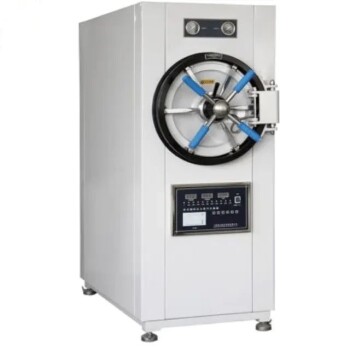
- Laboratory Horizontal Autoclave Steam Sterilizer Lab Microcomputer Sterilizer
- Desktop Fast High Pressure Laboratory Autoclave Sterilizer 16L 24L for Lab Use
- Portable Digital Display Automatic Laboratory Sterilizer Lab Autoclave for Sterilization Pressure
- Desktop Fast Laboratory Autoclave Sterilizer 35L 50L 90L for Lab Use
People Also Ask
- Why is a laboratory high-pressure autoclave sterilizer necessary? Ensure Accuracy in Antibacterial Research
- What is the role of a laboratory high-pressure autoclave in the conversion of furfural to piperidine? Optimize Yields
- What are the two types of autoclave used in the laboratory? Gravity vs. Pre-Vacuum Explained
- What precautions should be taken during autoclave in laboratory? A Complete Safety Guide to Prevent Burns and Explosions
- What extreme conditions does a laboratory autoclave simulate? Testing Wear Resistance of Nuclear Fuel Cladding