The short answer is that neither method is inherently "better" than the other. The best choice depends entirely on your personal priorities. High Pressure/High Temperature (HPHT) diamonds tend to have better color grades on average, while Chemical Vapor Deposition (CVD) diamonds often exhibit higher clarity. The production process also makes CVD a generally more cost-effective option.
The decision between HPHT and CVD is not about choosing a superior technology, but about understanding a fundamental trade-off. You are primarily choosing between prioritizing top-tier color (HPHT) or exceptional clarity and value (CVD).
How Each Method Shapes the Diamond
To understand the difference in outcomes, you must first understand the two distinct environments in which these diamonds are grown. Each process mimics a different aspect of natural diamond formation.
The HPHT Process: Mimicking Nature's Force
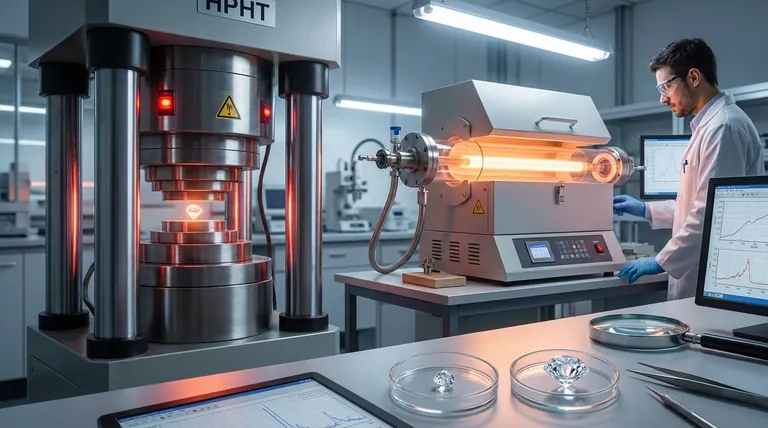
HPHT was the original method for creating lab-grown diamonds. It replicates the intense conditions deep within the Earth where natural diamonds form.
A small diamond "seed" is placed in a chamber with a carbon source (like graphite) and subjected to immense pressure and extreme heat. This environment melts the carbon, which then crystallizes onto the diamond seed, growing a new, larger rough diamond.
The CVD Process: Building Atom by Atom
CVD is a newer technique that can be compared to atomic-level 3D printing. It takes place inside a vacuum chamber under low pressure.
A diamond seed is exposed to a carbon-rich gas mixture (like methane). Microwaves are used to heat the gas into a plasma, which causes carbon atoms to break away and deposit onto the seed, building the diamond layer by layer.
A Direct Comparison: Color vs. Clarity
The differences in the growth processes lead to distinct, albeit subtle, characteristics in the final gemstone. On average, each method excels in one of the primary "4 Cs" of diamond grading.
Why HPHT Excels in Color
The high-pressure, high-temperature environment of the HPHT process is highly controlled, which naturally limits the introduction of impurities that can cause discoloration.
As a result, HPHT diamonds are more likely to achieve top-tier colorless grades (D, E, F) straight out of the growth chamber.
Why CVD Excels in Clarity
The layer-by-layer growth method of CVD is less prone to creating the types of inclusions common in other growth processes.
Consequently, CVD diamonds tend to have fewer internal blemishes. It is more common to find CVD stones with exceptional clarity grades like Internally Flawless (IF) or Very, Very Slightly Included (VVS).
Understanding the Trade-offs
Choosing a lab-grown diamond involves balancing competing attributes. To the naked eye, both types are indistinguishable from each other and from natural diamonds. The right choice is a technical and financial one.
The Cost Factor
The HPHT method requires massive presses and consumes a significant amount of energy, making it a more expensive process to operate.
CVD operates at more moderate temperatures and lower pressures, making it a more energy-efficient and scalable technology. This production advantage often translates to a lower retail price for the consumer.
Post-Growth Treatments
It is a common and accepted industry practice for some diamonds, particularly CVD-grown ones, to undergo a treatment process after growth to enhance their color. Often, this treatment is an HPHT process.
This treatment can improve a CVD diamond's color by several grades, allowing it to compete with the best HPHT stones. This fact blurs the lines, reinforcing that you should judge the final stone's certificate, not just its origin method.
Can You Tell the Difference?
No. Without advanced gemological equipment, even a trained jeweler cannot visually distinguish between an HPHT and a CVD diamond. The choice has no bearing on the stone's day-to-day beauty, fire, or brilliance.
Making the Right Choice for Your Goal
Select the growth method that aligns with the characteristic you value most.
- If your primary focus is the best possible color: HPHT diamonds often provide a higher probability of achieving top-tier colorless grades without needing any post-growth enhancements.
- If your primary focus is the highest clarity: CVD diamonds frequently offer better clarity ratings and are more likely to be found in the VVS or IF range.
- If your primary focus is the best overall value: CVD generally presents a more cost-effective option, potentially allowing you to secure a larger diamond for your budget.
Ultimately, the "better" diamond is the one whose certified characteristics best match your personal priorities and budget.
Summary Table:
| Feature | HPHT Diamond | CVD Diamond |
|---|---|---|
| Best For | Top-Tier Color (D-F) | High Clarity (VVS/IF) & Value |
| Average Color Grade | Typically Higher | May require post-growth treatment |
| Average Clarity Grade | Standard | Typically Higher |
| Average Cost | Higher | More Cost-Effective |
Still unsure which diamond growth method is right for your specific needs?
The experts at KINTEK are here to help. As specialists in laboratory equipment and consumables, including technologies relevant to advanced material synthesis, we understand the science behind these processes. Let us provide you with the technical insights to make a confident decision.
Contact our specialists today for personalized guidance and discover how KINTEK supports precision and innovation in laboratories worldwide.
Visual Guide

Related Products
- Cylindrical Resonator MPCVD Machine System Reactor for Microwave Plasma Chemical Vapor Deposition and Lab Diamond Growth
- Laboratory CVD Boron Doped Diamond Materials
- Microwave Plasma Chemical Vapor Deposition MPCVD Machine System Reactor for Lab and Diamond Growth
- Custom CVD Diamond Coating for Lab Applications
- CVD Diamond Optical Windows for Lab Applications
People Also Ask
- How does a microwave plasma reactor facilitate the synthesis of diamond? Master MPCVD with Precision Technology
- How is a diamond formed from CVD? The Science of Growing Diamonds Atom by Atom
- What is the difference between MPCVD and HFCVD? Choose the Right CVD Method for Your Application
- What are the advantages of a Microwave Plasma CVD reactor for MCD/NCD coatings? Precision Multilayer Diamond Engineering
- Why is argon-rich gas phase chemistry used for UNCD growth? Unlock Precision Nano-Diamond Synthesis