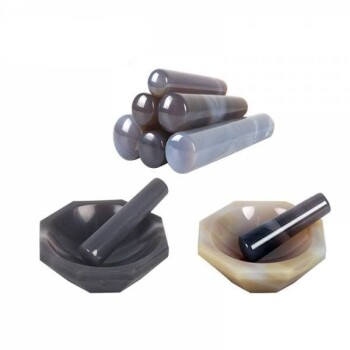
The preference for agate grinding jars stems directly from the critical need to eliminate metallic impurities during the synthesis of LLZO precursor powders. While metal jars inevitably shed microscopic debris due to abrasion, agate offers a chemically inert and wear-resistant surface that maintains the strict purity required for solid-state electrolytes.
LLZO is highly sensitive to cation doping, meaning even trace amounts of metal wear debris can alter its properties. Agate jars prevent this contamination, ensuring the material’s electrochemical performance remains uncompromised.
The Critical Importance of Purity in LLZO Synthesis
Sensitivity to Cation Doping
LLZO (Lithium Lanthanum Zirconium Oxide) is not merely a powder mixture; it is a precise chemical structure designed for specific electrochemical behavior.
The material is highly sensitive to cation doping, a process where foreign ions are introduced into the crystal lattice.
If metal jars are used, metal ions can unintentionally dope the material, fundamentally altering its performance characteristics.
The Problem with Metal Wear Debris
Ball milling is an inherently abrasive, high-energy process involving constant impact between grinding media and the jar walls.
When using metal jars, this physical stress causes metal wear debris to flake off and mix with the precursor powders.
This debris acts as a contaminant, introducing impurities that are difficult, if not impossible, to remove during subsequent processing steps.
Why Agate is the Material of Choice
Superior Chemical Inertness
To combat the risk of contamination, the milling environment must be chemically neutral.
Agate is selected for its chemical inertness, meaning it does not react with the LLZO precursor materials even under the heat and stress of milling.
This ensures that the chemical composition of the final product reflects only the intended ingredients, not the material of the container.
Excellent Wear Resistance
Beyond chemical stability, the physical durability of the jar is paramount.
Agate possesses excellent wear resistance, significantly reducing the amount of material eroded from the jar walls during milling.
By minimizing physical degradation, agate prevents the introduction of foreign particulates that would otherwise compromise the solid-state electrolyte.
The Consequence of Contamination
Unpredictable Electrochemical Performance
The ultimate goal of synthesizing LLZO is to create a solid-state electrolyte with high ionic conductivity and stability.
If metal contamination occurs, the electrochemical performance of the final material will likely degrade or become unpredictable.
Using agate is a preventative measure to ensure the material functions exactly as designed in a battery environment.
Making the Right Choice for Your Goal
To ensure the success of your LLZO synthesis, select your equipment based on your specific purity requirements.
- If your primary focus is High Purity: Use agate jars to strictly prevent the introduction of metal wear debris and unwanted dopants.
- If your primary focus is Electrochemical Consistency: Avoid metal jars to eliminate variable contamination that causes unpredictable performance fluctuations.
By prioritizing inert materials like agate, you protect the integrity of the precursor powder and secure the final quality of the solid-state electrolyte.
Summary Table:
| Feature | Agate Grinding Jars | Metal Grinding Jars |
|---|---|---|
| Contamination Risk | Extremely Low (Inert) | High (Metallic Wear Debris) |
| Chemical Stability | Chemically Inert | Reactive with certain precursors |
| Wear Resistance | High (Resists abrasion) | Prone to flaking under high energy |
| Effect on LLZO | Preserves electrochemical purity | Risk of unwanted cation doping |
| Best Use Case | Solid-state electrolytes & high purity | Non-sensitive industrial grinding |
Elevate Your Battery Research with KINTEK Precision
Don't let metallic impurities compromise your solid-state electrolyte performance. KINTEK specializes in premium laboratory equipment designed for the most sensitive research applications. From high-purity agate grinding jars and milling systems to advanced battery research tools, vacuum furnaces, and hydraulic pellet presses, we provide the end-to-end solutions necessary for superior LLZO synthesis.
Ready to optimize your powder processing? Contact KINTEK experts today to find the perfect milling and thermal solution for your laboratory's needs.
Related Products
- Laboratory Jar Mill with Agate Grinding Jar and Balls
- Nature Agate Mortar and Pestle for Grinding and Mixing
- Laboratory Jar Ball Mill with Alumina Zirconia Grinding Jar and Balls
- Laboratory Ball Mill Jar Mill with Metal Alloy Grinding Jar and Balls
People Also Ask
- What are the different types of laboratory mills? Choose the Right Grinder for Your Sample Material
- What is use for grinding in the laboratory? Select the Right Mill for Accurate Sample Prep
- What laboratory apparatus is used for grinding? Match the Right Mill to Your Sample Material
- What is the function of a laboratory grinding mill? Achieve Precise Sample Preparation for Accurate Results
- Why are agate milling jars and balls used for Mo-La2O3 powder mixing? Ensure High-Purity Material Dispersion