Industrial-grade grinding systems are essential because they transform irregular, coarse carbonized biomass into a refined, high-surface-area powder. This level of precision is necessary to ensure uniform binder distribution, high structural integrity in the final molded product, and optimal chemical reactivity during subsequent processing stages.
The core necessity of industrial grinding lies in its ability to manipulate particle size to maximize surface area and material homogeneity. By reducing biomass to a micron-scale powder, these systems enable superior mechanical strength and thermal efficiency that cannot be achieved with coarse materials.
Enhancing Material Homogeneity and Structural Integrity
Maximizing Specific Surface Area for Binder Uniformity
Industrial grinding systems reduce carbonized biomass to specific sizes, often smaller than 0.12 mm or 150 mesh. This drastic reduction significantly increases the specific surface area, allowing binders to coat every particle evenly.
When binders are distributed uniformly, the resulting mixture achieves a level of consistency that prevents structural weak points. This ensures that the final products, such as activated carbon pellets or charcoal briquettes, possess high mechanical strength and resistance to breakage.
Optimizing Particle Interlocking and Density
Fine powders act as an efficient filler material that occupies microscopic voids between larger particles. This optimization of the particle size distribution leads to a denser microstructure during the pressing or molding stage.
A denser structure directly correlates to higher bulk density and lower porosity. For manufacturers, this results in high-quality fuel pellets that are durable enough to withstand the rigors of transportation and industrial handling.
Ensuring Process Efficiency and Thermal Performance
Facilitating Rapid and Uniform Heat Transfer
In processes like pyrolysis or chemical modification, the physical form of the biomass dictates the speed of the reaction. Fine, uniform powders allow heat to transfer rapidly and evenly to the core of every particle.
This uniformity prevents "cold spots" and ensures that the entire batch reaches the required temperature simultaneously. The result is a more homogeneous biochar with consistent physicochemical properties across the entire production run.
Maximizing Combustion and Gasification Efficiency
Precise particle size control is vital for applications where carbon powder is injected into kilns. If particles are too large, they may fail to gasify or combust completely while in flight.
Oversized particles often fall onto the clinker layer, leading to incomplete combustion and reduced flame temperatures. Industrial grinders mitigate this risk, ensuring that the fuel burns efficiently and maintains the high temperatures required for industrial kilns.
Understanding the Trade-offs and Limitations
The Balance of Energy Consumption and Fineness
While ultra-fine grinding improves product quality, it requires significant mechanical energy. The cost of electricity and equipment maintenance increases exponentially as the target particle size decreases.
Equipment Wear and Abrasive Characteristics
Carbonized biomass can be highly abrasive, leading to rapid wear on grinding media and internal liners. Industrial-grade systems are necessary because they use specialized alloys and replaceable wear parts designed to handle these harsh conditions, whereas standard equipment would fail prematurely.
Selecting the Right Grinding Strategy for Your Project
To achieve the best results, your grinding specifications must align with your specific end-use requirements.
- If your primary focus is Activated Carbon Production: Aim for ultra-fine grinding (approx. 150 mesh) to maximize surface area for chemical activation and binder integration.
- If your primary focus is Industrial Fuel Pellets: Prioritize high-density filling by creating a particle size distribution that minimizes voids and enhances mechanical interlocking.
- If your primary focus is Flash Gasification or Kiln Injection: Focus on strict particle size limits (typically sub-millimeter) to ensure total carbon burnout and maintain flame stability.
By mastering the transition from coarse biomass to precision powder, you secure the foundation for high-performance carbon products.
Summary Table:
| Feature | Impact on Carbonized Biomass | Industrial Benefit |
|---|---|---|
| Particle Size Control | Achieves <0.12 mm (150 mesh) | Optimal filler density & structural integrity |
| Surface Area Maximization | Uniform binder coating | High mechanical strength & durability |
| Thermal Efficiency | Rapid, uniform heat transfer | Consistent biochar properties & quality |
| Process Optimization | Prevents incomplete combustion | Stable flame temperatures & gasification efficiency |
Elevate Your Biomass Processing with KINTEK
Achieving the perfect micron-scale powder is the foundation of high-performance carbon products. At KINTEK, we provide the precision engineering required for superior material homogeneity and structural integrity.
Our extensive portfolio includes high-durability crushing and milling systems, sieving equipment, and hydraulic presses, alongside an industry-leading range of high-temperature furnaces (muffle, rotary, vacuum, CVD) and high-pressure reactors. Whether you are focused on activated carbon production or industrial fuel pellets, we have the tools to ensure your process efficiency.
Ready to optimize your material quality? Contact our technical experts today to find the ideal processing solution for your laboratory or industrial application!
References
- Iwona Skoczko, Remigiusz Gumiński. Tests on the Application of Various Types of Biomass for Activated Carbon Production. DOI: 10.12911/22998993/174223
This article is also based on technical information from Kintek Solution Knowledge Base .
Related Products
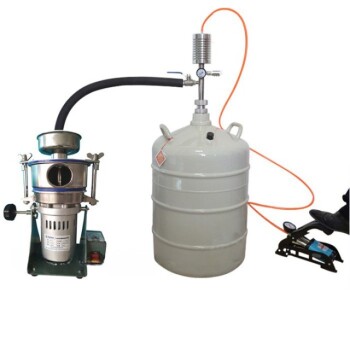
- Small Cryogenic Grinder Cryomill Cryogrinder with Liquid Nitrogen for Laboratory Use
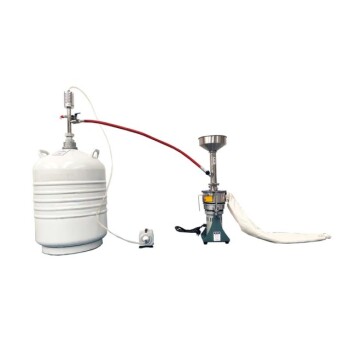
- Liquid Nitrogen Cryogenic Grinder Mill Cryomill Airflow Ultrafine Pulverizer
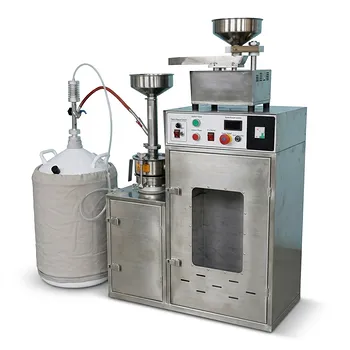
- Liquid Nitrogen Cryogenic Grinder Mill Cryomill with Screw Feeder
- Graphite Vacuum Furnace Bottom Discharge Graphitization Furnace for Carbon Materials
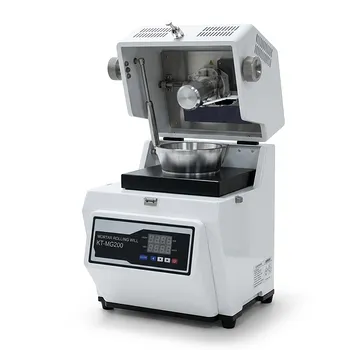
- Laboratory Grinding Mill Mortar Grinder for Sample Preparation
People Also Ask
- What are the advantages of using a cryogenic grinder? Achieve Nanoscale Precision for All-Solid-State Battery Cathodes
- Why is a cryogenic grinder required for cured alkyd resin HRMAS NMR? Ensure Structural Integrity & Sample Precision
- What is the role of a cryogenic grinder in PET recycling? Transform Waste into High-Reactive Micron Powders
- What is cryogenic grinding of crumb rubber? Achieve Fine, High-Quality Rubber Powder
- What food is cryogenic grinding? The Ultimate Guide to Preserving Flavor & Aroma