Cryogenic grinding offers a decisive advantage over traditional ball milling by fundamentally altering the mechanical properties of ductile organic materials during processing.
While traditional milling often results in agglomeration and thermal degradation, cryogenic grinding utilizes liquid nitrogen to induce a ductile-to-brittle transition. This allows soft organic polymers to be shattered into nanoscale particles while simultaneously suppressing harmful chemical reactions between the cathode and sensitive sulfide electrolytes.
Core Insight: The primary value of cryogenic grinding is not just particle reduction, but chemical preservation. By freezing the milling environment, you mechanically enable the pulverization of soft materials that would otherwise deform, while thermodynamically preventing the side reactions that typically degrade all-solid-state battery interfaces.
Overcoming the "Soft Material" Barrier
The Ductile-to-Brittle Transition
Organic electrode materials, such as pyrene-4,5,9,10-tetraone (PTO), are naturally ductile. In a traditional room-temperature ball mill, these materials tend to deform or flatten rather than fracture.
Cryogenic grinding lowers the temperature to the point where these organic polymers undergo a ductile-to-brittle transition. Once embrittled, the material yields to mechanical force by shattering rather than bending, enabling effective pulverization.
Achieving Nanoscale Dispersion
Because the material is brittle during impact, it breaks down into a fine, uniform powder.
This process ensures uniform dispersion of the active material within the composite. It effectively eliminates the agglomeration issues common in room-temperature dry milling, where soft particles stick together to form larger clusters.
Preserving Chemical Integrity
Suppressing Reaction Kinetics
The most critical challenge in all-solid-state batteries is the reactivity of sulfide solid electrolytes (like Li3PS4). These materials are chemically unstable and prone to side reactions when in contact with organics under energy-intensive conditions.
The ultra-low temperature of the cryogenic environment drastically reduces reaction kinetics. This suppresses harmful chemical side reactions, maintaining the purity and chemical integrity of both the organic cathode and the solid electrolyte.
Preventing Thermal Degradation
Traditional high-energy ball milling generates significant friction and localized heat.
While wet milling with solvents like acetone can help dissipate this heat, cryogenic grinding eliminates the risk entirely. It ensures the material structure is not compromised by the "hot spots" typical of mechanical friction.
Understanding the Trade-offs
Process Complexity
While superior for material quality, cryogenic grinding introduces operational complexity. Handling liquid nitrogen requires specialized equipment and safety protocols compared to the relative simplicity of standard dry or wet ball milling.
Solvent Considerations
Traditional wet milling relies on liquid media (like acetone) to lower surface energy and prevent agglomeration. Cryogenic grinding achieves similar anti-agglomeration results physically via freezing, removing the need for solvents that might be difficult to remove or incompatible with certain battery chemistries.
Making the Right Choice for Your Goal
- If your primary focus is processing ductile organics: The ductile-to-brittle transition provided by cryogenic grinding is essential for achieving nanoscale particle sizes.
- If your primary focus is electrolyte stability: The low-temperature environment is critical to prevent chemical degradation of reactive sulfide electrolytes during the milling process.
- If your primary focus is dispersion without solvents: Cryogenic grinding offers a physical route to prevent agglomeration without introducing potential impurities from liquid grinding media.
Cryogenic grinding is the definitive choice when material ductility and chemical reactivity are the limiting factors in your cathode preparation.
Summary Table:
| Feature | Traditional Ball Milling | Cryogenic Grinding |
|---|---|---|
| Material State | Ductile (deformation/flattening) | Brittle (efficient shattering) |
| Particle Size | Microscale (agglomeration common) | Nanoscale (uniform dispersion) |
| Thermal Impact | High friction; risk of heat spots | Zero thermal degradation |
| Chemical Stability | Risk of electrolyte side reactions | Kinetic suppression of reactions |
| Solvent Dependency | Often requires solvents (e.g. Acetone) | Physical anti-agglomeration (solvent-free) |
Elevate Your Battery Research with KINTEK Precision
Don't let material ductility or chemical degradation compromise your all-solid-state battery breakthroughs. KINTEK specializes in high-performance laboratory equipment, including advanced crushing and milling systems designed to handle the most sensitive organic-lithium materials.
Our comprehensive range of cryogenic solutions, high-temperature furnaces, and hydraulic pellet presses ensures your research is backed by industrial-grade reliability and precision. From maintaining the chemical integrity of sulfide electrolytes to achieving perfect nanoscale dispersion, our experts are ready to help you optimize your material processing workflow.
Ready to refine your results? Contact us today to find the perfect solution for your lab!
Related Products
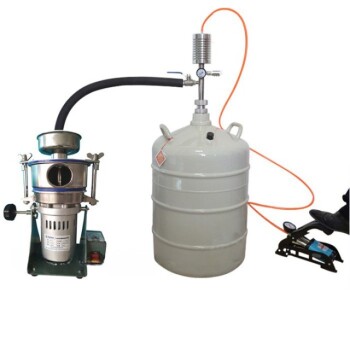
- lab cryogenic grinding use liquid-nitrogen for pulverizing plastic raw materials and heat sensitive materials
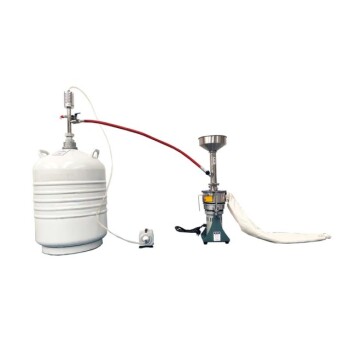
- Small Cryogenic Grinder Cryomill Cryogrinder with Liquid Nitrogen for Laboratory Use
- Liquid Nitrogen Cryogenic Grinder Mill Cryomill Airflow Ultrafine Pulverizer
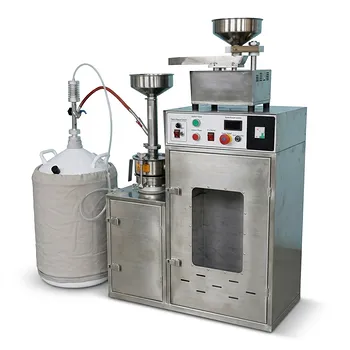
- Liquid Nitrogen Cryogenic Grinder Mill Cryomill with Screw Feeder
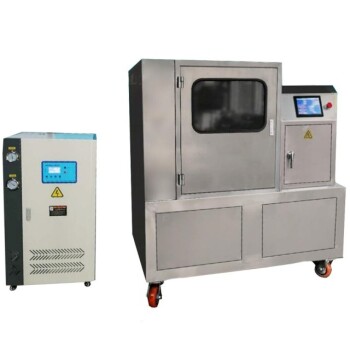
- Low-Temperature Water-Cooled Touchscreen Vibratory Ultrafine Pulverizer
People Also Ask
- Why is a cryogenic grinder required for cured alkyd resin HRMAS NMR? Ensure Structural Integrity & Sample Precision
- What is the role of a cryogenic grinder in PET recycling? Transform Waste into High-Reactive Micron Powders
- What is cool grinding technology? Unlock Efficient Milling for Heat-Sensitive Materials
- What are cryogenic ground spices? Unlock Maximum Flavor with Advanced Grinding Technology
- What is cryogenic grinding of herbs? Preserve Flavor and Potency with Sub-Zero Milling