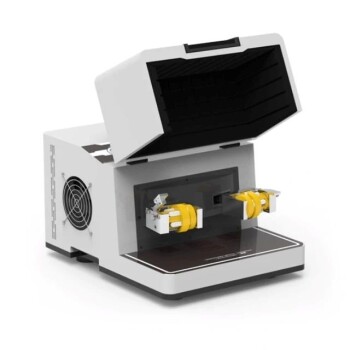
A laboratory ball mill is required to mechanically reduce dried leaching residues into an ultra-fine, uniform powder, typically smaller than 90 micrometers. By standardizing particle size, this equipment eliminates the sampling bias inherent in coarse materials, ensuring that small sub-samples accurately reflect the composition of the entire batch.
Homogenization via ball milling transforms a heterogeneous mixture into a uniform standard. This process removes sampling bias, guaranteeing that sensitive quantitative methods like carbon-sulfur analysis yield repeatable and accurate data.
Solving the Problem of Heterogeneity
Eliminating Sampling Bias
Leaching residues are rarely uniform; they often consist of particles varying significantly in size and composition.
If you analyze a sample with mixed particle sizes, you risk selecting a non-representative scoop that skews your data.
The ball mill crushes everything to a consistent size, ensuring the physical sample matches the chemical reality of the bulk material.
Achieving Critical Particle Size
To obtain reliable data, residues generally need to be ground to below 90 micrometers.
At this microscopic level, the material behaves like a fluid powder, allowing for perfect mixing.
This specific threshold is often a prerequisite for validated laboratory protocols.
Ensuring Analytical Precision
Facilitating Carbon-Sulfur Analysis
High-precision instruments, such as carbon-sulfur analyzers, require uniform combustion of the sample.
Inconsistent particle sizes can lead to uneven burn rates or incomplete combustion, resulting in erratic readings.
Homogenized samples ensure a steady, predictable reaction within the analyzer.
Optimizing Chemical Digestion
Many compositional analyses rely on chemical digestion methods (dissolving the sample in acid).
Fine grinding drastically increases the surface area of the residue.
This ensures the acids can attack and dissolve the sample completely and rapidly, preventing undissolved solids from altering the final concentration results.
Understanding the Trade-offs
Equipment Maintenance and Cleaning
While ball mills ensure accuracy, they introduce a risk of cross-contamination between samples.
Because the grinding process produces fine dust, the jar and balls must be meticulously cleaned after every run.
Failing to clean the equipment thoroughly will carry over elements from previous residues, corrupting your new data.
Processing Time vs. Throughput
Achieving a particle size under 90 micrometers is a mechanical process that requires time.
This adds a distinct preparation step to the workflow, potentially creating a bottleneck in high-throughput labs.
However, skipping this step to save time invariably costs more later due to the need for re-testing failed or suspicious samples.
Ensuring Data Integrity for Your Project
To ensure your leaching residue analysis is valid, apply the following guidelines:
- If your primary focus is Repeatability: Ensure every single sample is milled to the exact same particle size specification (e.g., <90 µm) to rule out physical variations.
- If your primary focus is Chemical Accuracy: Use the ball mill to maximize surface area, ensuring complete digestion or combustion in your analytical instruments.
The laboratory ball mill is not merely a grinder; it is the essential gatekeeper that ensures your raw material is fit for high-precision measurement.
Summary Table:
| Feature | Requirement for Residue Analysis | Impact on Data Quality |
|---|---|---|
| Particle Size | Typically < 90 micrometers | Ensures uniform sub-sampling and representative data |
| Surface Area | High (Ultra-fine powder) | Accelerates chemical digestion and ensures complete combustion |
| Homogeneity | High-level mechanical mixing | Eliminates sampling bias in heterogeneous leaching residues |
| Analytical Compatibility | Uniform burn/dissolution rates | Critical for carbon-sulfur analysis and acid digestion accuracy |
Elevate Your Analytical Precision with KINTEK
Don't let sampling bias compromise your research integrity. KINTEK specializes in high-performance crushing and milling systems, including advanced laboratory ball mills designed to achieve the ultra-fine homogenization required for leaching residues and complex material analysis.
Beyond sample preparation, we offer a comprehensive suite of laboratory solutions:
- High-Temperature Equipment: Muffle, tube, and vacuum furnaces for thermal processing.
- Material Processing: Hydraulic presses, sieving equipment, and homogenizers.
- Advanced Reactors: High-temperature high-pressure reactors and autoclaves.
- Specialized Tools: Battery research consumables, electrolytic cells, and high-purity ceramics.
Ready to optimize your lab's workflow and ensure repeatable, accurate data? Contact our technical experts today to find the perfect equipment tailored to your specific analysis requirements.
References
- Benedikt Flerus, Bernd Friedrich. Recovery of Gallium from Smartphones—Part II: Oxidative Alkaline Pressure Leaching of Gallium from Pyrolysis Residue. DOI: 10.3390/met10121565
This article is also based on technical information from Kintek Solution Knowledge Base .
Related Products
- Stainless Steel Laboratory Ball Mill for Dry Powder and Liquid with Ceramic Polyurethane Lining
- Laboratory Planetary Ball Mill Rotating Ball Milling Machine
- Laboratory Ball Mill Jar Mill with Metal Alloy Grinding Jar and Balls
- Laboratory Planetary Ball Mill Cabinet Planetary Ball Milling Machine
- Laboratory Jar Ball Mill with Alumina Zirconia Grinding Jar and Balls
People Also Ask
- How do laboratory ball mills facilitate the mechanochemical synthesis of ZIF-8? Solvent-Free Synthesis Explained
- What is the primary function of a laboratory ball mill in the modification of sulfide-based solid electrolytes with LiPO2F2?
- How does a laboratory ball mill ensure the mixing quality of Mn3Zn0.8Sn0.2N and Ti? Achieve Perfect Homogeneity
- What is the function of a laboratory ball mill in the preparation of AMMCs? Optimize Dispersion & Grain Refinement
- In what way does a laboratory ball mill affect material properties when modifying PHBV/pulp fiber composites?