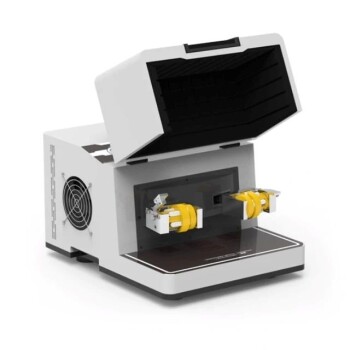
Mechanical alloying equipment, particularly ball milling, is deployed to fundamentally alter the microstructure of nickel-based alloy powders. It goes beyond simple mixing; it utilizes high-energy grinding to refine particle sizes down to the micron or nanometer scale. This process significantly increases the reaction activity of the powder, making it a critical pretreatment step for advanced manufacturing techniques like Spark Plasma Sintering (SPS).
Core Takeaway: The primary function of mechanical alloying is to induce intense plastic deformation and atomic-level diffusion through impact and shear forces. This transforms raw ingredients into a highly reactive, homogeneous feedstock essential for achieving high yield strength and hardness in the final alloy.
Driving Microstructural Evolution
The use of a ball mill during pretreatment is not merely about combining ingredients; it is about forcing a physical transformation at the atomic level.
Achieving Nanometer-Scale Precision
High-energy grinding subjects the metal powders to repeated impact and shearing forces. This mechanical action physically breaks down the particles, refining their size significantly.
The process reduces particles from their raw state down to the micron or even nanometer scale. This massive reduction in size creates a larger specific surface area for the material.
Inducing Atomic Diffusion
As the grinding balls impact the powder, they induce intense plastic deformation. This energy forces the various principal elements to mix intimately.
This facilitates atomic-level diffusion, allowing the elements to form solid solution alloy powders even before the sintering phase begins.
Creating Lattice Defects
The intense impact introduces a high density of lattice defects within the metal structure. These defects are not flaws in this context; they are energy storage mechanisms.
By disrupting the perfect crystal lattice, the internal energy of the powder increases. This stored energy is the driver for future reactions.
The Role in Spark Plasma Sintering (SPS)
The ultimate goal of this pretreatment is to prepare the "green" body (unfired powder) for consolidation, typically via Spark Plasma Sintering.
Enhancing Reaction Activity
The refined particle size and high density of lattice defects significantly increase the reaction activity of the powder.
Higher activity means the powder responds more effectively to the heat and pressure of the sintering process. It lowers the energy barrier required for the particles to bond.
Promoting Strengthening Phases
Mechanical alloying promotes the formation of specific strengthening phases within the material.
These phases are responsible for the alloy's mechanical properties. Without this pretreatment, developing the specific stoichiometric ratios required for high performance would be difficult or impossible.
Understanding the Trade-offs
While mechanical alloying is a powerful tool for material synthesis, it involves intense physical forces that must be carefully managed.
Energy Intensity and Heat
The process relies on "high-energy" grinding. The friction and impact generate significant heat and consume substantial energy.
This energy must be high enough to induce plastic deformation but controlled to prevent unwanted chemical reactions (like oxidation) before the sintering stage.
Processing Time vs. Refinement
Achieving the nanometer scale requires repeated, prolonged exposure to grinding forces.
There is a balance to be struck; insufficient milling leads to chemically segregated powders, while excessive milling can lead to contamination or diminishing returns on particle size reduction.
Making the Right Choice for Your Goal
Mechanical alloying is a prerequisite for high-performance nickel alloys, but your specific focus dictates how you parameterize the process.
- If your primary focus is Final Material Strength: Prioritize milling parameters that maximize grain refinement and the formation of solid solution phases to ensure high yield strength and hardness.
- If your primary focus is Sintering Efficiency: Focus on introducing high densities of lattice defects to maximize the powder's reaction activity, facilitating easier consolidation during SPS.
This pretreatment is the bridge between raw elemental powders and a high-performance, engineering-grade alloy.
Summary Table:
| Feature | Mechanical Alloying Effect | Benefit for Nickel Alloys |
|---|---|---|
| Particle Size | Refinement to micron/nanometer scale | Increases specific surface area and reactivity |
| Atomic Structure | Induces intense plastic deformation | Facilitates atomic-level diffusion and solid solutions |
| Lattice State | Creates high-density lattice defects | Increases internal energy to drive sintering reactions |
| SPS Readiness | Lowers energy barriers for bonding | Promotes strengthening phases for high hardness/yield |
Elevate Your Material Research with KINTEK Precision
Ready to transform your nickel-based alloy development? KINTEK specializes in advanced laboratory equipment designed to meet the rigorous demands of mechanical alloying and materials synthesis. Whether you need high-energy crushing and milling systems for nanometer-scale refinement or precision high-temperature furnaces and Spark Plasma Sintering (SPS) support, our comprehensive range of tools ensures your powders achieve maximum reaction activity and superior mechanical properties.
From high-pressure reactors to specialized consumables like crucibles and ceramic tools, KINTEK provides the end-to-end solutions researchers need for high-performance engineering. Contact us today to optimize your lab's workflow!
Related Products
- Laboratory Ball Mill Jar Mill with Metal Alloy Grinding Jar and Balls
- Mini Planetary Ball Mill Machine for Laboratory Milling
- High Energy Planetary Ball Mill for Laboratory Horizontal Tank Type Milling Machine
- High Energy Planetary Ball Mill Milling Machine for Laboratory
- High Energy Planetary Ball Mill Milling Machine for Laboratory
People Also Ask
- What is the function of a laboratory ball mill in the preparation of AMMCs? Optimize Dispersion & Grain Refinement
- What is the primary function of a laboratory ball mill in the modification of sulfide-based solid electrolytes with LiPO2F2?
- What is the function of a laboratory ball mill in the pretreatment of waste tire char (WTC)? Optimize Material Reactivity
- What is the primary function of a laboratory ball mill in Rice Husk Ash (RHA) modification? Achieve Peak Densification
- How do laboratory ball mills facilitate the mechanochemical synthesis of ZIF-8? Solvent-Free Synthesis Explained