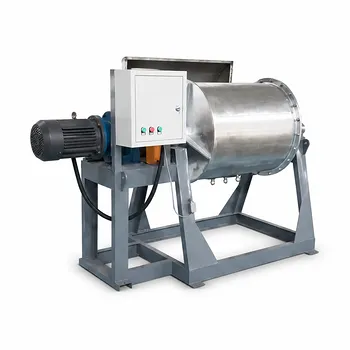
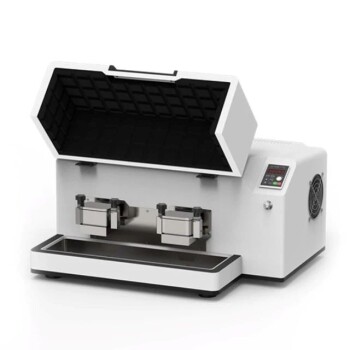
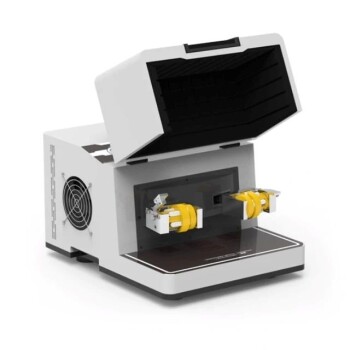
The primary function of a laboratory ball mill in copper ore processing is to act as the central mechanism for the fine grinding stage. By utilizing internal grinding media to deliver mechanical impact forces, the mill systematically reduces the ore's particle size to a precise degree. This physical reduction is critical for "liberating" valuable copper minerals from the surrounding waste matrix, ensuring they are exposed and accessible for subsequent extraction processes.
The laboratory ball mill facilitates the essential "liberation" phase of mineral processing, breaking down ore structures to expose valuable copper for extraction while establishing energy baselines for larger-scale operations.
The Mechanics of Mineral Liberation
Achieving Precise Particle Reduction
The laboratory ball mill operates by rotating a cylinder filled with grinding media (typically steel or ceramic balls) and the ore sample.
As the cylinder rotates, the media cascades and tumbles, subjecting the ore to intense impact and attrition forces. This action reduces coarse ore fragments into fine powder, achieving a target particle size distribution necessary for testing.
Breaking the Ore Matrix
The ultimate goal of this reduction is not simply to create dust, but to achieve mineral liberation.
Copper minerals are often locked inside a larger rock matrix (gangue). The ball mill physically breaks this matrix, detaching the valuable mineral grains from the waste rock so they can be physically or chemically separated later.
Optimizing Process Efficiency
Enhancing Surface Area for Extraction
By pulverizing the ore, the ball mill significantly increases the specific surface area of the material.
This increased surface area is vital for the efficiency of subsequent stages, such as flotation or leaching. It ensures that chemical reagents can contact the copper minerals effectively, maximizing recovery rates.
Managing Energy Consumption
Grinding is traditionally the most energy-intensive part of mineral processing.
The laboratory ball mill allows metallurgists to determine the minimum energy required to achieve the necessary liberation size. This data is used to optimize the overall energy consumption of the processing plant, balancing cost against recovery performance.
Understanding the Trade-offs
The Risk of Over-Grinding
While reducing particle size is necessary, there is a point of diminishing returns known as over-grinding.
Producing particles that are too fine ("slimes") can impede downstream separation processes and lead to the loss of valuable copper. It also represents a significant waste of energy. The laboratory mill is used to identify this threshold to avoid process inefficiencies.
Scale-Up Discrepancies
Data obtained from a laboratory ball mill provides a crucial baseline, but it is not a perfect 1:1 representation of industrial operations.
Variations in impact mechanics and efficiency at different scales mean that laboratory results must be carefully extrapolated when designing full-scale plant circuits.
How to Apply This to Your Project
To maximize the utility of your laboratory ball mill data, consider your specific processing objectives:
- If your primary focus is Extraction Efficiency: Target a particle size that maximizes the percentage of liberated mineral grains, ensuring reagents have full access to the copper.
- If your primary focus is Operational Cost: Analyze the grind time and power draw to find the coarsest possible grind size that still yields acceptable recovery rates, minimizing energy waste.
Successful copper processing relies on finding the precise balance between sufficient liberation and efficient energy use.
Summary Table:
| Function | Description | Impact on Process |
|---|---|---|
| Mineral Liberation | Breaking the ore matrix to detach copper from waste rock | Ensures valuable minerals are accessible for extraction |
| Particle Size Reduction | Using impact and attrition to reach a specific powder fineness | Increases specific surface area for chemical reagents |
| Energy Optimization | Determining the minimum power required for desired grind | Balances operational costs with recovery performance |
| Process Control | Identifying the threshold to avoid "over-grinding" | Prevents loss of copper and energy waste in slimes |
Maximize Your Ore Processing Efficiency with KINTEK
Precision in the laboratory is the foundation for profitability in the plant. At KINTEK, we specialize in high-performance crushing and milling systems, including advanced laboratory ball mills designed to provide accurate data for your scale-up operations.
Whether you are focusing on maximizing extraction efficiency or minimizing operational energy costs, our comprehensive range of laboratory equipment—from high-temperature furnaces to hydraulic presses and PTFE consumables—is engineered to meet the rigorous demands of mineral research.
Ready to refine your grinding process and achieve superior mineral liberation? Contact KINTEK today to discuss our customized laboratory solutions and see how our expertise can drive your project's success.
References
- Błażej Doroszuk, Robert Król. Calibrating the Digital Twin of a Laboratory Ball Mill for Copper Ore Milling: Integrating Computer Vision and Discrete Element Method and Smoothed Particle Hydrodynamics (DEM-SPH) Simulations. DOI: 10.3390/min14040407
This article is also based on technical information from Kintek Solution Knowledge Base .
Related Products
- Stainless Steel Laboratory Ball Mill for Dry Powder and Liquid with Ceramic Polyurethane Lining
- Laboratory Planetary Ball Mill Rotating Ball Milling Machine
- Laboratory Ball Mill Jar Mill with Metal Alloy Grinding Jar and Balls
- Laboratory Planetary Ball Mill Cabinet Planetary Ball Milling Machine
- Laboratory Jar Ball Mill with Alumina Zirconia Grinding Jar and Balls
People Also Ask
- How do laboratory ball mills facilitate the mechanochemical synthesis of ZIF-8? Solvent-Free Synthesis Explained
- What is the primary function of a laboratory ball mill in the modification of sulfide-based solid electrolytes with LiPO2F2?
- How does a laboratory ball mill ensure the mixing quality of Mn3Zn0.8Sn0.2N and Ti? Achieve Perfect Homogeneity
- What is the function of a laboratory ball mill in the preparation of AMMCs? Optimize Dispersion & Grain Refinement
- In what way does a laboratory ball mill affect material properties when modifying PHBV/pulp fiber composites?