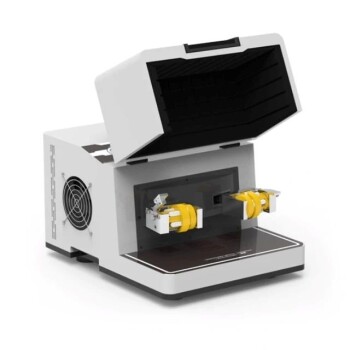
A laboratory ball mill is strictly required to apply mechanical force that refines raw materials like calcined lime and opoka. This process drastically increases the specific surface area of the particles, which is the fundamental prerequisite for efficient hydrothermal synthesis.
Secondary grinding is not just about reducing size; it is about activating the material. It ensures the dissolution activity and microscopic contact necessary for the rapid formation of high-crystallinity calcium silicate hydrates.
The Mechanics of Material Activation
Increasing Specific Surface Area
The primary function of the ball mill is the application of mechanical force.
By physically breaking down the calcined lime and opoka, the mill significantly increases the specific surface area of the powder. This exposes more material to the reaction environment, moving it from a passive state to an active one.
Enhancing Dissolution Activity
Hydrothermal synthesis relies heavily on how well materials dissolve in water under heat and pressure.
The increased surface area directly enhances the dissolution activity of the raw materials. This ensures that the chemical components are readily available in the solution to react, rather than remaining locked inside larger, unreactive particles.
Optimizing Chemical Interaction
Achieving Microscopic Contact
For synthesis to occur efficiently, the reactants must be in close proximity.
Secondary grinding ensures the close contact of calcium and silicon components at a microscopic level. This intimate mixing eliminates "dead zones" where ingredients might otherwise remain isolated and unreacted.
Promoting Rapid Crystallization
The ultimate goal of this preparation is the creation of specific structural compounds.
High reactivity and intimate mixing promote the rapid formation of calcium silicate hydrates. Furthermore, proper grinding ensures these hydrates achieve high crystallinity, which is often critical for the mechanical properties of the final material.
The Consequence of Insufficient Grinding
The "Reactivity Gap"
It is important to understand the trade-off of bypassing or under-utilizing this process.
Without sufficient mechanical refinement, raw materials possess low specific surface area. This leads to sluggish dissolution rates and poor contact between the calcium and silicon sources. The result is a slow reaction and a final product with low crystallinity or incomplete formation.
Making the Right Choice for Your Goal
To optimize your hydrothermal synthesis, consider how the ball milling stage aligns with your specific objectives:
- If your primary focus is Reaction Speed: Prioritize maximizing specific surface area to accelerate dissolution activity and shorten synthesis time.
- If your primary focus is Product Quality: Ensure extended grinding times to guarantee the microscopic contact required for high-crystallinity calcium silicate hydrates.
The ball mill is not merely a crushing tool; it is the enabler of high-performance chemical synthesis.
Summary Table:
| Process Objective | Mechanism of Action | Impact on Synthesis |
|---|---|---|
| Surface Area Expansion | Mechanical force breaks particles down to micron levels | Dramatically increases material exposure to reactants |
| Dissolution Activation | Reduced particle size accelerates solubility | Ensures chemical components are readily available in solution |
| Microscopic Contact | Intimate mixing of calcium and silicon sources | Eliminates unreacted zones and promotes uniform formation |
| Crystallization Boost | High reactivity of refined precursors | Leads to rapid formation of high-crystallinity hydrates |
Elevate Your Material Research with KINTEK Precision
Don't let inefficient grinding hinder your synthesis results. KINTEK specializes in high-performance crushing and milling systems designed to provide the precise mechanical activation required for advanced hydrothermal processes.
Whether you are producing high-crystallinity calcium silicate hydrates or developing new chemical compounds, our comprehensive range of laboratory equipment—including planetary ball mills, high-temperature high-pressure reactors, and autoclaves—ensures your materials achieve peak reactivity.
Ready to optimize your lab's efficiency and product quality? Contact our technical experts today to find the perfect milling and synthesis solution for your specific application.
References
- R. Šiaučiūnas, Edita Prichockiene. Synthesis of High Crystallinity 1.13 nm Tobermorite and Xonotlite from Natural Rocks, Their Properties and Application for Heat-Resistant Products. DOI: 10.3390/ma15103474
This article is also based on technical information from Kintek Solution Knowledge Base .
Related Products
- Stainless Steel Laboratory Ball Mill for Dry Powder and Liquid with Ceramic Polyurethane Lining
- Laboratory Planetary Ball Mill Rotating Ball Milling Machine
- Laboratory Ball Mill Jar Mill with Metal Alloy Grinding Jar and Balls
- Laboratory Planetary Ball Mill Cabinet Planetary Ball Milling Machine
- Laboratory Jar Ball Mill with Alumina Zirconia Grinding Jar and Balls
People Also Ask
- How do laboratory ball mills facilitate the mechanochemical synthesis of ZIF-8? Solvent-Free Synthesis Explained
- What is the primary function of a laboratory ball mill in the modification of sulfide-based solid electrolytes with LiPO2F2?
- How does a laboratory ball mill ensure the mixing quality of Mn3Zn0.8Sn0.2N and Ti? Achieve Perfect Homogeneity
- What is the function of a laboratory ball mill in the preparation of AMMCs? Optimize Dispersion & Grain Refinement
- In what way does a laboratory ball mill affect material properties when modifying PHBV/pulp fiber composites?