Knowledge What is the role of a cryogenic grinder in PET recycling? Transform Waste into High-Reactive Micron Powders
Author avatar

Tech Team · Kintek Solution

Updated 1 day ago

What is the role of a cryogenic grinder in PET recycling? Transform Waste into High-Reactive Micron Powders


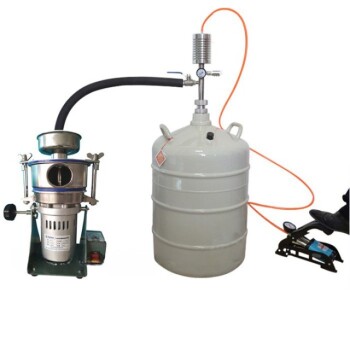
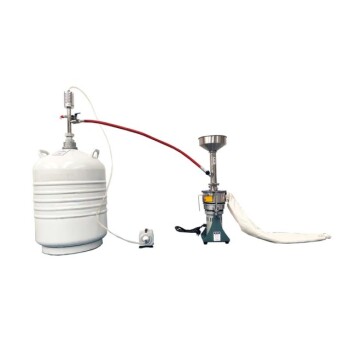
The primary role of a cryogenic grinder is to transform waste PET bottle flakes into chemically pure, micron-scale powders. By utilizing liquid nitrogen to cool the plastic to its embrittlement temperature, the machine uses high-frequency impact to shatter the material rather than mechanically shearing it.

Cryogenic grinding is the definitive solution for increasing the surface area of waste plastics without altering their chemical composition. It creates the ideal physical state for downstream chemical recycling by preventing the heat damage inherent in traditional grinding methods.

The Mechanics of Cryogenic Grinding

Achieving Embrittlement

Standard plastics like PET are naturally tough and resistant to breaking at room temperature. A cryogenic grinder uses liquid nitrogen to rapidly cool the PET samples.

This cooling process lowers the temperature of the plastic until it reaches its embrittlement point. At this stage, the material loses its elasticity and becomes glass-like, making it susceptible to fracturing.

High-Frequency Impact

Once the PET is embrittled, the grinder does not rely on traditional cutting blades. Instead, it utilizes high-frequency impact mechanisms.

Because the material is brittle, these impacts instantly shatter the bottle flakes. The result is a fine, uniform micron-scale powder.

Why This Matters for PET Recycling

Maximizing Reaction Efficiency

The transition from flake to micron-scale powder drastically increases the microscopic specific surface area of the raw material. This physical transformation is critical for the next stage of processing.

A larger surface area exposes more of the polymer to chemical agents. This provides a significantly higher number of active sites for subsequent reactions, specifically subcritical hydrolysis.

Preventing Thermal Degradation

Traditional mechanical grinding generates significant friction and heat. This uncontrolled heat can degrade the polymer chains, altering the chemical properties of the PET before it is even recycled.

Cryogenic grinding eliminates this risk entirely. By processing the material at extremely low temperatures, it ensures the chemical structure remains intact, avoiding thermal degradation completely.

Understanding the Trade-offs

Operational Complexity and Cost

While chemically superior, cryogenic grinding introduces logistical challenges compared to ambient grinding. The requirement for a continuous supply of liquid nitrogen increases operational costs significantly.

Energy Intensity

The process requires energy not only to power the high-frequency impact mechanism but also to maintain the cryogenic environment. It is generally reserved for high-value applications where material purity and particle size are non-negotiable.

Making the Right Choice for Your Goal

To determine if cryogenic grinding is the correct pretreatment for your waste PET, consider your downstream requirements.

  • If your primary focus is Chemical Recycling (Hydrolysis): You must use cryogenic grinding to maximize surface area and active sites without chemically degrading the polymer.
  • If your primary focus is cost-effective volume reduction: Cryogenic grinding is likely over-engineered; traditional mechanical grinding may suffice if thermal history is less critical.

By leveraging the brittle nature of frozen PET, cryogenic grinding turns waste into a highly reactive, pure feedstock ready for advanced chemical processing.

Summary Table:

Feature Cryogenic Grinding Traditional Mechanical Grinding
Material State Embrittled (Glass-like) Tough & Elastic
Mechanism High-frequency impact Mechanical shearing
Particle Size Micron-scale powder Large flakes/granules
Thermal Risk Zero degradation High risk of chain degradation
Surface Area Maximum (High reactivity) Low (Slower reactions)
Best Use Case Chemical recycling & Hydrolysis Basic volume reduction

Optimize Your Polymer Research with KINTEK Precision

Unlock the full potential of your chemical recycling processes with KINTEK’s advanced laboratory solutions. Whether you are performing subcritical hydrolysis or advanced material synthesis, our comprehensive range of crushing and milling systems, high-temperature high-pressure reactors, and cryogenic solutions ensures your raw materials maintain their chemical integrity.

Why choose KINTEK?

  • Superior Material Purity: Prevent thermal degradation with our specialized cooling and grinding equipment.
  • End-to-End Research Support: From PTFE consumables to isostatic presses and ULT freezers, we provide everything your lab needs for high-performance research.
  • Tailored for Innovation: We specialize in supporting target customers in battery research, dental labs, and material science with precision-engineered tools.

Ready to elevate your lab's efficiency? Contact KINTEK today to find the perfect equipment for your PET recycling workflow!

Related Products

People Also Ask

Related Products

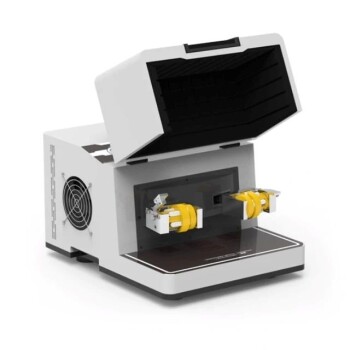
Small Cryogenic Grinder Cryomill Cryogrinder with Liquid Nitrogen for Laboratory Use

Small Cryogenic Grinder Cryomill Cryogrinder with Liquid Nitrogen for Laboratory Use

Our KINTEK Cryomilling is perfect for small runs and R&D trials. With a versatile cryogenic system, it can handle a variety of materials, including plastics, rubber, pharmaceuticals, and food grades. Plus, our specialized hydraulic laboratory crushers ensure accurate results through multiple passes, making it suitable for XRF analysis. Get finely-powdered samples with ease!

Liquid Nitrogen Cryogenic Grinder Mill Cryomill Airflow Ultrafine Pulverizer

Liquid Nitrogen Cryogenic Grinder Mill Cryomill Airflow Ultrafine Pulverizer

Discover the Liquid Nitrogen Cryogenic Grinding Machine, perfect for lab use, ultra-fine pulverization, and preserving material properties. Ideal for pharmaceuticals, cosmetics, and more.

Laboratory Grinding Mill Mortar Grinder for Sample Preparation

Laboratory Grinding Mill Mortar Grinder for Sample Preparation

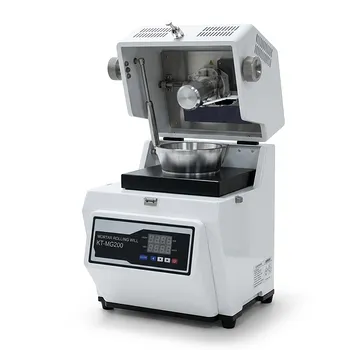
KT-MG200 mortar grinder can be used for mixing and homogenizing powder, suspension, paste and even viscous samples. It can help users realize the ideal operation of sample preparation with more regularization and higher repeatability.

Laboratory High Throughput Tissue Grinding Mill Grinder

Laboratory High Throughput Tissue Grinding Mill Grinder

KT-MT is a high-quality, small, and versatile tissue grinder used for crushing, grinding, mixing, and cell wall breaking in various fields, including food, medical, and environmental protection. It is equipped with 24 or 48 2ml adapters and ball grinding tanks and is widely employed for DNA, RNA, and protein extraction.

Benchtop Laboratory Freeze Dryer for Lab Use

Benchtop Laboratory Freeze Dryer for Lab Use

Premium benchtop laboratory freeze dryer for lyophilization, preserving samples with ≤ -60°C cooling. Ideal for pharmaceuticals & research.

Laboratory Jar Ball Mill with Alumina Zirconia Grinding Jar and Balls

Laboratory Jar Ball Mill with Alumina Zirconia Grinding Jar and Balls

Grind to perfection with alumina/zirconia grinding jars and balls. Available in volume sizes from 50ml to 2500ml, compatible with various mills.

Laboratory Micro Tissue Grinding Mill Grinder

Laboratory Micro Tissue Grinding Mill Grinder

KT-MT10 is a miniature ball mill with a compact structure design. The width and depth are only 15X21 cm, and the total weight is only 8 kg. It can be used with a minimum 0.2ml centrifuge tube or a maximum 15ml ball mill jar.

Laboratory Horizontal Planetary Ball Mill Milling Machine

Laboratory Horizontal Planetary Ball Mill Milling Machine

Improve sample uniformity with our Horizontal Planetary Ball Mills. KT-P400H reduces sample deposition and KT-P400E has multi-directional capabilities. Safe, convenient and efficient with overload protection.

Laboratory Disc Cup Vibratory Mill for Sample Grinding

Laboratory Disc Cup Vibratory Mill for Sample Grinding

The vibrating disc mill is suitable for non-destructive crushing and fine grinding of samples with large particle sizes, and can quickly prepare samples with analytical fineness and purity.

Small Lab Rubber Calendering Machine

Small Lab Rubber Calendering Machine

Small lab rubber calendering machine is used for producing thin, continuous sheets of plastic or rubber materials. It is commonly employed in laboratories, small-scale production facilities, and prototyping environments to create films, coatings, and laminates with precise thickness and surface finish.

Electric Split Lab Cold Isostatic Press CIP Machine for Cold Isostatic Pressing

Electric Split Lab Cold Isostatic Press CIP Machine for Cold Isostatic Pressing

Split cold isostatic presses are capable of providing higher pressures, making them suitable for testing applications that require high pressure levels.

Single Punch Electric Tablet Press Machine TDP Tablet Punching Machine

Single Punch Electric Tablet Press Machine TDP Tablet Punching Machine

The electric tablet punching machine is a laboratory equipment designed for pressing various granular and powdery raw materials into discs and other geometric shapes. It is commonly used in pharmaceutical, healthcare products, food, and other industries for small batch production and processing. The machine is compact, lightweight, and easy to operate, making it suitable for use in clinics, schools, laboratories, and research units.

Laboratory Vibratory Sieve Shaker Machine for Dry and Wet Three-Dimensional Sieving

Laboratory Vibratory Sieve Shaker Machine for Dry and Wet Three-Dimensional Sieving

KT-VD200 can be used for sieving tasks of dry and wet samples in the laboratory. The screening quality is 20g-3kg. The product is designed with a unique mechanical structure and an electromagnetic vibrating body with a vibration frequency of 3000 times per minute.

Custom PTFE Teflon Parts Manufacturer for PTFE Mesh F4 Sieve

Custom PTFE Teflon Parts Manufacturer for PTFE Mesh F4 Sieve

PTFE mesh sieve is a specialized test sieve designed for particle analysis in various industries, featuring a non-metallic mesh woven from PTFE filament. This synthetic mesh is ideal for applications where metal contamination is a concern . PTFE sieves are crucial for maintaining the integrity of samples in sensitive environments, ensuring accurate and reliable results in particle size distribution analysis.

Small Injection Molding Machine for Lab Use

Small Injection Molding Machine for Lab Use

The small injection molding machinehas fast and stable movements; good controllability and repeatability, super energy saving; the product can be automatically dropped and formed; the machine body is low, convenient for feeding, easy to maintain, and no height restrictions on the installation site.

Laboratory Sterilizer Lab Autoclave Herbal Powder Sterilization Machine for Plant

Laboratory Sterilizer Lab Autoclave Herbal Powder Sterilization Machine for Plant

The herbal powder sterilization autoclave machine for Chinese medicine uses saturated steam for effective sterilization. It utilizes the heat and penetrative properties of steam, achieves sterilization after heat preservation, and maintains a good drying effect with a dedicated drying system.

Laboratory Vibratory Sieve Shaker Machine Slap Vibrating Sieve

Laboratory Vibratory Sieve Shaker Machine Slap Vibrating Sieve

KT-T200TAP is a slapping and oscillating sieving instrument for laboratory desktop use, with 300 rpm horizontal circular motion and 300 vertical slapping motions to simulate manual sieving to help sample particles pass through better.

Laboratory Test Sieves and Vibratory Sieve Shaker Machine

Laboratory Test Sieves and Vibratory Sieve Shaker Machine

Efficiently process powders, granules, and small blocks with a high-frequency vibration sieve. Control vibration frequency, screen continuously or intermittently, and achieve accurate particle size determination, separation, and classification.

Lab Plastic PVC Calender Stretch Film Casting Machine for Film Testing

Lab Plastic PVC Calender Stretch Film Casting Machine for Film Testing

The cast film machine is designed for the molding of polymer cast film products and has multiple processing functions such as casting, extrusion, stretching, and compounding.

Vacuum Hot Press Furnace Machine for Lamination and Heating

Vacuum Hot Press Furnace Machine for Lamination and Heating

Experience clean and precise lamination with Vacuum Lamination Press. Perfect for wafer bonding, thin-film transformations, and LCP lamination. Order now!


Leave Your Message