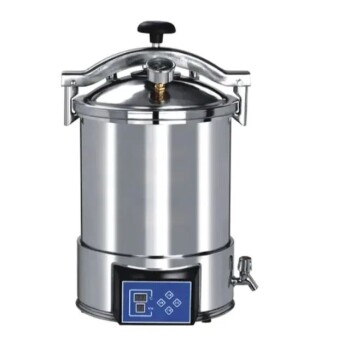
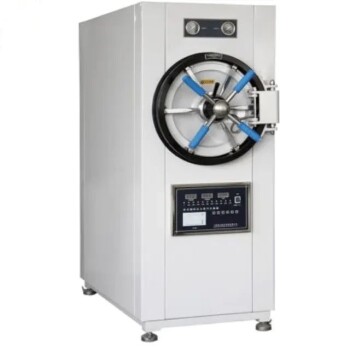
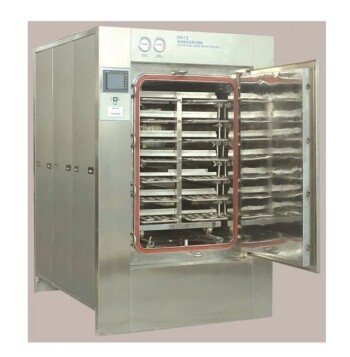
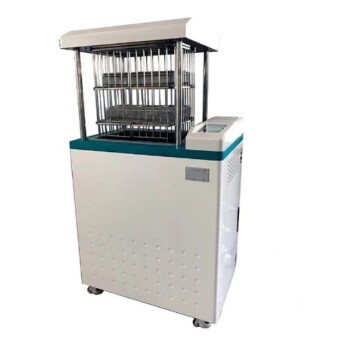
A specialized industrial-grade stainless steel high-pressure autoclave is required to create a contained, self-pressurizing environment. This vessel enables the synthesis of NbC/C nanocomposites at significantly lower temperatures (approximately 800°C) compared to the 1000°C+ required by traditional methods. The device traps gaseous by-products (CO and CO2) to generate intense internal pressure, which acts as the critical thermodynamic driver to convert niobium oxides into single-phase niobium carbide.
By substituting extreme thermal energy with high internal pressure, the autoclave lowers the activation barrier for synthesis. This allows for energy-efficient production while ensuring high crystallinity and phase purity that open-system methods cannot achieve at similar temperatures.
The Role of Pressure in Carbothermal Reduction
Overcoming Thermodynamic Barriers
In traditional carbothermal reduction, extremely high temperatures (often exceeding 1000°C) are required to force the chemical conversion of niobium oxides.
The specialized autoclave changes the thermodynamic landscape. By conducting the reaction in a closed system, the high pressure compensates for the lower thermal energy. This allows the formation of single-phase niobium carbide to proceed efficiently at only 800°C.
The Self-Pressurizing Mechanism
The autoclave does not necessarily require an external gas compressor to achieve high pressure. Instead, it utilizes the reaction's own by-products.
During the reduction process, gases like Carbon Monoxide (CO) and Carbon Dioxide (CO2) are released. In an open furnace, these would dissipate. The autoclave traps these gases, causing the internal pressure to rise drastically, which drives the reaction kinetics forward.
Enhancing Crystallinity
The high-pressure environment does more than just lower the synthesis temperature; it improves the quality of the material.
Elevated pressures facilitate heterogeneous growth, often resulting in higher crystallinity and a more uniform distribution of the nanocomposites. This structural integrity is vital for the material's final performance characteristics.
Why "Specialized Industrial-Grade" is Non-Negotiable
Structural Integrity at 800°C
Standard laboratory vessels cannot withstand the combination of high internal pressure and temperatures near 800°C.
At these temperatures, the yield strength of many metals decreases significantly. A "specialized" industrial-grade stainless steel body is engineered to maintain its structural integrity and prevent catastrophic rupture under these simultaneous thermal and baric stresses.
The Limitation of Standard Liners
It is critical to distinguish this process from low-temperature hydrothermal synthesis (often performed at 180°C).
While lower-temperature processes often use Teflon liners to resist corrosion, Teflon cannot be used here, as it melts well below 800°C. The stainless steel vessel itself, or a specialized high-temperature liner/crucible, must withstand the reducing atmosphere directly.
Understanding the Trade-offs
Safety and Equipment Cost
Operating at 800°C under high pressure creates a significant safety hazard. The equipment must be rated for these specific conditions, making it considerably more expensive than standard tube furnaces or low-pressure hydrothermal autoclaves.
Process Visibility
Unlike open-air methods, the closed nature of an autoclave prevents real-time monitoring of the reaction.
You cannot easily adjust parameters mid-synthesis. This requires precise calculation of precursor ratios and anticipated pressures before sealing the vessel to ensure the reaction stays within safe and effective limits.
Making the Right Choice for Your Goal
To determine if this synthesis route aligns with your project requirements, consider the following:
- If your primary focus is Energy Efficiency: This method is superior, as it reduces the required synthesis temperature by roughly 200°C compared to conventional techniques.
- If your primary focus is Phase Purity: The high-pressure environment is highly effective at driving the reaction to completion, ensuring single-phase niobium carbide without unreacted oxides.
- If your primary focus is Equipment Simplicity: Be aware that this method requires rated pressure vessels and strict safety protocols, which adds operational complexity compared to atmospheric heating.
The autoclave is not merely a container; it is an active thermodynamic tool that leverages pressure to redefine the efficiency limits of nanomaterial synthesis.
Summary Table:
| Feature | Traditional Carbothermal Reduction | Autoclave-Assisted Synthesis |
|---|---|---|
| Temperature Required | > 1000°C | ~ 800°C |
| Pressure Source | Atmospheric (Open System) | Self-Pressurizing (Closed System) |
| Key Driver | Extreme Thermal Energy | High Internal Gas Pressure (CO/CO2) |
| Material Quality | Variable Purity | High Crystallinity & Phase Purity |
| Liner Requirement | Open Crucible | Specialized High-Temp Stainless Steel |
Elevate Your Nanomaterial Synthesis with KINTEK
Precision and safety are paramount when conducting high-pressure carbothermal reductions. KINTEK specializes in advanced laboratory solutions, providing the industrial-grade high-temperature high-pressure reactors and autoclaves required to maintain structural integrity at 800°C.
Whether you are developing NbC/C nanocomposites or advancing battery research, our comprehensive portfolio—including crushing and milling systems, ceramic crucibles, and cooling solutions—is designed to meet the rigorous demands of modern material science.
Ready to optimize your lab’s energy efficiency and phase purity? Contact our technical experts today to find the perfect high-pressure solution for your research goals.
References
- Aayush Gupta, O.P. Pandey. Low temperature synthesis of NbC/C nano-composites as visible light photoactive catalyst. DOI: 10.1038/s41598-018-31989-z
This article is also based on technical information from Kintek Solution Knowledge Base .
Related Products
- Stainless High Pressure Autoclave Reactor Laboratory Pressure Reactor
- Mini SS High Pressure Autoclave Reactor for Laboratory Use
- Customizable High Pressure Reactors for Advanced Scientific and Industrial Applications
- Desktop Fast High Pressure Laboratory Autoclave Sterilizer 16L 24L for Lab Use
- Laboratory High Pressure Horizontal Autoclave Steam Sterilizer for Lab Use
People Also Ask
- Why is a laboratory high-pressure reactor used in the hydrothermal synthesis of hydroxyapatite catalysts?
- Why is a laboratory high-pressure reactor necessary for synthesizing fly ash-based zeolite? Achieve Pure Crystallization
- What role does a laboratory high-pressure reactor play in the leaching process of spent cathode materials? Optimize Recovery
- What conditions do laboratory high-pressure reactors provide for HTC? Optimize Your Biochar Production Processes
- How are high-pressure reactors used to prepare metaphosphate electrocatalysts? Master In-Situ Precursor Growth