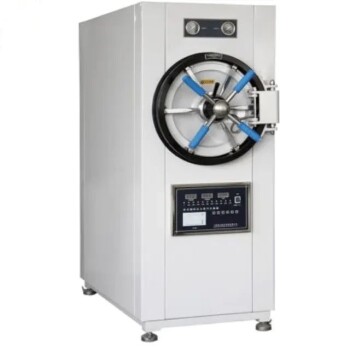
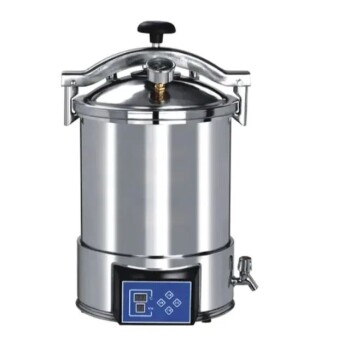
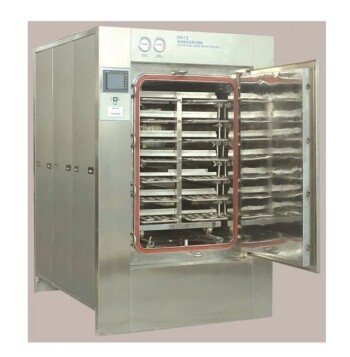
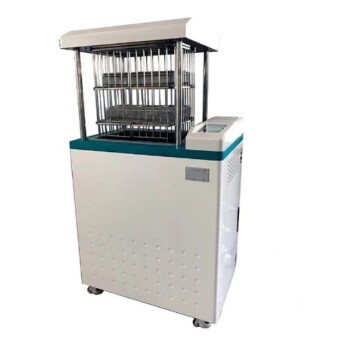
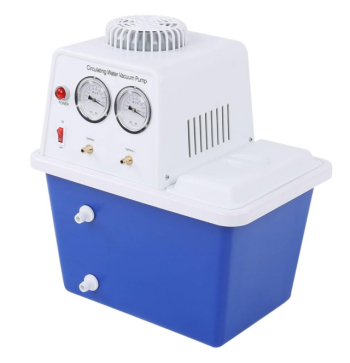
The autoclave is essential to the Klason method because it provides the precise high-temperature (121°C) and high-pressure environment required for the secondary hydrolysis of wood samples. This controlled thermal processing ensures that cellulose and hemicellulose are completely broken down into soluble sugars, allowing the insoluble Klason lignin to be isolated and weighed with high quantitative accuracy.
The autoclave serves as a high-efficiency reactor that overcomes the chemical recalcitrance of the lignocellulosic matrix. By maintaining a stable, pressurized steam environment, it ensures the complete removal of carbohydrates, which is the "make or break" step for obtaining pure lignin data.
The Mechanism of Accelerated Hydrolysis
Breaking the Lignocellulosic Bond
Wood is a complex matrix where lignin is tightly interwoven with cellulose and hemicellulose. The autoclave uses saturated steam to reach temperatures well above the boiling point of water, providing the energy necessary to disrupt these robust chemical bonds.
Achieving Complete Solubilization
While initial acid treatment begins the breakdown, the autoclave phase—often referred to as secondary hydrolysis—is what finishes the job. It ensures that all non-lignin polysaccharides are converted into monomeric sugars that can be easily filtered away.
Isolating the Insoluble Fraction
Without the intense conditions provided by an autoclave, residual carbohydrates would remain bound to the lignin. This would result in an overestimation of lignin content, as the "lignin" being weighed would actually contain significant carbohydrate contamination.
Precision Through Controlled Environments
The Significance of 121°C
The Klason method relies on a specific temperature of 121°C to drive the dilute sulfuric acid reaction. This temperature is the industry standard because it is high enough to ensure reaction completion without being so high that it causes excessive degradation of the lignin itself.
Pressure as a Catalyst
The elevated pressure inside the autoclave prevents the acid solution from boiling off, maintaining a constant concentration throughout the reaction. This stability is vital for reproducibility across different laboratory samples and batches.
Standardizing the Analytical Window
Using an autoclave allows researchers to set a rigorous, repeatable timeframe for the reaction. This standardization is what makes the Klason method the "gold standard" for comparative wood chemistry studies worldwide.
Understanding the Trade-offs and Limitations
The Risk of Pseudo-Lignin Formation
If the autoclave cycle is too long or the temperature is poorly regulated, carbohydrates can undergo dehydration to form pseudo-lignin. These degradation products are insoluble and will falsely increase the measured lignin weight.
Material Degradation Hazards
The combination of high pressure and dilute sulfuric acid is highly corrosive to laboratory equipment. Frequent maintenance of the autoclave is required to ensure that acid vapors do not damage the internal seals or heating elements over time.
Safety and Sample Handling
Operating at 121°C under pressure introduces significant safety risks, including the potential for steam burns or vessel failure. Precise adherence to venting protocols is necessary to prevent sample loss due to "bumping" or rapid pressure changes.
Applying This Knowledge to Your Analysis
To achieve the most accurate results in your lignin quantification, you must treat the autoclave phase as a precision chemical reaction rather than just a heating step.
- If your primary focus is high-accuracy research: Ensure your autoclave is calibrated specifically for the 121°C setpoint and that samples are distributed evenly to prevent "cold spots."
- If your primary focus is process efficiency: Group samples of similar wood species together to ensure the hydrolysis duration is optimized for the specific density of the material.
- If your primary focus is equipment longevity: Use secondary containment or acid-resistant trays to protect the autoclave chamber from potential spills or corrosive vapors.
By mastering the high-pressure environment of the autoclave, you ensure the integrity and reproducibility of your quantitative lignin analysis.
Summary Table:
| Parameter | Role in Klason Method | Impact on Analytical Accuracy |
|---|---|---|
| Temperature (121°C) | Drives secondary hydrolysis | Ensures complete breakdown of non-lignin polysaccharides |
| High Pressure | Maintains constant acid concentration | Prevents boiling and ensures reproducible chemical reactions |
| Saturated Steam | Provides high-energy thermal environment | Overcomes the recalcitrance of the lignocellulosic matrix |
| Standardization | Sets a rigorous reaction timeframe | Eliminates variability for global comparative wood studies |
Elevate Your Analytical Precision with KINTEK
Ensure the integrity of your biomass research with KINTEK’s high-performance laboratory solutions. We understand that the Klason method demands absolute control over temperature and pressure to prevent pseudo-lignin formation and ensure pure results.
KINTEK specializes in laboratory equipment and consumables, offering a comprehensive range of high-temperature high-pressure reactors and autoclaves designed to withstand corrosive environments and deliver consistent thermal processing. Our portfolio also features essential tools for material preparation, including crushing and milling systems, ceramic crucibles, and high-temperature furnaces.
Don't let equipment variability compromise your quantitative data. Contact us today to learn how our specialized autoclaves and laboratory systems can optimize your workflow and deliver the reliability your research deserves!
References
- Youngho Jeon, Jungmok You. Multiscale Porous Carbon Materials by In Situ Growth of Metal–Organic Framework in the Micro-Channel of Delignified Wood for High-Performance Water Purification. DOI: 10.3390/nano13192695
This article is also based on technical information from Kintek Solution Knowledge Base .
Related Products
- Portable High Pressure Laboratory Autoclave Steam Sterilizer for Lab Use
- Laboratory Horizontal Autoclave Steam Sterilizer Lab Microcomputer Sterilizer
- Desktop Fast High Pressure Laboratory Autoclave Sterilizer 16L 24L for Lab Use
- Portable Digital Display Automatic Laboratory Sterilizer Lab Autoclave for Sterilization Pressure
- Desktop Fast Laboratory Autoclave Sterilizer 35L 50L 90L for Lab Use
People Also Ask
- Why is a laboratory high-pressure autoclave sterilizer necessary? Ensure Accuracy in Antibacterial Research
- What is the role of a laboratory high-pressure autoclave in the conversion of furfural to piperidine? Optimize Yields
- What are the two types of autoclave used in the laboratory? Gravity vs. Pre-Vacuum Explained
- What precautions should be taken during autoclave in laboratory? A Complete Safety Guide to Prevent Burns and Explosions
- What extreme conditions does a laboratory autoclave simulate? Testing Wear Resistance of Nuclear Fuel Cladding