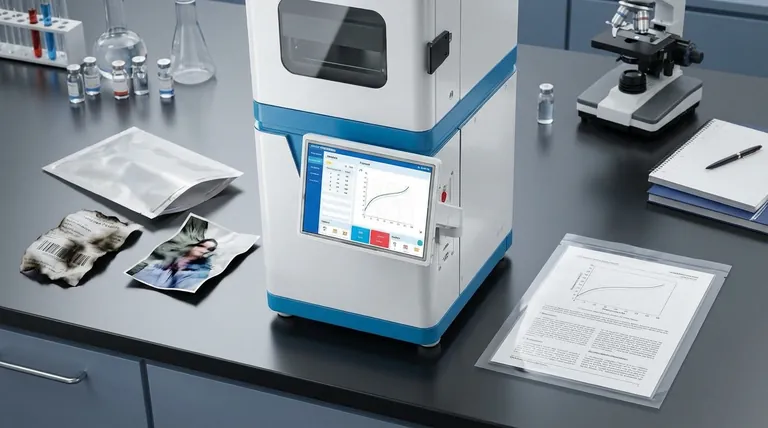
It’s a scenario that plays out in labs far too often. You have a critical piece of information—a thermal printout from an instrument, a signed compliance form, or a unique sample photo. To protect it from spills and wear, you decide to laminate it. You carefully place it in the pouch, feed it into the machine, and wait.
But what comes out the other side is a disaster. The thermal print is now a blackened, illegible smear. The ink on the photograph has bled. Your irreplaceable document is permanently ruined. That feeling of dread is immediate: the data is lost, the record is destroyed, and you’re back to square one.
The Vicious Cycle of Guesswork and Failure
If this has happened to you, you’re not alone. It’s a common and deeply frustrating problem. The typical reaction is to blame the tools.
- "Is the laminator too hot?" you might wonder, fiddling with the temperature settings.
- "Are these cheap pouches?" you might ask, questioning your supplies.
- "Maybe I just need to run it through faster," you might guess, trying the same process again and hoping for a different outcome.
These attempts almost always end in the same failure. The business consequences are more than just a minor annoyance. Destroying a critical document can mean:
- Permanent Data Loss: Irreplaceable readings from analytical instruments are gone forever.
- Compliance Risks: Ruined chain-of-custody forms or signed SOPs can lead to failed audits.
- Wasted Resources: Time and money are spent rerunning tests, reprinting documents, and repeating the failed lamination process.
- Reduced Protection: Out of fear, some labs stop laminating altogether, leaving vital documents vulnerable to the exact damage they were trying to prevent.
The problem persists because these "solutions" are just shots in the dark. They fail to address the real, underlying reason for the failure.
The Real Culprit: It's Not the Machine, It's the Method
The turning point comes when you realize the problem isn't a faulty machine or a bad batch of supplies. The problem is a fundamental mismatch between your document and the lamination method you're using.
There are two distinct ways to laminate, and they operate on completely different principles.
How Hot Lamination Works
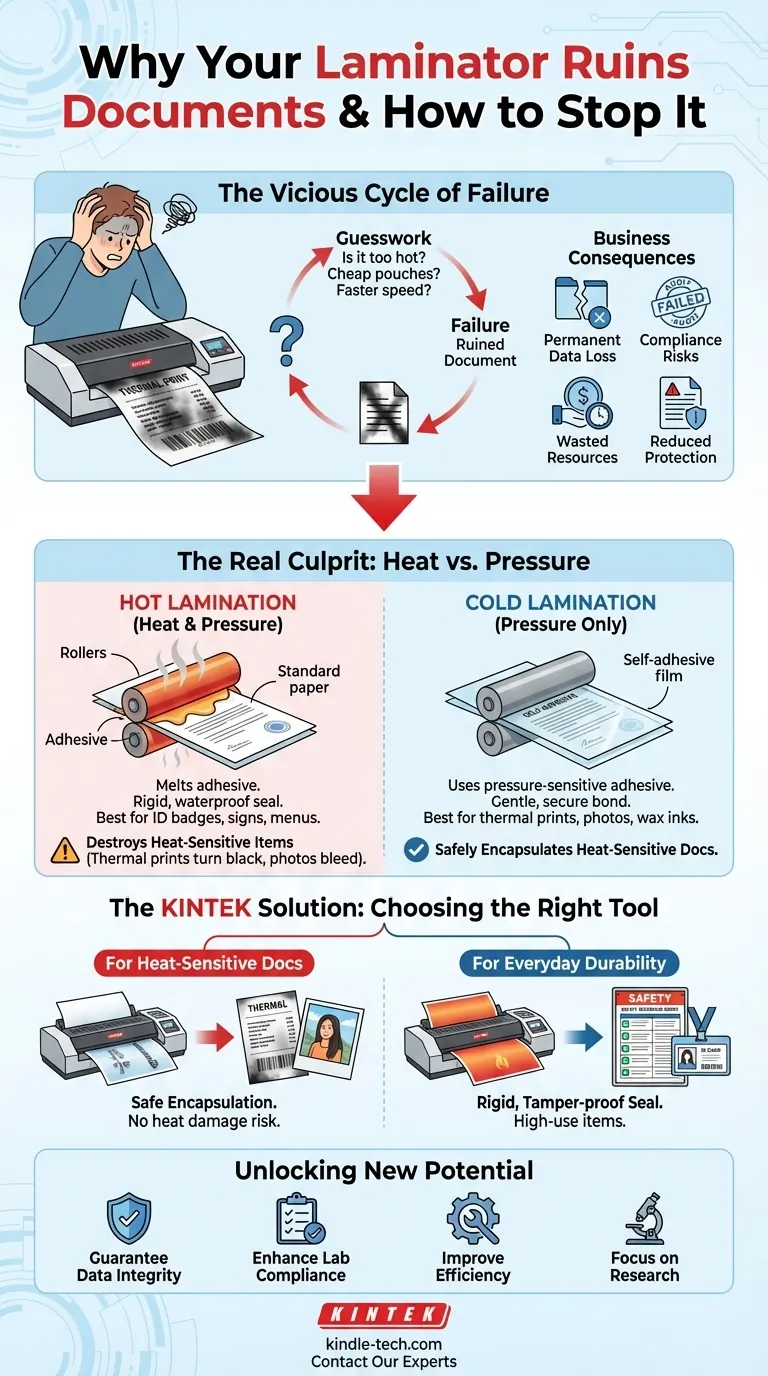
Think of this as the industry standard for durability. A hot laminator uses heated rollers—often reaching over 200°F / 95°C—to melt a special, heat-activated adhesive inside the plastic pouch. This process is like ironing on a patch; the heat and pressure create a rigid, permanent, and completely waterproof seal. It’s perfect for standard paper documents like ID badges, signs, and menus.
How Cold Lamination Works
This is the gentle alternative. A cold laminator uses no heat at all. Instead, it relies on a pressure-sensitive adhesive, much like an industrial-strength sticker. The machine uses unheated rollers to apply firm, even pressure, bonding the self-adhesive film to your document smoothly and securely.
This single difference—heat vs. pressure—is the root of every lamination disaster.
When you feed a heat-sensitive item into a hot laminator, you are essentially cooking it. Thermal paper (like receipts or instrument printouts) is designed to turn black when exposed to heat. Certain photo papers and inks will bleed and warp under high temperatures. You could have the most expensive hot laminator in the world, but it will still destroy a thermal printout, because it's using the wrong scientific principle for the job.
From Guesswork to Guarantee: Choosing the Right Tool
To truly solve this problem, you don't need to "tweak" a broken process; you need to choose the correct process from the start. The solution is simple:
- For maximum durability on standard paper, you need heat and pressure.
- For protecting anything heat-sensitive, you need pressure only.
This is where having the right equipment, guided by real expertise, becomes critical. At KINTEK, we don't just sell laminators; we provide the clarity to ensure you get the perfect result every time. Our product line is designed based on a deep understanding of these challenges.
-
For Heat-Sensitive Documents: Our cold lamination systems are the purpose-built solution. They use pressure-sensitive films to safely encapsulate thermal prints, valuable photographs, and documents with wax-based inks without any risk of heat damage. It’s not a workaround; it’s the correct tool for the job.
-
For Everyday Durability: Our hot lamination systems are engineered for reliability and strength. They provide the rigid, tamper-proof, and cost-effective seal you need for high-use items like safety procedures, ID cards, and instructional charts, ensuring they withstand the demanding lab environment.
By equipping your lab with both capabilities, you move from a world of risky guesswork to one of guaranteed protection for every document.
Beyond Preservation: Unlocking New Potential in Your Lab
When you no longer have to worry about destroying important documents, you unlock a new level of efficiency and professionalism. With the right lamination strategy in place, you can:
- Guarantee Data Integrity: Confidently preserve every instrument reading for long-term storage and audits, knowing it's safe and legible.
- Enhance Lab Compliance: Create durable, waterproof, and chemical-resistant SOPs, safety warnings, and equipment logs that remain pristine for years.
- Improve Operational Efficiency: Stop wasting time and resources on reprinting and re-laminating. Protect your documents correctly the first time.
- Focus on What Matters: Free your team to concentrate on their research, not on administrative headaches caused by damaged paperwork.
Solving this common lamination problem isn't just about protecting paper; it's about safeguarding your data, streamlining your compliance, and professionalizing your lab's operations. Your lab's documentation needs are unique, and ensuring their integrity is non-negotiable. Let our team help you build a comprehensive strategy to protect your most critical assets. Contact Our Experts.
Visual Guide
Related Products
- Vacuum Hot Press Furnace Machine for Lamination and Heating
- Electric Heated Hydraulic Vacuum Heat Press for Lab
- Touchscreen Automatic Vacuum Heat Press
- Warm Isostatic Press for Solid State Battery Research
- Lab Plastic PVC Calender Stretch Film Casting Machine for Film Testing
Related Articles
- Forging Perfection in a Void: The Physics of Ultra-Dense Materials
- Vacuum Hot Press Furnace: A Comprehensive Guide
- Comprehensive Guide to Vacuum Hot Press Furnace Application
- The Purity Paradox: Choosing the Heart of Your Vacuum Hot Press Furnace
- The Physics of Perfection: How Vacuum Hot Presses Overcome the Invisible Barriers in Material Science