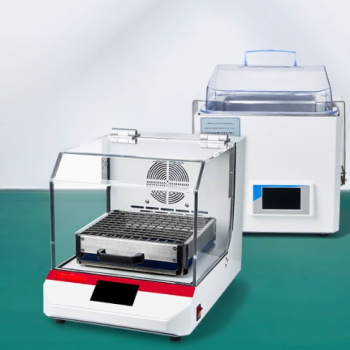
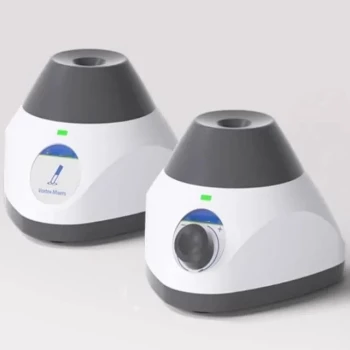
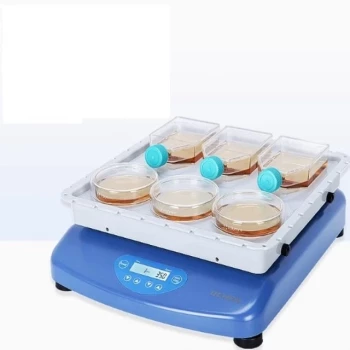
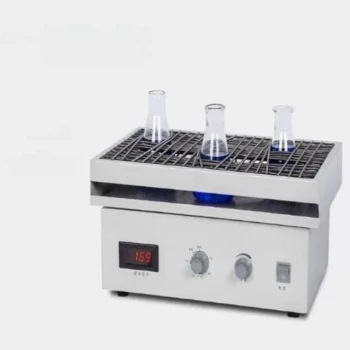
Baffled flasks and orbital shaker incubators work in tandem to optimize oxygen availability for cell growth. By generating turbulence and maintaining continuous fluid motion, this setup significantly enhances the oxygen mass transfer efficiency at the gas-liquid interface. This ensures that oleaginous yeast strains receive the high levels of dissolved oxygen required to accurately reveal their lipid production capabilities during the screening process.
The combination of baffled flasks and orbital shakers simulates a high-dissolved-oxygen environment at the micro-scale. This is critical for preventing oxygen limitations that could otherwise mask the true metabolic potential of yeast strains during lipid production screening.
The Mechanics of Enhanced Oxygenation
The Function of Baffled Flasks
Standard flasks often allow liquid to swirl smoothly, limiting the surface area exposed to air. Baffled flasks interrupt this laminar flow.
The indentations (baffles) on the sides of the flask physically disrupt the liquid as it rotates. This disruption creates turbulence within the medium.
The Role of the Orbital Shaker
While the flask provides the physical barriers, the orbital shaker provides the kinetic energy.
Continuous rotation forces the liquid against the baffles. This dynamic motion ensures the turbulence is constant and uniform throughout the screening period.
Maximizing Mass Transfer
The primary goal of this mechanical combination is to improve oxygen mass transfer efficiency.
Turbulence increases the surface area of the liquid in contact with the air. This facilitates a faster and more efficient exchange of oxygen from the headspace into the liquid medium.
Why This Matters for Oleaginous Yeast
Simulating High-Performance Environments
Screening at the shake-flask level is intended to predict how a strain will perform in a larger bioreactor.
By using baffled flasks and shakers, you simulate a high-dissolved-oxygen environment. This mimics the aeration conditions found in industrial fermentation, providing a more realistic predictive model.
Removing Metabolic Bottlenecks
Oleaginous yeast requires significant oxygen to drive the metabolic pathways responsible for lipid accumulation.
If oxygen is limited, the yeast may survive but fail to produce lipids efficiently. This setup ensures that oxygen availability does not become the limiting factor in the experiment.
Ensuring Accurate Data
The ultimate goal of screening is to evaluate the genetic potential of the strain.
High oxygen transfer ensures that the observed lipid production reflects the yeast's true capability, rather than an artifact of poor culture conditions.
Understanding the Trade-offs
The Risk of Shear Stress
While turbulence is necessary for oxygenation, it introduces physical stress to the cells.
The collision of liquid against baffles creates shear forces. While oleaginous yeasts are generally robust, excessive turbulence can potentially damage more fragile cell structures depending on the specific strain.
Consistency vs. Reality
This setup significantly improves screening accuracy compared to standard flasks. However, it is still an approximation of a bioreactor.
While it mimics high dissolved oxygen, it does not perfectly replicate the mixing dynamics or pH control of a fully instrumented fermentation vessel.
Making the Right Choice for Your Goal
To ensure your screening data is actionable, consider the specific requirements of your experiment.
- If your primary focus is determining maximum lipid potential: Use baffled flasks with high orbital rotation to eliminate oxygen starvation as a variable.
- If your primary focus is maintenance of fragile cultures: Consider standard smooth-walled flasks to reduce shear stress, accepting lower oxygen transfer rates.
By prioritizing oxygen mass transfer through turbulence, you ensure that your screening results accurately reflect the biological potential of your yeast strains.
Summary Table:
| Feature | Mechanism | Benefit for Yeast Screening |
|---|---|---|
| Baffled Flasks | Physical indentations disrupt laminar flow | Creates turbulence and increases liquid surface area |
| Orbital Shakers | Constant kinetic energy / rotation | Ensures uniform, continuous oxygen mass transfer |
| Turbulence | High gas-liquid interface interaction | Prevents oxygen limitations that mask metabolic potential |
| High Dissolved O2 | Simulates industrial bioreactor conditions | Provides realistic predictive data for lipid accumulation |
Maximize Your Research Potential with KINTEK
Are you looking to scale your bioprocessing or optimize laboratory screening? KINTEK specializes in providing high-performance laboratory equipment designed to remove metabolic bottlenecks. From precision orbital shakers and incubators to a comprehensive range of crushing and milling systems, homogenizers, and high-temperature autoclaves, we offer the tools needed to reveal the true biological potential of your strains.
Whether you are working on battery research, dental applications, or lipid production, our expert team is here to support your workflow with high-quality consumables like PTFE products and ceramics.
Ready to enhance your lab's efficiency and data accuracy? Contact KINTEK today to find the perfect solution for your specific research goals!
References
- Afonso Fontes, Teresa Lopes da Silva. Monitoring Yeast Cultures Grown on Corn Stover Hydrolysate for Lipid Production. DOI: 10.3390/pr12030558
This article is also based on technical information from Kintek Solution Knowledge Base .
Related Products
- Shaking Incubators for Diverse Laboratory Applications
- Laboratory Vortex Mixer Orbital Shaker Multifunctional Rotation Oscillation Mixer
- Laboratory Oscillating Orbital Shaker
- Laboratory Multifunctional Small Speed-Adjustable Horizontal Mechanical Shaker for Lab
- Laboratory Test Sieves and Vibratory Sieve Shaker Machine
People Also Ask
- What physical conditions does a shaking incubator provide for bioethanol fermentation? Optimize Yeast Productivity
- Why is the mechanical agitation provided by a shaking incubator necessary for the enzymatic hydrolysis of biomass?
- What critical reaction conditions does a shaking incubator provide? Optimize Cassava Cellulose Enzymatic Hydrolysis
- What are the primary functions of a shaking incubator? Optimize Biomass Fenton Pretreatment Efficiency
- What function does a laboratory shaking incubator serve for halophilic archaea? Optimize Your Seed Cultivation Today