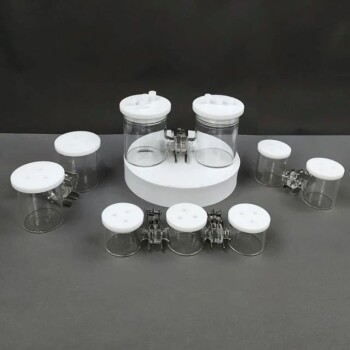
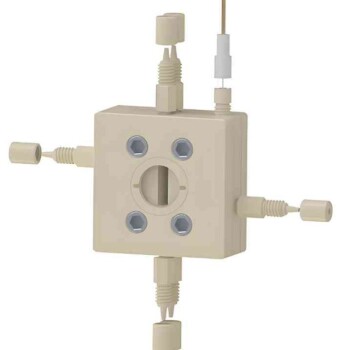
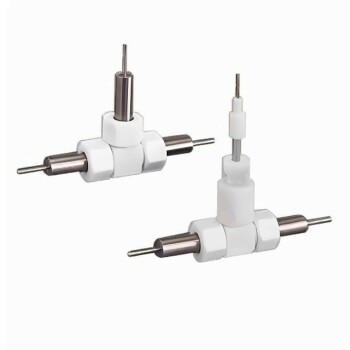
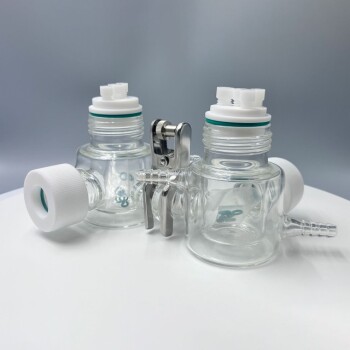
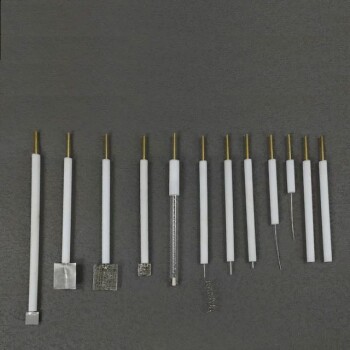
A three-electrode electrochemical cell system facilitates the study of redox stability by physically isolating the current path from the voltage measurement path. This configuration allows for the precise simulation of highly oxidizing, acidic environments while eliminating measurement errors caused by solution resistance, ensuring that observed corrosion rates reflect the true material properties of Magnéli phase titanium oxide.
By decoupling the reference measurement from the current flow, this system provides the accuracy required to validate Magnéli phase titanium oxide as a durable carrier for noble metal catalysts. It enables the detection of passivation behavior and equilibrium potentials without the interference of polarization errors.
Precision Through Isolation: How the System Works
The Three-Electrode Configuration
To study redox stability accurately, the system divides the circuit into three distinct components: the working electrode (the Magnéli phase titanium oxide sample), the reference electrode (typically Ag/AgCl), and the auxiliary electrode (often a graphite rod).
Eliminating Measurement Errors
In a two-electrode system, high currents can cause significant voltage drops due to solution resistance. The three-electrode design prevents this by ensuring the applied current flows primarily between the working and auxiliary electrodes.
Pure Potential Measurement
Simultaneously, the potential is measured exclusively between the working and reference electrodes. Because negligible current flows through the reference loop, the measurement remains unaffected by polarization or solution resistance, providing a pure data point for analysis.
Simulating Operational Reality
Recreating Oxidizing Conditions
Magnéli phase titanium oxide is often intended for use in extreme environments. When paired with an electrochemical workstation, this cell setup effectively simulates highly oxidizing conditions, such as those found in strong acidic solutions.
Testing Catalyst Carrier Viability
The primary "Deep Need" for this testing is to verify the material's feasibility as a carrier for noble metal catalysts. The system allows researchers to observe how the oxide behaves under the specific electrical and chemical stresses it would face in a real-world fuel cell or electrolyzer.
Diagnostic Techniques and Metrics
Cyclic Voltammetry (CV) and Potentiodynamic Scanning
The three-electrode setup facilitates advanced techniques like Cyclic Voltammetry (CV) and potentiodynamic scanning. These methods sweep the voltage across a specific range to identify exactly when and how the material begins to react or degrade.
Assessing Corrosion and Passivation
Through these scans, researchers can quantify the electrochemical corrosion rate and identify the material's equilibrium potential. Crucially, this setup helps detect passivation behavior at high potentials, revealing whether the material forms a stable protective layer or continues to degrade.
Understanding the Limitations
Idealized vs. Real-World Conditions
While the three-electrode cell is excellent for determining fundamental electrochemical stability, it represents a static, idealized environment. It does not account for physical factors such as fluid flow, mechanical abrasion, or temperature fluctuations that may occur in an industrial reactor.
Reference Electrode Drift
In extremely acidic or aggressive electrolytes, the reference electrode itself (e.g., Ag/AgCl) can degrade or drift over time. If not calibrated frequently, this drift can be misinterpreted as a change in the redox stability of the Magnéli phase titanium oxide sample.
Making the Right Choice for Your Research
To effectively utilize a three-electrode system for Magnéli phase titanium oxide, tailor your approach to your specific end-goal:
- If your primary focus is fundamental material science: Prioritize potentiodynamic scanning to map the exact equilibrium potential and identify the onset of passivation layers.
- If your primary focus is application feasibility: Focus on long-term Cyclic Voltammetry to simulate repeated stress cycles, measuring the drift in corrosion rate over time to predict catalyst support lifespan.
The reliability of your stability data depends entirely on the system's ability to maintain potential accuracy, making the three-electrode configuration the definitive standard for characterizing these advanced materials.
Summary Table:
| Feature | Function in Redox Stability Study | Benefit for Magnéli Phase Analysis |
|---|---|---|
| Working Electrode | The Magnéli phase sample being tested | Direct measurement of material-specific corrosion |
| Reference Electrode | Provides a stable potential reference | Eliminates voltage drop errors for pure data |
| Auxiliary Electrode | Completes the circuit for current flow | Prevents polarization interference at the reference |
| CV & Scanning | Sweeps voltage across a specific range | Identifies passivation points and equilibrium potential |
Elevate Your Electrochemical Research with KINTEK
Precision in material science starts with the right environment. KINTEK specializes in high-performance laboratory equipment, providing the advanced electrolytic cells, electrodes, and electrochemical workstations necessary to characterize materials like Magnéli phase titanium oxide with absolute accuracy.
Whether you are developing next-generation catalysts or exploring battery research, our comprehensive portfolio—from high-temperature reactors and muffle furnaces to precision crushing systems and PTFE consumables—is designed to meet the rigorous demands of modern laboratories.
Ready to validate your material's durability? Contact us today to find the perfect solution for your lab!
References
- Aditya Farhan Arif, Kikuo Okuyama. Highly conductive nano-sized Magnéli phases titanium oxide (TiOx). DOI: 10.1038/s41598-017-03509-y
This article is also based on technical information from Kintek Solution Knowledge Base .
Related Products
- PTFE Electrolytic Cell Electrochemical Cell Corrosion-Resistant Sealed and Non-Sealed
- H Type Electrolytic Cell Triple Electrochemical Cell
- Customizable PEM Electrolysis Cells for Diverse Research Applications
- Electrolytic Electrochemical Cell for Coating Evaluation
- Quartz Electrolytic Electrochemical Cell for Electrochemical Experiments
People Also Ask
- What is the necessity of selecting a PTFE electrolytic cell? Ensure Precise Graphene Corrosion Testing Accuracy
- What is the proper method for cleaning the surface of an all-PTFE electrolytic cell? Ensure Accurate Results with a Pristine Surface
- How should an all-PTFE electrolytic cell be stored after use? Expert Maintenance Tips for Long-Lasting Performance
- What is the proper cleaning method for an all-PTFE electrolytic cell? Essential Tips for Surface Integrity
- What are the standard opening specifications for all-PTFE electrolytic cells? A Guide to Sealed vs. Non-Sealed Ports