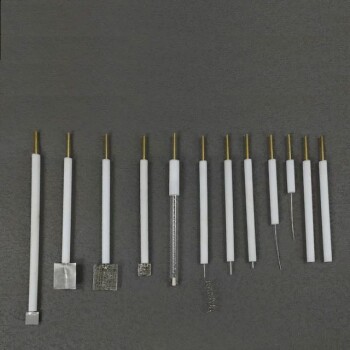
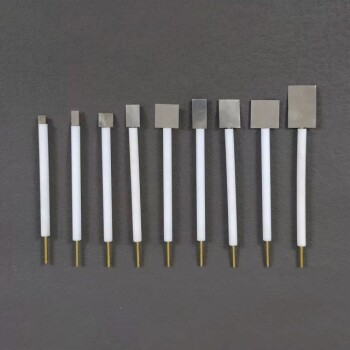
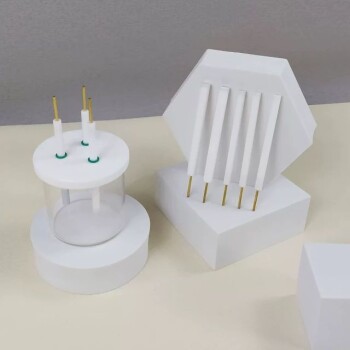
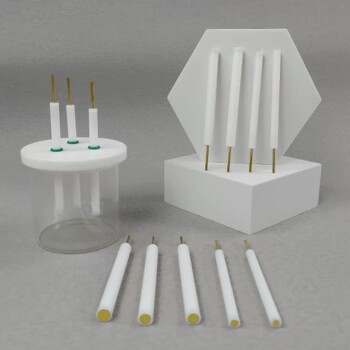
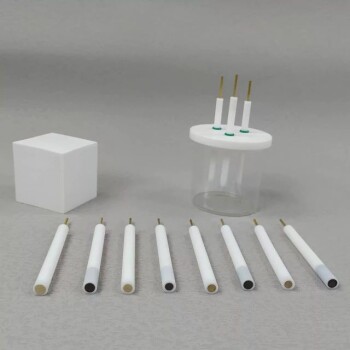
The platinum electrode serves as the counter (or auxiliary) electrode in an electrochemical three-electrode system used to evaluate nickel coatings. Its primary function is to complete the electrical circuit with the nickel sample (the working electrode), facilitating the flow of current required for testing without participating in the reaction itself.
Core Takeaway The reliability of corrosion data depends on the stability of the measurement system. Platinum is utilized because its electrochemical inertness prevents electrode dissolution, ensuring that the measured signals originate exclusively from the nickel coating and are not distorted by impurities or reactions at the counter electrode.
The Role of the Counter Electrode
Completing the Current Circuit
In a standard three-electrode setup, the nickel coating acts as the "working electrode." The platinum serves as the "counter electrode."
Its most basic function is to close the electrical loop. This allows current to pass through the electrolyte and the nickel sample, enabling the instrumentation to measure electrochemical responses.
Facilitating Efficient Current Flow
Platinum is selected for its superior electrical conductivity. This ensures efficient current transmission within the system.
By minimizing resistance at the counter electrode, the system maintains a stable electrical environment. This allows for precise control over the potential or current applied to the nickel coating.
Why Platinum Ensures Data Accuracy
Chemical Inertness and Stability
Platinum is highly chemically stable and electrochemically inert. It resists oxidation and does not dissolve, even when exposed to harsh electrolytes.
This stability is critical when simulating aggressive environments, such as those containing acids (HCl, H2SO4) or salts (NaCl). It ensures the electrode structure remains intact throughout the testing duration.
Preventing Electrolyte Contamination
Because platinum does not corrode, it does not release impurity ions into the solution. A less stable electrode would dissolve, altering the chemical composition of the electrolyte.
Maintaining the purity of the electrolyte is essential. It ensures that the chemical environment surrounding the nickel sample remains constant and predictable.
Isolating the True Corrosion Signal
The objective of the test is to evaluate the nickel coating, not the test equipment. Platinum ensures that the electrochemical reactions occur primarily at the working electrode.
This guarantees that data from Electrochemical Impedance Spectroscopy (EIS) and polarization curves are accurate. The recorded signals are a true reflection of the nickel's corrosion resistance, free from interference.
Common Pitfalls in Electrode Selection
The Risk of Reactive Electrodes
If a counter electrode is not sufficiently inert, it may become a second "working electrode." This creates a mixed potential that obscures the data.
In such cases, the instrument cannot distinguish between the breakdown of the coating and the breakdown of the counter electrode. This leads to false readings regarding the coating's durability.
Instability in Harsh Environments
Non-noble metals often fail to maintain stable current transmission in corrosive media. This results in fluctuating data and poor repeatability.
Platinum eliminates this variable. It ensures that any changes in current density or potential are caused solely by the changes in the nickel coating's surface properties.
Making the Right Choice for Your Goal
To ensure your corrosion evaluation is valid, apply these principles to your testing setup:
- If your primary focus is Data Integrity: Use platinum to prevent impurity ions from altering the electrolyte composition, which is critical for sensitive EIS measurements.
- If your primary focus is Harsh Environment Simulation: Rely on platinum's inertness to maintain a stable circuit in aggressive acidic or saline solutions without degrading the electrode.
By using a platinum auxiliary electrode, you eliminate the test system as a variable, isolating the performance of the nickel coating for a definitive evaluation.
Summary Table:
| Feature | Function in Electrochemical Testing | Benefit for Nickel Coating Evaluation |
|---|---|---|
| Electrical Circuitry | Completes the current loop with the working electrode | Enables precise measurement of electrochemical responses |
| Chemical Inertness | Resists oxidation and dissolution in harsh electrolytes | Prevents electrolyte contamination and electrode degradation |
| Signal Isolation | Ensures reactions occur at the nickel sample | Guarantees that data reflects only the coating's performance |
| Conductivity | Minimizes electrical resistance | Maintains a stable environment for polarization and EIS testing |
Elevate Your Electrochemical Research with KINTEK
Precision in corrosion testing starts with high-quality components. KINTEK specializes in premium laboratory equipment and consumables, offering a robust selection of electrolytic cells and electrodes, including high-purity platinum auxiliary electrodes designed for superior stability.
Whether you are evaluating nickel coatings or developing advanced materials, our comprehensive portfolio—from high-temperature furnaces and vacuum systems to high-pressure reactors and precision hydraulic presses—provides the reliability your lab demands.
Ready to achieve definitive data integrity? Contact our specialists today to find the perfect tools for your research!
References
- Huawei Li, Fuhui Wang. Study of Microstructure and Corrosion Behavior of Multilayered Ni Coatings by Ultrasound-assisted Electrodeposition. DOI: 10.1590/1980-5373-mr-2020-0291
This article is also based on technical information from Kintek Solution Knowledge Base .
Related Products
- Platinum Auxiliary Electrode for Laboratory Use
- Platinum Sheet Electrode for Laboratory and Industrial Applications
- Platinum Sheet Electrode for Battery Lab Applications
- Rotating Platinum Disk Electrode for Electrochemical Applications
- RRDE rotating disk (ring disk) electrode / compatible with PINE, Japanese ALS, Swiss Metrohm glassy carbon platinum
People Also Ask
- Why is platinum typically selected as the auxiliary electrode for electrochemical testing of oxazoline inhibitors?
- What does the auxiliary electrode do? Ensuring Accurate Electrochemical Measurements
- What are the roles of Pt counter and reference electrodes in nitrided steel testing? Optimize Your Electrochemical Data
- What are the advantages of using a platinum counter electrode? Ensure Purity in Photocatalytic Coating Deposition
- What role does a platinum counter electrode play in a three-electrode cell? Ensuring Data Purity & Circuit Stability