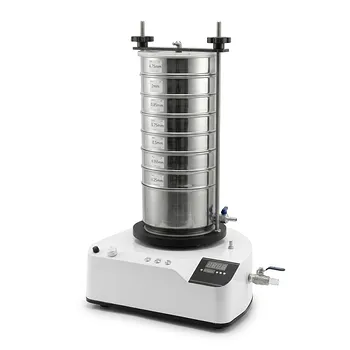
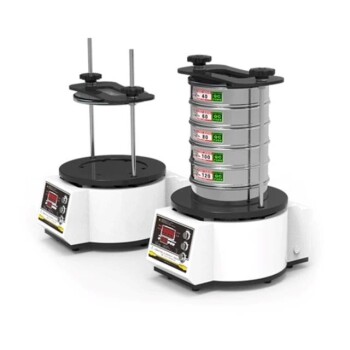
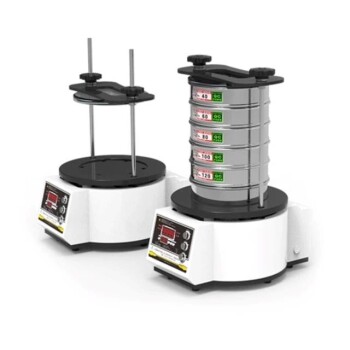
Sieve analysis equipment provides the foundational empirical data required to model fuel particle kinetics by accurately measuring Particle Size Distribution (PSD). In power plant simulations, this physical data is converted into a Rosin-Rammler distribution function. This mathematical model allows engineers to predict how fuel particles will behave within a furnace flow field, specifically regarding their movement, thermal absorption, and combustion duration.
By translating physical sieve measurements into mathematical distribution functions, engineers can ensure that numerical simulations of furnace environments accurately reflect the aerodynamic and thermal behavior of real-world pulverized fuels.
The Role of Physical Measurement in Modeling
Measuring Real-World Fuel Samples
Sieve analysis equipment is the primary tool for quantifying the physical dimensions of actual coal samples and biomass pellets. By passing fuel through a series of increasingly fine meshes, technicians establish a precise profile of the fuel’s granularity.
This empirical step is vital because the size of a particle directly dictates its mass-to-surface-area ratio. This ratio is the fundamental driver of how a particle interacts with the surrounding atmosphere and heat sources.
Bridging the Gap: The Rosin-Rammler Function
Raw data from sieve analysis is rarely used in its "as-measured" form for complex simulations. Instead, the results are converted into a Rosin-Rammler distribution function.
This function serves as a statistical bridge, allowing the simulation software to generate a continuous range of particle sizes that match the characteristics of fuel produced by industrial pulverized mills. It ensures the virtual fuel "looks" and "acts" like the physical fuel.
Impact on Simulation Kinetics
Defining Movement Trajectories
The kinetic energy and drag forces acting on a particle are heavily dependent on its size and shape. Sieve analysis ensures the simulation accounts for the weight of larger particles and the buoyancy of fines.
Accurate size distribution allows the simulation to plot realistic movement trajectories. Without this data, the model might incorrectly predict where fuel accumulates or how it bypasses critical combustion zones.
Thermal Behavior and Residence Times
A particle's size determines its heating rate, as smaller particles reach ignition temperatures significantly faster than larger ones. Sieve data allows the simulation to calculate the specific heat transfer for each size fraction.
Furthermore, these measurements define the residence time—the duration a particle remains within the furnace. Accurate sieve data ensures the model correctly predicts whether a particle will fully combust or exit the furnace as unburnt carbon.
Understanding the Trade-offs
Limitations of Mathematical Modeling
While the Rosin-Rammler function is a powerful tool, it is a mathematical approximation of reality. It assumes a degree of uniformity that may not capture the "extremes" or outliers in a fuel batch that can cause localized slagging or efficiency drops.
Potential for Measurement Errors
Sieve analysis itself is subject to human and mechanical error, such as mesh blinding or insufficient shaking time. If the initial physical measurement is flawed, the resulting kinetic simulation will produce "garbage in, garbage out" results regardless of the software's complexity.
Applying Sieve Data to Your Simulation
How to Optimize Your Power Plant Model
To ensure your numerical simulations provide actionable insights for furnace performance, align your measurement strategy with your specific operational goals.
- If your primary focus is combustion efficiency: Prioritize high-resolution sieve analysis of the "fines" to accurately model rapid ignition and localized heat release.
- If your primary focus is reducing slagging and erosion: Focus on the upper tail of the particle size distribution to track the trajectories of larger, heavier particles that impact furnace walls.
- If your primary focus is fuel switching (e.g., Coal to Biomass): Perform comparative sieve analysis to adjust the Rosin-Rammler parameters, as biomass often exhibits different breakage patterns than coal.
By grounding your virtual models in rigorous physical sieve analysis, you transform abstract simulations into reliable predictors of industrial furnace performance.
Summary Table:
| Key Feature | Role in Power Plant Simulation | Impact on Kinetic Modeling |
|---|---|---|
| Particle Size Distribution (PSD) | Provides empirical data on fuel granularity | Establishes the mass-to-surface-area ratio for heat transfer. |
| Rosin-Rammler Function | Statistical bridge for continuous size modeling | Ensures virtual fuel reflects real-world physical characteristics. |
| Movement Trajectories | Calculates drag forces and kinetic energy | Predicts fuel accumulation and prevents bypass of combustion zones. |
| Thermal Behavior | Determines heating rates and ignition timing | Optimizes heat release and predicts residence time for full combustion. |
Optimize Your Simulation Accuracy with KINTEK Precision Equipment
Precise kinetic modeling starts with accurate empirical data. KINTEK specializes in high-performance laboratory equipment designed to bridge the gap between raw fuel samples and advanced simulations.
Whether you are refining combustion efficiency or modeling fuel switching, our comprehensive range of sieving equipment, crushing and milling systems, and high-temperature furnaces provides the reliability your research demands. Beyond fuel analysis, our portfolio includes high-pressure reactors, hydraulic presses, and specialized ceramics to support your entire laboratory workflow.
Ready to elevate your industrial modeling? Contact KINTEK today to discover how our expert solutions and high-quality consumables can streamline your testing processes and deliver actionable insights for your power plant simulations.
References
- Mohammad Nurizat Rahman, Armando T. Quitain. Oil Palm Wastes Co-firing in an Opposed Firing 500 MW Utility Boiler: A Numerical Analysis. DOI: 10.37934/cfdl.15.3.139152
This article is also based on technical information from Kintek Solution Knowledge Base .
Related Products
- Laboratory Test Sieves and Vibratory Sieve Shaker Machine
- Laboratory Test Sieves and Sieving Machines
- Laboratory Vibratory Sieve Shaker Machine for Dry and Wet Three-Dimensional Sieving
- Laboratory Vibratory Sieve Shaker Machine Slap Vibrating Sieve
- Laboratory Wet Three-Dimensional Vibratory Sieve Shaker Machine
People Also Ask
- How does a laboratory vibratory sieve shaker facilitate the microstructural study of gas-atomized alloy powders?
- What role does a laboratory vibrating sieve shaker play in the LiFePO4 powder processing workflow? Ensure Batch Quality
- What is the use of vibratory sieve shaker? Achieve Precise Particle Size Analysis for Your Lab
- How is a vibratory sieve shaker used in the particle size analysis of mechanically alloyed powders? Expert Guide
- Why use a vibratory sieve shaker for PET powder? Achieve Precise Particle Size Control for Chemical Research