Knowledge vacuum induction melting furnace What are the disadvantages of core type induction heating? Poor Adaptability for Complex Parts
Author avatar

Tech Team · Kintek Solution

Updated 1 month ago

What are the disadvantages of core type induction heating? Poor Adaptability for Complex Parts


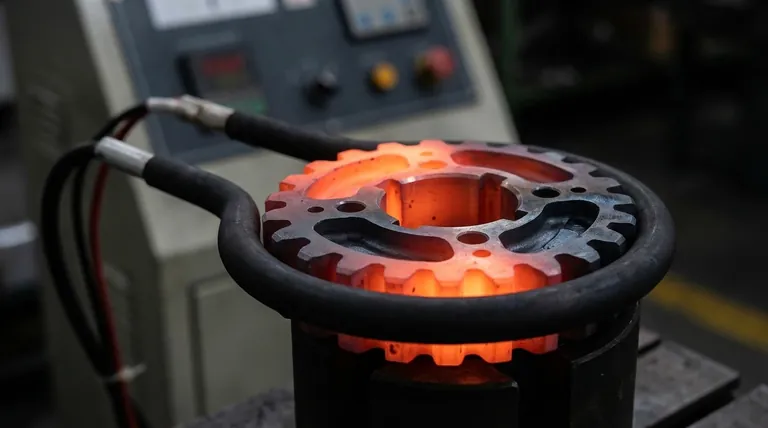
The primary disadvantage of core induction heating, specifically in its application for surface hardening, is its poor adaptability to complex workpiece geometries. This limitation means the process is highly specialized and often impractical for parts with intricate shapes, sharp corners, or non-uniform surfaces. It excels in controlled, high-volume production of simple components but struggles with one-off or geometrically complex jobs.

The core limitation of induction heating isn't about its effectiveness but its specificity. The technology demands precise setups for each unique geometry, making it an inefficient and often cost-prohibitive choice for anything other than simple, repeatable shapes in mass production.
What are the disadvantages of core type induction heating? Poor Adaptability for Complex Parts

The Fundamental Challenge: Geometry and Adaptability

Induction heating works by generating an electromagnetic field that induces an electrical current within the target object, creating heat from the inside out. The efficiency and uniformity of this process are entirely dependent on the relationship between the heating coil and the workpiece.

The Problem of Uneven Heating

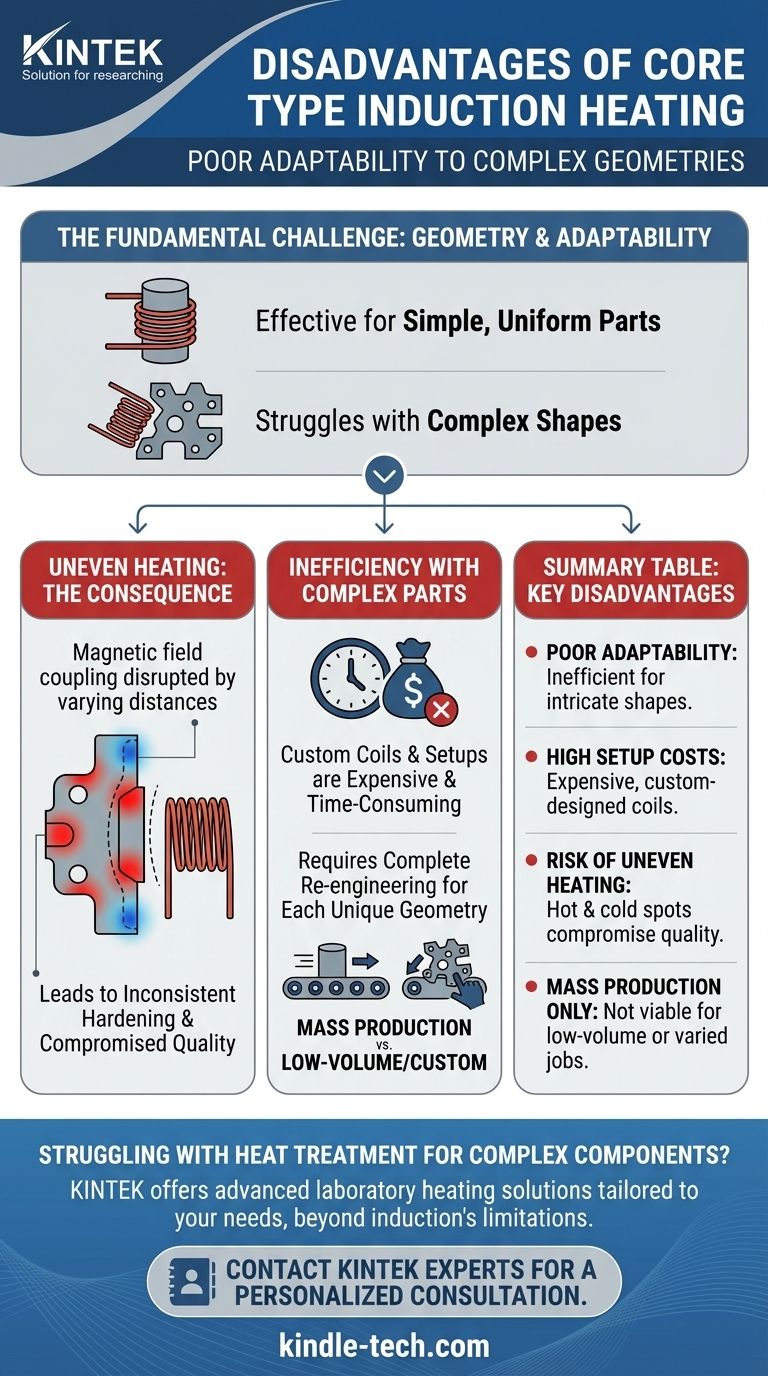
For induction heating to be effective, the magnetic field must couple consistently with the surface of the part. Complex shapes, with varying distances from the induction coil, disrupt this coupling.

This can lead to significant problems with heat uniformity, creating hot spots on surfaces closer to the coil and cold spots in recessed areas. Such uneven heating compromises the quality of the final product, especially in precision applications like surface hardening.

The Specialization for Simple Workpieces

The technology finds its ideal application in the pipelined production of simple jobs, such as hardening shafts, gears, or pipes. In these scenarios, a single, optimized coil design can process thousands or millions of identical parts with exceptional speed and consistency.

The process is perfectly suited for assembly line integration where the geometry does not change.

The Inefficiency with Complex Parts

When faced with a "complicated mechanical workpiece," the system's lack of adaptability becomes its critical failure point. A part with multiple angles, holes, or varying thicknesses requires an extremely complex coil and a difficult setup process to achieve even heating, if it's possible at all.

Understanding the Trade-offs: Specialization vs. Versatility

Choosing induction heating requires a clear understanding of its inherent trade-offs. It is a highly specialized tool, not a versatile, all-purpose heating method.

The Benefit of Specialization: Speed and Control

When the workpiece geometry is simple and uniform, induction heating is unparalleled. The heat is generated internally, allowing for extremely rapid heating cycles.

Furthermore, because there is no direct contact with the part, it is an ideal process for applications where surface contamination must be avoided. This speed and cleanliness are its primary advantages in a controlled production environment.

The Cost of Specialization: Lack of Adaptability

The main drawback is that this specialization comes at the cost of flexibility. Unlike a furnace that can heat any object placed inside it, an induction heater is fundamentally tied to the specific shape of the part it was designed for.

Adapting the process to a new, complex part often requires a complete re-engineering of the induction coil and setup, which is both time-consuming and expensive. This is why it is considered to have "poor adaptability."

Making the Right Choice for Your Application

To determine if induction heating is the correct process, you must evaluate your primary goal.

  • If your primary focus is high-volume production of simple, uniform parts: Induction heating is an excellent choice, offering unmatched speed, repeatability, and control.
  • If your primary focus is low-volume, custom, or geometrically complex parts: The technology's poor adaptability and the high cost of custom tooling make it an impractical and inefficient solution.
  • If your primary focus is improving wear and fatigue resistance on simple shapes: Induction hardening is a proven technology for creating a hard surface with beneficial compressive stress, significantly improving component life.

Ultimately, selecting induction heating is a decision based on geometry and scale; it is a master of repetition, not a tool for variation.

Summary Table:

Disadvantage Key Impact
Poor Adaptability to Complex Geometries Inefficient for parts with sharp corners, holes, or varying thicknesses.
High Cost for Custom Setups Requires expensive, custom-designed coils for each unique part shape.
Risk of Uneven Heating Leads to hot and cold spots, compromising hardening quality on complex shapes.
Ideal for Mass Production Only Cost-effective only for high-volume runs of simple, uniform parts.

Struggling with Heat Treatment for Complex Components?

While core induction heating has limitations with intricate geometries, KINTEK offers a full range of advanced laboratory heating solutions tailored to your specific needs. Whether you require precise surface hardening for simple, high-volume parts or alternative methods for complex, custom workpieces, our expertise ensures you select the right equipment for optimal results and cost-efficiency.

Let KINTEK provide the right heating solution for your lab's unique challenges. Contact our experts today for a personalized consultation!

Visual Guide
What are the disadvantages of core type induction heating? Poor Adaptability for Complex Parts Visual Guide

Related Products

People Also Ask

Related Products

Silicon Carbide SiC Thermal Heating Elements for Electric Furnace

Silicon Carbide SiC Thermal Heating Elements for Electric Furnace

Experience the advantages of Silicon Carbide (SiC) Heating Element: Long service life, high corrosion and oxidation resistance, fast heating speed, and easy maintenance. Learn more now!

600T Vacuum Induction Hot Press Furnace for Heat Treat and Sintering

600T Vacuum Induction Hot Press Furnace for Heat Treat and Sintering

Discover the 600T Vacuum Induction Hot Press Furnace, designed for high-temperature sintering experiments in vacuum or protected atmospheres. Its precise temperature and pressure control, adjustable working pressure, and advanced safety features make it ideal for nonmetal materials, carbon composites, ceramics, and metal powders.

Platinum Sheet Electrode for Laboratory and Industrial Applications

Platinum Sheet Electrode for Laboratory and Industrial Applications

Elevate your experiments with our Platinum Sheet Electrode. Crafted with quality materials, our safe and durable models can be tailored to fit your needs.

High-Purity Titanium Foil and Sheet for Industrial Applications

High-Purity Titanium Foil and Sheet for Industrial Applications

Titanium is chemically stable, with a density of 4.51g/cm3, which is higher than aluminum and lower than steel, copper, and nickel, but its specific strength ranks first among metals.

Ultra-High Temperature Graphite Vacuum Graphitization Furnace

Ultra-High Temperature Graphite Vacuum Graphitization Furnace

The ultra-high temperature graphitization furnace utilizes medium frequency induction heating in a vacuum or inert gas environment. The induction coil generates an alternating magnetic field, inducing eddy currents in the graphite crucible, which heats up and radiates heat to the workpiece, bringing it to the desired temperature. This furnace is primarily used for graphitization and sintering of carbon materials, carbon fiber materials, and other composite materials.

Engineering Advanced Fine Ceramics Alumina Crucibles (Al2O3) for Thermal Analysis TGA DTA

Engineering Advanced Fine Ceramics Alumina Crucibles (Al2O3) for Thermal Analysis TGA DTA

TGA/DTA thermal analysis vessels are made of aluminum oxide (corundum or aluminum oxide). It can withstand high temperature and is suitable for analyzing materials that require high temperature testing.

Vacuum Sealed Continuous Working Rotary Tube Furnace Rotating Tube Furnace

Vacuum Sealed Continuous Working Rotary Tube Furnace Rotating Tube Furnace

Experience efficient material processing with our vacuum-sealed rotary tube furnace. Perfect for experiments or industrial production, equipped with optional features for controlled feeding and optimized results. Order now.

Electrolytic Electrochemical Cell with Five-Port

Electrolytic Electrochemical Cell with Five-Port

Streamline your laboratory consumables with Kintek's Electrolytic Cell with five-port design. Choose from sealed and non-sealed options with customizable electrodes. Order now.

PTFE Electrolytic Cell Electrochemical Cell Corrosion-Resistant Sealed and Non-Sealed

PTFE Electrolytic Cell Electrochemical Cell Corrosion-Resistant Sealed and Non-Sealed

Choose our PTFE Electrolytic Cell for reliable, corrosion-resistant performance. Customize specifications with optional sealing. Explore now.

Quartz Electrolytic Electrochemical Cell for Electrochemical Experiments

Quartz Electrolytic Electrochemical Cell for Electrochemical Experiments

Looking for a reliable quartz electrochemical cell? Our product boasts excellent corrosion resistance and complete specifications. With high-quality materials and good sealing, it's both safe and durable. Customize to meet your needs.

H Type Electrolytic Cell Triple Electrochemical Cell

H Type Electrolytic Cell Triple Electrochemical Cell

Experience versatile electrochemical performance with our H-type Electrolytic Cell. Choose from membrane or non-membrane sealing, 2-3 hybrid configurations. Learn more now.

Customizable CO2 Reduction Flow Cell for NRR ORR and CO2RR Research

Customizable CO2 Reduction Flow Cell for NRR ORR and CO2RR Research

The cell is meticulously crafted from high-quality materials to ensure chemical stability and experimental accuracy.

Arc-Shaped Alumina Ceramic Crucible High Temperature Resistant for Engineering Advanced Fine Ceramics

Arc-Shaped Alumina Ceramic Crucible High Temperature Resistant for Engineering Advanced Fine Ceramics

In the journey of scientific exploration and industrial production, every detail is crucial. Our arc-shaped alumina ceramic crucibles, with their excellent high temperature resistance and stable chemical properties, have become a powerful assistant in laboratories and industrial fields. They are made of high-purity alumina materials and manufactured through precision processes to ensure excellent performance in extreme environments.

Mini SS High Pressure Autoclave Reactor for Laboratory Use

Mini SS High Pressure Autoclave Reactor for Laboratory Use

Mini SS High Pressure Reactor - Ideal for medicine, chemical, and scientific research industries. Programmed heating temp and stirring speed, up to 22Mpa pressure.

H-Type Double-Layer Optical Electrolytic Electrochemical Cell with Water Bath

H-Type Double-Layer Optical Electrolytic Electrochemical Cell with Water Bath

Double-layer H-type optical water bath electrolytic cells, with excellent corrosion resistance and a wide range of specifications available. Customization options are also available.

Rotating Platinum Disk Electrode for Electrochemical Applications

Rotating Platinum Disk Electrode for Electrochemical Applications

Upgrade your electrochemical experiments with our Platinum Disc Electrode. High-quality and reliable for accurate results.

Electrolytic Electrochemical Cell Gas Diffusion Liquid Flow Reaction Cell

Electrolytic Electrochemical Cell Gas Diffusion Liquid Flow Reaction Cell

Looking for a high-quality gas diffusion electrolysis cell? Our liquid flow reaction cell boasts exceptional corrosion resistance and complete specifications, with customizable options available to suit your needs. Contact us today!

RRDE rotating disk (ring disk) electrode / compatible with PINE, Japanese ALS, Swiss Metrohm glassy carbon platinum

RRDE rotating disk (ring disk) electrode / compatible with PINE, Japanese ALS, Swiss Metrohm glassy carbon platinum

Elevate your electrochemical research with our Rotating Disk and Ring Electrodes. Corrosion resistant and customizable to your specific needs, with complete specifications.

Customizable PEM Electrolysis Cells for Diverse Research Applications

Customizable PEM Electrolysis Cells for Diverse Research Applications

Custom PEM test cell for electrochemical research. Durable, versatile, for fuel cells & CO2 reduction. Fully customizable. Get a quote!

Vacuum Hot Press Furnace Machine for Lamination and Heating

Vacuum Hot Press Furnace Machine for Lamination and Heating

Experience clean and precise lamination with Vacuum Lamination Press. Perfect for wafer bonding, thin-film transformations, and LCP lamination. Order now!


Leave Your Message