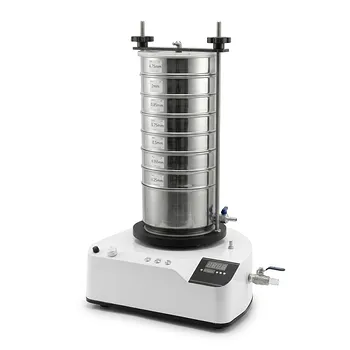
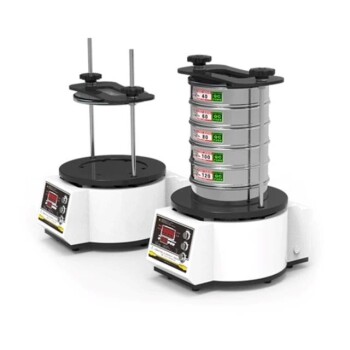
The primary sources of error in a sieve analysis test fall into three distinct categories: issues with the material sample itself, problems with the equipment, and mistakes in the procedure. Errors can arise from taking a non-representative sample, using worn or damaged sieves, overloading the screens, or not sieving for a sufficient amount of time.
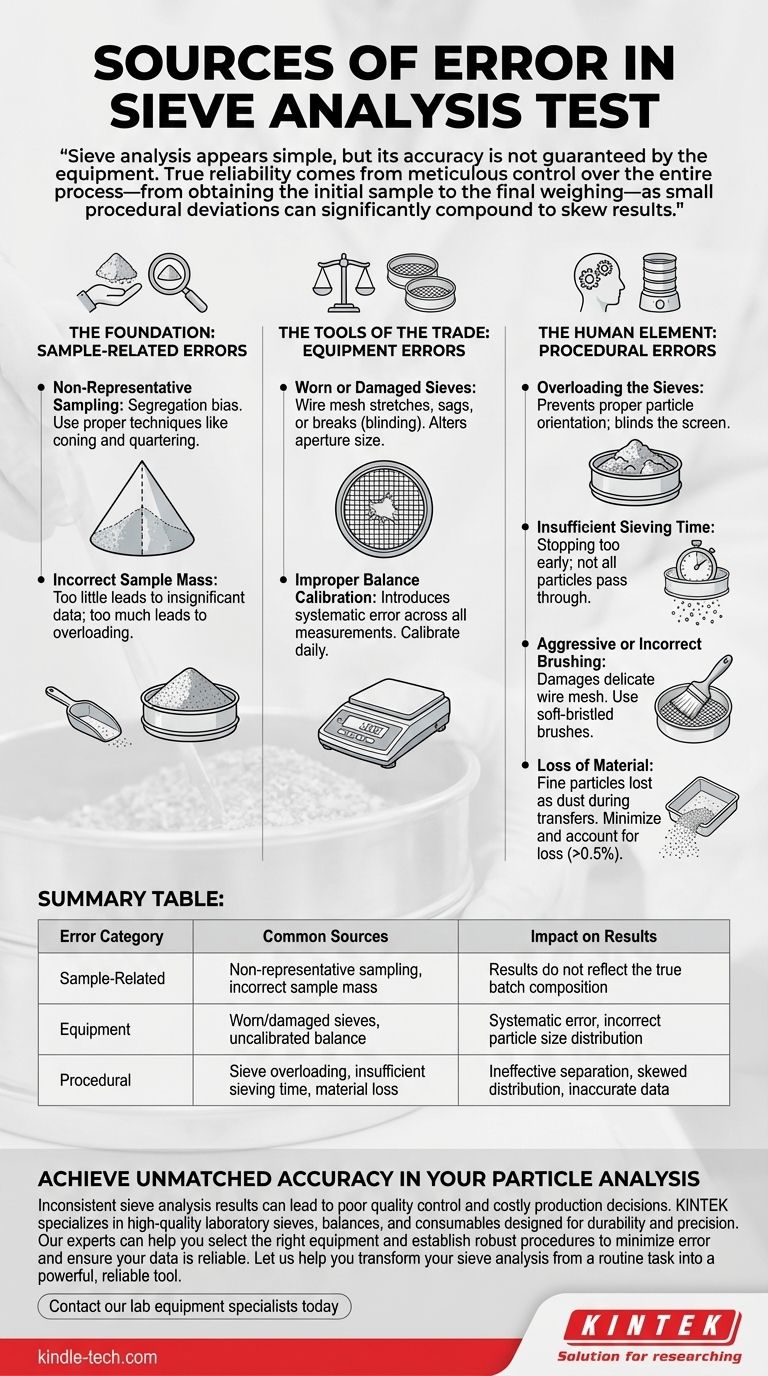
Sieve analysis appears simple, but its accuracy is not guaranteed by the equipment. True reliability comes from meticulous control over the entire process—from obtaining the initial sample to the final weighing—as small procedural deviations can significantly compound to skew results.
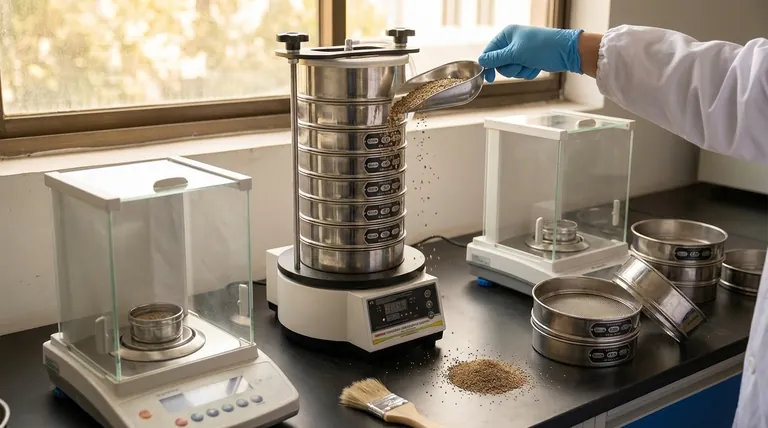
The Foundation: Sample-Related Errors
The most critical errors often occur before the test even begins. If the initial sample is flawed, the results will be meaningless, regardless of how well the procedure is executed.
Non-Representative Sampling
The portion of material tested must accurately reflect the entire batch. Taking a sample just from the top of a pile, for instance, can lead to segregation bias, as finer particles tend to settle.
Proper techniques like coning and quartering are essential to create a smaller, truly representative sample for analysis.
Incorrect Sample Mass
Using too little material can result in statistically insignificant data, where the presence or absence of a few large particles can drastically alter the final distribution.
Conversely, using too much material for the sieve diameter leads to overloading, which is a major procedural error.
The Tools of the Trade: Equipment Errors
The physical condition and calibration of your equipment are non-negotiable prerequisites for accurate analysis.
Worn or Damaged Sieves
Over time, the wire mesh in a sieve can stretch, sag, or break, a condition known as blinding. This alters the aperture size, allowing larger particles to pass through or trapping smaller ones, corrupting the separation process.
Regular inspection of sieves with a magnifying lens or calibrated microscope is crucial for identifying damage.
Improper Balance Calibration
The entire analysis is based on mass. An uncalibrated or inaccurate balance will introduce a systematic error across all measurements, making the final particle size distribution incorrect.
Balances should be calibrated daily or before each use according to standard laboratory procedures.
The Human Element: Procedural Errors
This is where the operator's skill and attention to detail have the greatest impact. Most day-to-day errors in sieve analysis are procedural.
Overloading the Sieves
This is arguably the most common mistake. When too much material is placed on a sieve, the particles cannot properly orient themselves to pass through the apertures.
This creates a "bed" of material that blinds the screen, preventing effective separation and leading to an over-reporting of coarse particles.
Insufficient Sieving Time
Sieving must continue until the rate of particles passing through each sieve becomes negligible. Stopping the test too early means many particles have not had the chance to find an aperture.
The rule of thumb is to sieve until less than 1% of the material on a given sieve passes through it during a one-minute interval.
Aggressive or Incorrect Brushing
When cleaning sieves, harsh brushing can damage the delicate wire mesh, creating larger openings and invalidating the sieve for future tests.
Only soft-bristled brushes designed specifically for sieves should be used, with brushing motions parallel to the wires.
Loss of Material
Fine particles can be lost as dust during transfers between sieves and weighing pans. While small losses are inevitable, they must be minimized and accounted for.
A total mass loss of more than 0.5% between the initial and final summed weights often indicates a flawed test.
Common Pitfalls to Avoid
Understanding the trade-offs between speed and precision is key to maintaining data integrity in a real-world lab environment.
Ignoring the End-Point
Many operators simply run the shaker for a fixed time (e.g., 10 minutes) without confirming that separation is complete. This is a gamble.
The only way to be certain is to perform an end-point analysis by periodically stopping the test and weighing the pans until the weights stabilize.
Misinterpreting Agglomerates
Clumps of fine particles (agglomerates) can behave like large, single particles if they are not properly broken up before or during sieving. This is especially true for materials with moisture or electrostatic charge.
Wet sieving or adding anti-static agents may be necessary for certain materials to ensure you are measuring primary particles, not clumps.
Making the Right Choice for Your Goal
Your approach to minimizing error should match the required precision of your results.
- If your primary focus is research-grade precision or regulatory compliance: You must validate every step, from sampling protocol to confirming the sieving end-point for each material type.
- If your primary focus is routine production quality control: Standardize your procedure with a fixed sieving time and sample mass, but be aware that this introduces a potential trade-off in absolute accuracy for the sake of repeatability.
- If you are experiencing inconsistent results: The first places to investigate are always sample representativeness and sieve condition, as these foundational errors cannot be corrected by procedure alone.
Mastering these variables transforms sieve analysis from a routine task into a powerful and reliable analytical tool.
Summary Table:
| Error Category | Common Sources | Impact on Results |
|---|---|---|
| Sample-Related | Non-representative sampling, incorrect sample mass | Results do not reflect the true batch composition |
| Equipment | Worn/damaged sieves, uncalibrated balance | Systematic error, incorrect particle size distribution |
| Procedural | Sieve overloading, insufficient sieving time, material loss | Ineffective separation, skewed distribution, inaccurate data |
Achieve Unmatched Accuracy in Your Particle Analysis
Inconsistent sieve analysis results can lead to poor quality control and costly production decisions. KINTEK specializes in high-quality laboratory sieves, balances, and consumables designed for durability and precision. Our experts can help you select the right equipment and establish robust procedures to minimize error and ensure your data is reliable.
Let us help you transform your sieve analysis from a routine task into a powerful, reliable tool.
Contact our lab equipment specialists today for a consultation tailored to your specific materials and compliance needs.
Visual Guide
Related Products
- Laboratory Test Sieves and Vibratory Sieve Shaker Machine
- Laboratory Test Sieves and Sieving Machines
- Custom PTFE Teflon Parts Manufacturer for PTFE Mesh F4 Sieve
- Laboratory Vibratory Sieve Shaker Machine Slap Vibrating Sieve
- Laboratory Vibratory Sieve Shaker Machine for Dry and Wet Three-Dimensional Sieving
People Also Ask
- What is the principle of vibratory sieve shaker? Achieve Accurate Particle Size Analysis
- How is a vibratory sieve shaker used in the particle size analysis of mechanically alloyed powders? Expert Guide
- Why use a vibratory sieve shaker for PET powder? Achieve Precise Particle Size Control for Chemical Research
- What are the different types of sieve shakers? Match the Shaker to Your Material for Accurate Particle Analysis
- What is the use of vibratory sieve shaker? Achieve Precise Particle Size Analysis for Your Lab