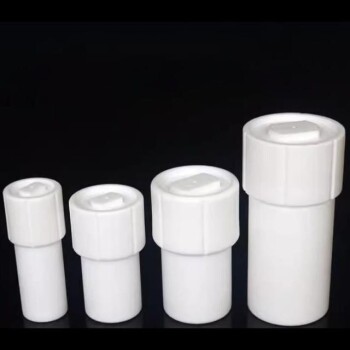
In the hydrothermal synthesis of cerium oxide (CeO2), the stainless steel high-pressure reactor provides a sealed, high-pressure environment that allows reactions to occur above the atmospheric boiling point of water. The PTFE (Polytetrafluoroethylene) liner acts as a chemically inert internal vessel that prevents the reaction solution from corroding the metal shell and ensures the final carrier remains free of metal ion impurities.
The combination of these two components creates a controlled "micro-laboratory" where high temperatures and autogenous pressures facilitate the anisotropic growth of cerium precursors into high-purity nanostructures like rods, cubes, or sheets.
The Role of the Stainless Steel High-Pressure Reactor
Providing a Sealed High-Pressure Environment
The primary function of the reactor is to maintain a sealed environment where the internal pressure increases as the temperature rises. This autogenous pressure allows aqueous solutions to remain in a liquid state well above 100°C, which is essential for the hydrothermal process.
Facilitating Nucleation and Crystal Growth
By maintaining stable temperatures—often between 120°C and 180°C—the reactor provides the kinetic energy necessary for the in-situ nucleation of cerium dioxide. This controlled thermal energy ensures that the cerium source distributes uniformly and undergoes steady crystallization.
Enabling Morphological Control
The reactor’s ability to sustain precise temperature and pressure over extended periods is critical for regulating the nanostructure morphology. This control allows researchers to expose specific crystal planes, which directly influences the catalytic activity and the strong metal-support interaction (SMSI) of the CeO2 carrier.
The Critical Function of the PTFE Liner
Preventing Metal Ion Contamination
In CeO2 synthesis, maintaining high purity is vital for the carrier's performance. The PTFE liner prevents the reaction solution from coming into direct contact with the stainless steel shell, effectively blocking the introduction of impurity ions that could poison the catalyst.
Resistance to Corrosive Environments
Hydrothermal synthesis often involves strong alkaline conditions or corrosive precursors that would otherwise erode the reactor walls. The chemical inertness of PTFE ensures the vessel remains undamaged even under aggressive chemical profiles.
Supporting Structural Integrity
By acting as a protective barrier, the liner ensures that the structural integrity of the synthesized cerium dioxide (such as nanosheets or nanorods) is not compromised by secondary reactions with the metal vessel. This leads to more uniform and predictable carrier materials.
Understanding the Trade-offs and Limitations
Temperature Constraints of PTFE
While PTFE is exceptionally inert, it has a clear thermal limit, typically around 220°C to 250°C. Exceeding these temperatures can cause the liner to soften or release toxic fumes, meaning researchers must balance high-temperature synthesis needs against the material limits of the liner.
Heat Transfer Inefficiency
PTFE is an effective insulator, which can result in a lag in heat transfer from the reactor's heating source to the internal reaction solution. This requires careful calibration of soak times and external temperature settings to ensure the internal environment reaches the desired target.
Pressure Limitations
The stainless steel shell provides the strength, but the overall assembly has a maximum pressure rating. If the reaction generates excessive gas or if the temperature is ramped too quickly, the system risks failure, necessitating the use of pressure relief valves or rupture disks for safety.
How to Apply This to Your Synthesis Project
Making the Right Choice for Your Goal
- If your primary focus is high-purity morphology (nanorods/cubes): Ensure you use a high-quality PTFE liner to prevent any metal leaching that could disrupt the anisotropic growth along specific crystal planes.
- If your primary focus is high-temperature crystallization (above 220°C): Consider alternative liner materials like PPL (Para-polyphenylene) or gold-plated vessels, as standard PTFE may deform or fail.
- If your primary focus is scalable production of CeO2 carriers: Optimize the reactor volume and heating rate to account for the PTFE liner's insulation properties, ensuring uniform temperature distribution throughout the batch.
By mastering the balance between the reactor's physical containment and the liner's chemical protection, you can precisely engineer cerium oxide carriers with the exact structural properties required for advanced catalytic applications.
Summary Table:
| Component | Primary Function | Key Benefit | Material Limit |
|---|---|---|---|
| Stainless Steel Reactor | Pressure & Temperature Control | Enables autogenous pressure for crystal nucleation | Subject to maximum pressure rating |
| PTFE Liner | Chemical Barrier | Prevents metal ion contamination & corrosion | Temperature limit of 220°C - 250°C |
| The System | Sealed "Micro-Laboratory" | Precise control over morphology (rods, cubes, sheets) | Heat transfer lag due to insulation |
Elevate Your Material Synthesis with KINTEK
Precision is paramount when engineering high-purity cerium oxide carriers. KINTEK specializes in high-performance laboratory equipment, providing the robust high-pressure reactors and autoclaves you need for successful hydrothermal synthesis.
Whether you require chemically inert PTFE or PPL liners, specialized high-temperature furnaces, or precision hydraulic presses, our comprehensive range of tools is designed to ensure repeatable, impurity-free results.
Ready to optimize your lab’s synthesis capabilities? Contact our experts today to find the perfect reactor configuration and consumables for your specific research goals!
References
- Junjie Chen, Eleni A. Kyriakidou. Ni/CeO<sub>2</sub> Nanocatalysts with Optimized CeO<sub>2</sub> Support Morphologies for CH<sub>4</sub> Oxidation. DOI: 10.1021/acsanm.2c05496
This article is also based on technical information from Kintek Solution Knowledge Base .
Related Products
- Stainless High Pressure Autoclave Reactor Laboratory Pressure Reactor
- Mini SS High Pressure Autoclave Reactor for Laboratory Use
- Customizable High Pressure Reactors for Advanced Scientific and Industrial Applications
- Customizable Laboratory High Temperature High Pressure Reactors for Diverse Scientific Applications
- High Pressure Laboratory Autoclave Reactor for Hydrothermal Synthesis
People Also Ask
- Why is a laboratory high-pressure reactor necessary for synthesizing fly ash-based zeolite? Achieve Pure Crystallization
- Why is a laboratory high-pressure reactor used in the hydrothermal synthesis of hydroxyapatite catalysts?
- What role does a laboratory high-pressure reactor play in the leaching process of spent cathode materials? Optimize Recovery
- What conditions do laboratory high-pressure reactors provide for HTC? Optimize Your Biochar Production Processes
- How are high-pressure reactors used to prepare metaphosphate electrocatalysts? Master In-Situ Precursor Growth