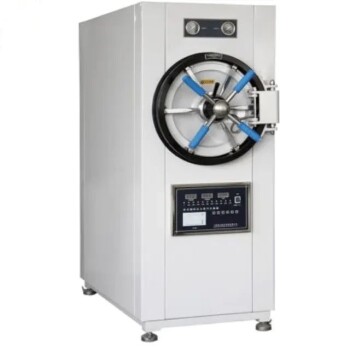
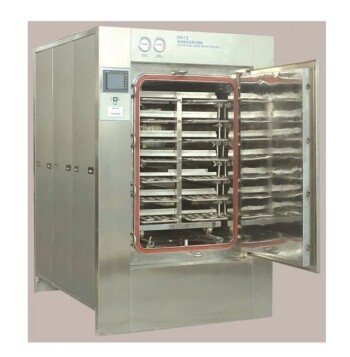
A supercritical water autoclave establishes an extreme testing environment characterized by a stable high temperature of 500 °C and an ultra-high pressure of 25 MPa. These specific parameters drive water beyond its critical point into a supercritical state, creating the distinct physical and chemical conditions necessary to simulate the working environment of Ni–20Cr–5Al alloys. By integrating precise temperature and pressure regulation, the device allows for the rigorous evaluation of long-term corrosion behavior intended for future reactor applications.
The primary function of this autoclave is to create a controlled supercritical water environment that simulates the aggressive thermal and hydraulic conditions of Supercritical Water-cooled Reactors (SCWR), enabling researchers to isolate and analyze the specific corrosion mechanisms affecting advanced alloys.
Engineering the Supercritical Environment
To understand how Ni–20Cr–5Al alloys will perform in next-generation applications, the testing environment must replicate specific thermodynamic thresholds.
Achieving Critical Parameters
The autoclave is designed to surpass the critical point of water.
It maintains a consistent temperature of 500 °C, which is significantly higher than standard operating temperatures for current nuclear reactors.
Simultaneously, it subjects the environment to 25 MPa of pressure. This combination ensures the water is neither liquid nor gas, but a supercritical fluid with unique density and solubility properties.
Integrated Regulation Systems
Maintaining these extreme conditions requires sophisticated control.
The system integrates advanced temperature control and pressure regulation functions.
This ensures that the environment remains stable over long periods, which is essential for valid simulation results. Instability in these parameters would disrupt the supercritical state and invalidate corrosion data.
The Purpose of Extreme Simulation
The physical conditions provided by the autoclave are not arbitrary; they are dictated by the specific end-use cases for the materials being tested.
Replicating SCWR Conditions
The autoclave is specifically engineered to simulate the environment of Supercritical Water-cooled Reactors (SCWR).
Unlike current commercial reactors, SCWRs operate under much higher thermal stress to increase efficiency.
Testing Ni–20Cr–5Al alloys in this device confirms their suitability for these specific future energy systems.
Evaluating Long-Term Durability
The core goal of this simulation is to assess long-term corrosion behavior.
Supercritical water is highly aggressive chemically.
By sustaining 500 °C and 25 MPa, the autoclave accelerates interactions between the fluid and the alloy, revealing potential degradation pathways that would occur over years of service.
Distinguishing Simulation Environments
It is critical to select the correct autoclave type based on the reactor design you are simulating. A supercritical autoclave differs fundamentally from standard high-pressure autoclaves used for Light Water Reactors (LWR).
Phase State Differences
A standard LWR autoclave typically operates at roughly 330 °C and maintains water in a liquid state.
In contrast, the supercritical autoclave pushes to 500 °C, forcing a phase change to supercritical fluid.
This distinction matters because corrosion mechanisms change drastically between high-temperature liquid water and supercritical water.
Chemical Control Focus
Standard LWR simulations often focus on controlling dissolved hydrogen to observe the formation of thin (nanometer-scale) passivation films on alloys like FeCrAl.
Supercritical simulations focus more broadly on the structural integrity and general corrosion resistance of alloys like Ni–20Cr–5Al under extreme thermal stress.
Making the Right Choice for Your Goal
Selecting the correct experimental setup depends entirely on the operational environment you intend to mimic.
- If your primary focus is Supercritical Water-cooled Reactors (SCWR): You require an autoclave capable of maintaining 500 °C and 25 MPa to evaluate material stability in the supercritical phase.
- If your primary focus is Light Water Reactors (LWR): You should utilize standard high-pressure autoclaves operating at roughly 330 °C to study passivation films in a liquid water environment.
The supercritical water autoclave provides the essential bridge between theoretical alloy design and practical application in next-generation nuclear technology.
Summary Table:
| Feature | Supercritical Water Autoclave (SCWR Simulation) | Standard High-Pressure Autoclave (LWR Simulation) |
|---|---|---|
| Temperature | 500 °C | ~330 °C |
| Pressure | 25 MPa | Varies (Lower than SCWR) |
| Water State | Supercritical Fluid | Liquid State |
| Primary Focus | Long-term corrosion & structural integrity | Dissolved hydrogen & passivation films |
| Target Material | Advanced alloys (e.g., Ni–20Cr–5Al) | Standard reactor alloys (e.g., FeCrAl) |
Elevate Your Material Research with KINTEK
Precision is paramount when simulating the extreme conditions of next-generation reactors. KINTEK specializes in advanced laboratory solutions, offering industry-leading high-temperature high-pressure reactors and autoclaves designed to maintain stable supercritical environments.
Whether you are analyzing the corrosion behavior of Ni–20Cr–5Al alloys or developing future energy systems, our comprehensive portfolio—including high-temperature furnaces, crushing systems, and specialized consumables—provides the reliability your lab demands.
Ready to achieve superior simulation accuracy? Contact KINTEK today to discuss your project requirements!
References
- Xiao Huang, D. Guzonas. Characterization of Ni–20Cr–5Al model alloy in supercritical water. DOI: 10.1016/j.jnucmat.2013.11.011
This article is also based on technical information from Kintek Solution Knowledge Base .
Related Products
- Mini SS High Pressure Autoclave Reactor for Laboratory Use
- Desktop Fast High Pressure Laboratory Autoclave Sterilizer 16L 24L for Lab Use
- Stainless High Pressure Autoclave Reactor Laboratory Pressure Reactor
- Desktop Fast Laboratory Autoclave Sterilizer 35L 50L 90L for Lab Use
- High Pressure Laboratory Autoclave Reactor for Hydrothermal Synthesis
People Also Ask
- Why use high-pressure reactors for molecular sieve synthesis? Unlock Superior Crystallinity and Framework Control
- Why are high-pressure reactors or autoclaves necessary for the synthesis of new functional materials? Unlock Precision.
- What is the function of a high-pressure reactor autoclave? Enhancing Cu/N Co-Doped Carbon Catalyst Synthesis
- What are the advantages of using a high-pressure reactor like an autoclave? Maximize Liquefaction Speed & Yield
- How are high-pressure reactors used to prepare metaphosphate electrocatalysts? Master In-Situ Precursor Growth