Knowledge autoclave sterilizer What damage is caused by autoclave? Protect Your Lab Equipment from Heat and Steam Damage
Author avatar

Tech Team · Kintek Solution

Updated 2 months ago

What damage is caused by autoclave? Protect Your Lab Equipment from Heat and Steam Damage


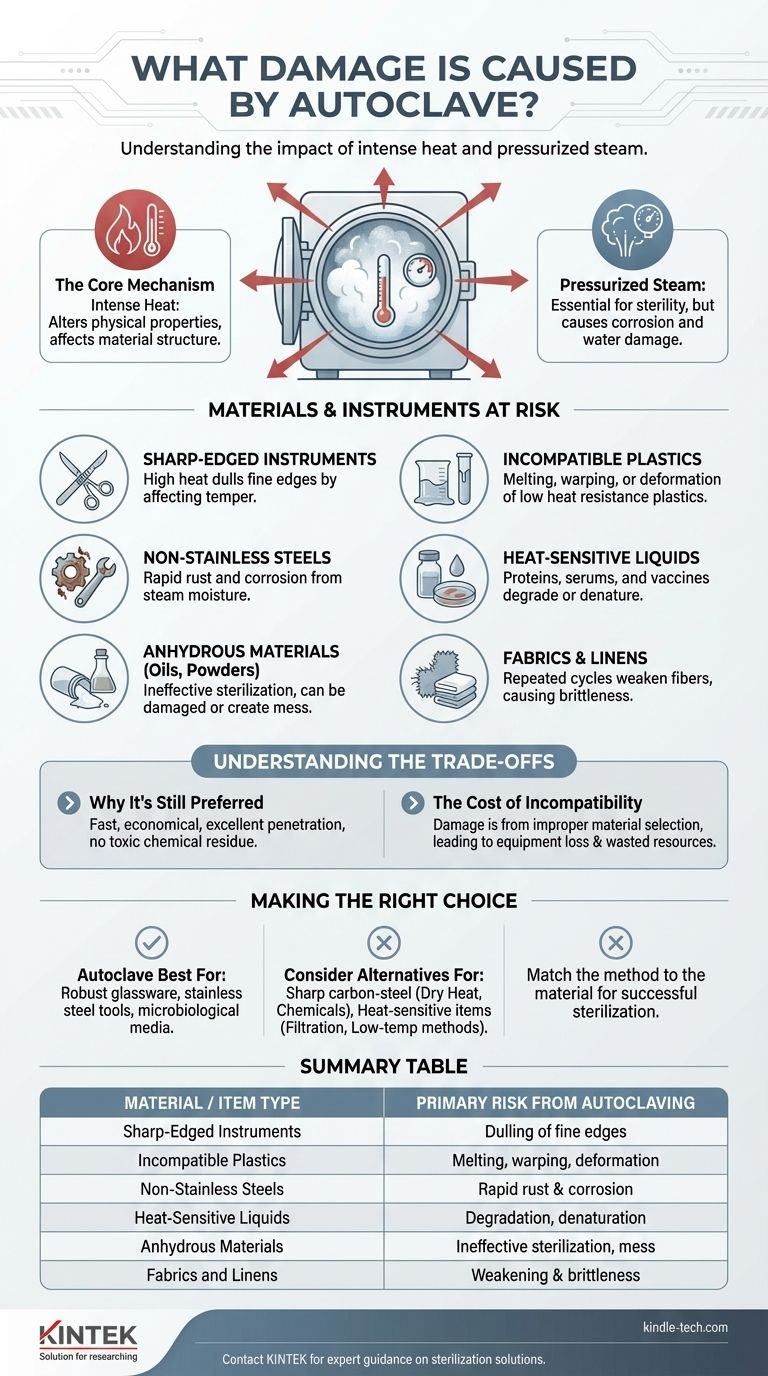
Autoclaving is a highly effective sterilization method, but its core mechanism—intense heat and pressurized steam—can cause significant damage. The primary risks include dulling sharp instruments, melting or warping incompatible plastics, corroding certain metals like carbon steel, and degrading heat-sensitive chemical and biological materials.

The fundamental issue is not a flaw in the autoclave itself, but a mismatch between the sterilization method and the material being processed. Damage occurs when an item cannot withstand the high temperatures and moisture required to achieve sterility.

What damage is caused by autoclave? Protect Your Lab Equipment from Heat and Steam Damage

The Root Cause: How an Autoclave Induces Damage

An autoclave achieves sterilization by subjecting its contents to high-pressure saturated steam at temperatures of 121°C (250°F) or higher. This combination is lethal to microorganisms but is inherently harsh on many materials.

Intense Heat

The high temperature is the most common source of damage. It can alter the physical properties of materials that are not specifically designed to withstand such thermal stress.

Pressurized Steam

Moisture is essential for the sterilization process, as it facilitates the coagulation of microbial proteins. However, this same moisture can be destructive, leading to corrosion and water damage on susceptible items.

Materials and Instruments at Risk

Understanding which materials are vulnerable is the key to preventing damage and ensuring both sterility and the longevity of your equipment.

Sharp-Edged Instruments

High heat can affect the temper of high-carbon steel, causing the fine, sharp edges on instruments like scalpels and some scissors to become dull and less effective.

Incompatible Plastics

Many common plastics have a melting point below standard autoclave temperatures. Only heat-resistant plastics, such as polypropylene (PP) and polycarbonate (PC), can be safely autoclaved. Others will melt, warp, or deform.

Non-Stainless Steels

While stainless steel is highly resistant to corrosion, standard carbon steel is not. The moisture from the steam will rapidly cause rust and corrosion on these instruments, compromising their integrity and function.

Heat-Sensitive Liquids and Biologicals

Many complex molecules cannot survive the autoclaving process. This includes certain high-protein solutions, vaccines, serums, and vitamins, which will degrade or denature, rendering them useless.

Anhydrous Materials (Oils and Powders)

Oily substances and powders cannot be sterilized effectively by an autoclave. The steam cannot penetrate these materials, and they can be damaged or create a mess within the chamber.

Fabrics and Linens

While some fabrics can be autoclaved, the process of repeated high-heat and moisture cycles can weaken the fibers over time, causing them to become brittle and tear easily.

Understanding the Trade-offs

Despite these risks, autoclaving remains a gold standard for sterilization in medical and laboratory settings for clear and compelling reasons.

Why It's Still the Preferred Method

The autoclave is fast, economical, and provides excellent penetration on all surfaces of suitable instruments. Critically, it achieves sterilization without the use of toxic chemicals, leaving behind no harmful residue.

The Cost of Incompatibility

The damage described is not a failure of the autoclave but a result of improper material selection. Attempting to autoclave an incompatible item leads directly to equipment loss, compromised experimental results, and wasted resources.

Making the Right Choice for Your Goal

Always verify an item's compatibility before placing it in an autoclave. When in doubt, consult the manufacturer's guidelines or choose an alternative method.

  • If your primary focus is robust glassware, stainless steel tools, or microbiological media: The autoclave is your most reliable and efficient choice.
  • If you are sterilizing sharp carbon-steel instruments: Consider dry heat or chemical sterilization to preserve the integrity of the cutting edge.
  • If you are working with heat-sensitive plastics, serums, or protein solutions: You must use low-temperature methods like filtration or specific chemical sterilants to prevent degradation.

Successful sterilization is ultimately about matching the method to the material.

Summary Table:

Material/Item Type Primary Risk from Autoclaving
Sharp-Edged Instruments Dulling of fine edges due to heat affecting temper
Incompatible Plastics Melting, warping, or deformation
Non-Stainless Steels Rapid rust and corrosion from moisture
Heat-Sensitive Liquids Degradation or denaturation of proteins and molecules
Anhydrous Materials (Oils, Powders) Ineffective sterilization and potential mess
Fabrics and Linens Weakening and brittleness of fibers over time

Protect your valuable lab equipment and ensure effective sterilization. Choosing the right method is critical for preserving your instruments and achieving reliable results. KINTEK specializes in lab equipment and consumables, serving laboratory needs. Our experts can help you select the right sterilization equipment or alternative solutions to prevent autoclave damage. Contact KINTEL today for a consultation and keep your lab running safely and efficiently!

Visual Guide
What damage is caused by autoclave? Protect Your Lab Equipment from Heat and Steam Damage Visual Guide

Related Products

People Also Ask

Related Products

Portable High Pressure Laboratory Autoclave Steam Sterilizer for Lab Use

Portable High Pressure Laboratory Autoclave Steam Sterilizer for Lab Use

Portable autoclave sterilization pressure is a device that uses pressure saturated steam to quickly and effectively sterilize items.

Laboratory Horizontal Autoclave Steam Sterilizer Lab Microcomputer Sterilizer

Laboratory Horizontal Autoclave Steam Sterilizer Lab Microcomputer Sterilizer

The horizontal autoclave steam sterilizer adopts the method of gravity displacement to remove the cold air in the inner chamber, so that the content of steam cold air in the inner chamber is less, and the sterilization is more reliable.

Desktop Fast High Pressure Laboratory Autoclave Sterilizer 16L 24L for Lab Use

Desktop Fast High Pressure Laboratory Autoclave Sterilizer 16L 24L for Lab Use

The desktop fast steam sterilizer is a compact and reliable device used for rapid sterilization of medical, pharmaceutical, and research items.

Portable Digital Display Automatic Laboratory Sterilizer Lab Autoclave for Sterilization Pressure

Portable Digital Display Automatic Laboratory Sterilizer Lab Autoclave for Sterilization Pressure

Portable autoclave sterilization pressure is a device that uses pressure saturated steam to quickly and effectively sterilize items.

Desktop Fast Laboratory Autoclave Sterilizer 35L 50L 90L for Lab Use

Desktop Fast Laboratory Autoclave Sterilizer 35L 50L 90L for Lab Use

The desktop fast steam sterilizer is a compact and reliable device used for rapid sterilization of medical, pharmaceutical, and research items. It efficiently sterilizes surgical instruments, glassware, medicines, and resistant materials, making it suitable for various applications.

Laboratory High Pressure Horizontal Autoclave Steam Sterilizer for Lab Use

Laboratory High Pressure Horizontal Autoclave Steam Sterilizer for Lab Use

The horizontal autoclave steam sterilizer adopts the gravity displacement method to remove the cold air in the inner chamber, so that the inner steam and cold air content is less, and the sterilization is more reliable.

Laboratory Sterilizer Lab Autoclave Herbal Powder Sterilization Machine for Plant

Laboratory Sterilizer Lab Autoclave Herbal Powder Sterilization Machine for Plant

The herbal powder sterilization autoclave machine for Chinese medicine uses saturated steam for effective sterilization. It utilizes the heat and penetrative properties of steam, achieves sterilization after heat preservation, and maintains a good drying effect with a dedicated drying system.

Desktop Fast Laboratory Autoclave Sterilizer 20L 24L for Lab Use

Desktop Fast Laboratory Autoclave Sterilizer 20L 24L for Lab Use

The desktop fast steam sterilizer is a compact and reliable device used for rapid sterilization of medical, pharmaceutical, and research items.

High Pressure Laboratory Autoclave Reactor for Hydrothermal Synthesis

High Pressure Laboratory Autoclave Reactor for Hydrothermal Synthesis

Discover the applications of Hydrothermal Synthesis Reactor - a small, corrosion-resistant reactor for chemical labs. Achieve rapid digestion of insoluble substances in a safe and reliable way. Learn more now.

Laboratory Sterilizer Lab Autoclave Vertical Pressure Steam Sterilizer for Liquid Crystal Display Automatic Type

Laboratory Sterilizer Lab Autoclave Vertical Pressure Steam Sterilizer for Liquid Crystal Display Automatic Type

Liquid crystal display automatic vertical sterilizer is a safe, reliable and automatic control sterilization equipment, which is composed of heating system, microcomputer control system and overheating and overvoltage protection system.

Laboratory High Pressure Steam Sterilizer Vertical Autoclave for Lab Department

Laboratory High Pressure Steam Sterilizer Vertical Autoclave for Lab Department

Vertical pressure steam sterilizer is a kind of sterilization equipment with automatic control, which is composed of heating system, microcomputer control system and overheating and overpressure protection system.

Mini SS High Pressure Autoclave Reactor for Laboratory Use

Mini SS High Pressure Autoclave Reactor for Laboratory Use

Mini SS High Pressure Reactor - Ideal for medicine, chemical, and scientific research industries. Programmed heating temp and stirring speed, up to 22Mpa pressure.

Laboratory Sterilizer Lab Autoclave Pulsating Vacuum Desktop Steam Sterilizer

Laboratory Sterilizer Lab Autoclave Pulsating Vacuum Desktop Steam Sterilizer

The pulsating vacuum desktop steam sterilizer is a compact and reliable device used for rapid sterilization of medical, pharmaceutical, and research items.

Laboratory Sterilizer Lab Autoclave Pulse Vacuum Lifting Sterilizer

Laboratory Sterilizer Lab Autoclave Pulse Vacuum Lifting Sterilizer

The pulse vacuum lifting sterilizer is a state-of-the-art equipment for efficient and precise sterilization. It uses pulsating vacuum technology, customizable cycles, and a user-friendly design for easy operation and safety.

Laboratory Scientific Electric Heating Blast Drying Oven

Laboratory Scientific Electric Heating Blast Drying Oven

The desktop fast autoclave sterilizer is a compact and reliable device used for rapid sterilization of medical, pharmaceutical, and research items.

Vacuum Cold Mounting Machine for Sample Preparation

Vacuum Cold Mounting Machine for Sample Preparation

Vacuum Cold Mounting Machine for precise sample prep. Handles porous, fragile materials with -0.08MPa vacuum. Ideal for electronics, metallurgy, and failure analysis.

Vacuum Hot Press Furnace Machine Heated Vacuum Press

Vacuum Hot Press Furnace Machine Heated Vacuum Press

Discover the advantages of Vacuum Hot Press Furnace! Manufacture dense refractory metals & compounds, ceramics, and composites under high temp and pressure.

Circulating Water Vacuum Pump for Laboratory and Industrial Use

Circulating Water Vacuum Pump for Laboratory and Industrial Use

Efficient circulating water vacuum pump for labs - oil-free, corrosion-resistant, quiet operation. Multiple models available. Get yours now!

10L Chilling Circulator Cooling Water Bath Low Temperature Constant Temperature Reaction Bath

10L Chilling Circulator Cooling Water Bath Low Temperature Constant Temperature Reaction Bath

Get the KinTek KCP 10L Chilling Circulator for your lab needs. With a stable and quiet chilling power of up to -120℃, it also works as a one chilling bath for versatile applications.

Electric Heated Hydraulic Vacuum Heat Press for Lab

Electric Heated Hydraulic Vacuum Heat Press for Lab

The Electric Vacuum Heat Press is a specialized heat press equipment that operates in a vacuum environment, utilizing advanced infrared heating and precise temperature control for high quality, rugged and reliable performance.


Leave Your Message