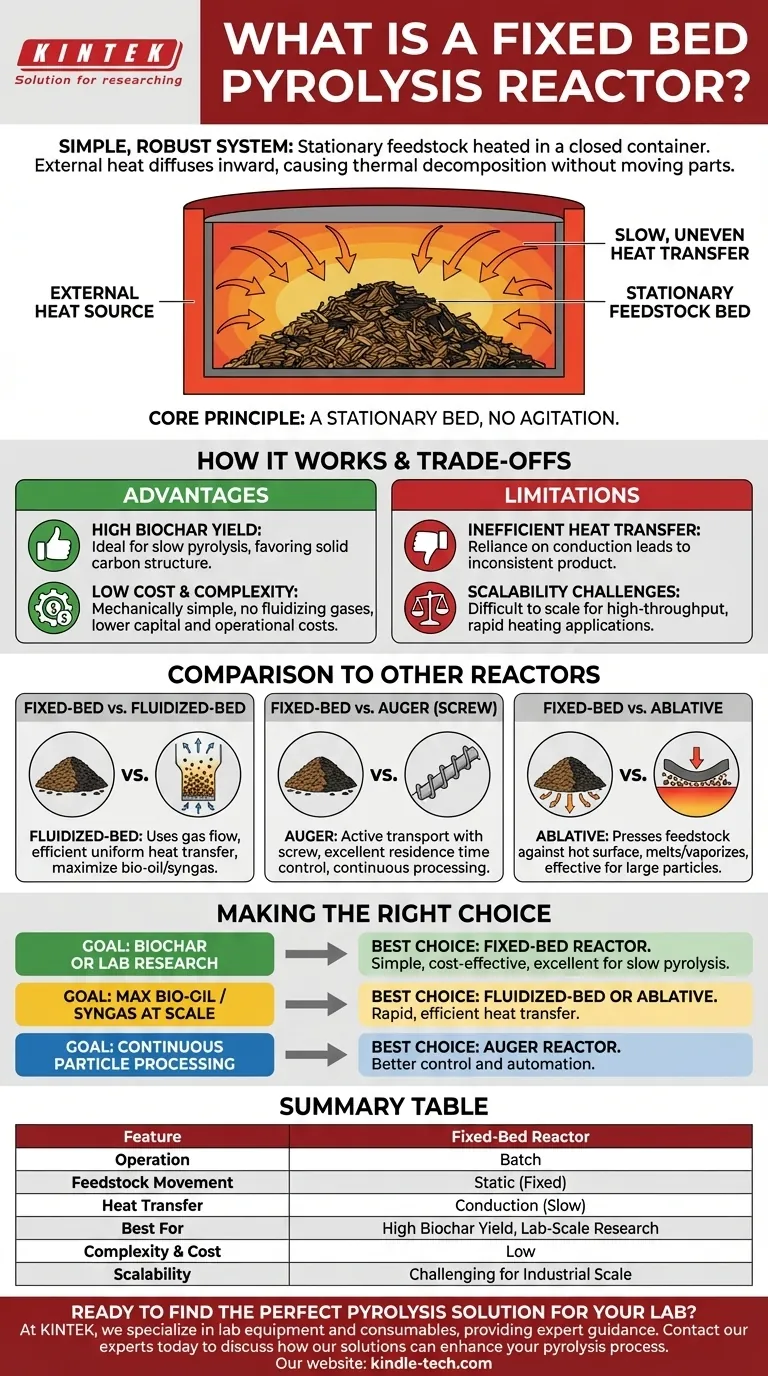
In essence, a fixed-bed pyrolysis reactor is a simple and robust system where a stationary mass of feedstock, or substrate, is heated in a closed container. Heat is applied to the outside of the vessel and slowly diffuses inward, causing the material to thermally decompose without the need for complex moving parts or fluidizing gases.
The defining characteristic of a fixed-bed reactor is its operational simplicity and static design. This makes it highly effective for producing solid biochar through slow pyrolysis but less efficient for generating liquid bio-oils at an industrial scale due to limitations in heat transfer.
How the Fixed-Bed Reactor Works
A fixed-bed reactor is one of the most straightforward designs for pyrolysis, operating on a clear and direct principle.
The Core Principle: A Stationary Bed
The feedstock is loaded into the reactor, where it remains as a static, or "fixed," bed of material.
Unlike more dynamic systems, the particles are not agitated, circulated, or moved by mechanical means during the process.
The Heat Transfer Mechanism
Heat is supplied externally to the reactor walls. This thermal energy must then conduct and radiate from the hot walls through the packed bed of material.
This process is relatively slow and can lead to uneven temperature distribution, as particles closer to the walls get hotter faster than those in the center.
Inherent Simplicity
The design does not require a fluidizing agent like nitrogen gas or bed materials like sand. It also avoids complex internal mechanisms like rotating drums or augers.
This simplicity makes it easier and cheaper to construct and operate, particularly for smaller-scale or laboratory applications.
How Fixed-Bed Compares to Other Reactor Types
Understanding the fixed-bed reactor requires seeing it in context with other common pyrolysis technologies. Each design is optimized for different feedstocks, scales, and desired end products.
Fixed-Bed vs. Fluidized-Bed
A fluidized-bed reactor uses a flow of hot gas to suspend and agitate the feedstock particles, causing them to behave like a fluid.
This creates extremely efficient and uniform heat transfer, making it ideal for rapid pyrolysis to maximize the yield of bio-oil and syngas. The fixed-bed's static nature is comparatively slow.
Fixed-Bed vs. Auger (Screw) Reactor
An auger reactor uses a large, heated screw to actively transport the feedstock through a sealed chamber.
This provides excellent control over residence time and allows for continuous processing, whereas fixed-bed reactors are often operated in batches.
Fixed-Bed vs. Ablative Reactor
An ablative reactor works by pressing feedstock against a rapidly moving hot surface. The material effectively melts and vaporizes on contact.
This method is highly effective for large particles that would heat too slowly in a fixed-bed system, as it bypasses the need for heat to diffuse through the particle itself.
The Trade-offs of the Fixed-Bed Design
The simplicity of the fixed-bed reactor is both its greatest strength and its primary source of limitations.
Key Advantage: High Biochar Yield
The slow heating rates and longer residence times inherent to the fixed-bed design are ideal for slow pyrolysis.
This process favors the formation of a solid carbon structure, resulting in a higher yield of biochar compared to other reactor types.
Key Advantage: Low Cost and Complexity
With no major moving parts or requirements for fluidizing gases, these reactors are mechanically simple. This reduces both the initial capital cost and ongoing operational complexity.
Primary Limitation: Inefficient Heat Transfer
The reliance on conduction through a static bed is the reactor's main weakness. This can result in an inconsistent product and makes it difficult to process large volumes of material efficiently.
Primary Limitation: Scalability Challenges
The poor heat transfer characteristics make it very difficult to scale up fixed-bed reactors for high-throughput industrial applications, especially those targeting liquid fuels where rapid heating is critical.
Making the Right Choice for Your Goal
Selecting the correct reactor technology depends entirely on your primary objective, feedstock, and desired scale of operation.
- If your primary focus is producing biochar or conducting lab-scale research: The fixed-bed reactor is an excellent, cost-effective choice due to its simplicity and effectiveness in slow pyrolysis.
- If your primary focus is maximizing bio-oil or syngas yield at scale: A fluidized-bed or ablative reactor is far superior due to its rapid and efficient heat transfer capabilities.
- If your primary focus is continuous processing of particulate matter: An auger reactor offers better control and automation for moving material through the system consistently.
Ultimately, choosing the right reactor is about matching the technology's inherent strengths to your specific production goals.
Summary Table:
| Feature | Fixed-Bed Reactor |
|---|---|
| Operation | Batch |
| Feedstock Movement | Static (Fixed) |
| Heat Transfer | Conduction (Slow) |
| Best For | High Biochar Yield, Lab-Scale Research |
| Complexity & Cost | Low |
| Scalability | Challenging for Industrial Scale |
Ready to find the perfect pyrolysis solution for your lab?
At KINTEK, we specialize in lab equipment and consumables, providing expert guidance to help you select the right reactor technology for your specific research or production goals—whether you're focused on biochar, bio-oil, or syngas.
Contact our experts today to discuss how our solutions can enhance your pyrolysis process and drive your projects forward.
Visual Guide
Related Products
- Electric Rotary Kiln Small Rotary Furnace Biomass Pyrolysis Plant
- Electric Rotary Kiln Continuous Working Small Rotary Furnace Heating Pyrolysis Plant
- Electric Rotary Kiln Pyrolysis Furnace Plant Machine Calciner Small Rotary Kiln Rotating Furnace
- Customer Made Versatile CVD Tube Furnace Chemical Vapor Deposition Chamber System Equipment
- Customizable Laboratory High Temperature High Pressure Reactors for Diverse Scientific Applications
People Also Ask
- What are the different types of calciners? A Guide to Selecting the Right Thermal Processing Equipment
- What are the reactors for fast pyrolysis? Choosing the Right System for Maximum Bio-Oil Yield
- What is a rotary kiln reactor? A Guide to Industrial Thermal Processing
- What are the principles of a rotary kiln? Master the Mechanics of High-Temperature Processing
- What are the main parts of a rotary kiln? A Guide to Its Core Components and Functions