A small pilot scale pyrolysis reactor is not a single type of device, but rather a category of reactors designed to bridge the gap between laboratory research and full-scale industrial production. Their purpose is to validate a technology, test different feedstocks, and gather critical operational data at a manageable and cost-effective scale before committing to a major industrial investment.
The key is understanding that "pilot scale" refers to the purpose—testing and validating a process—not a specific design. The best reactor type for your pilot project depends entirely on your specific goals, such as the type of feedstock you're using and the desired end products (bio-oil, biochar, or syngas).
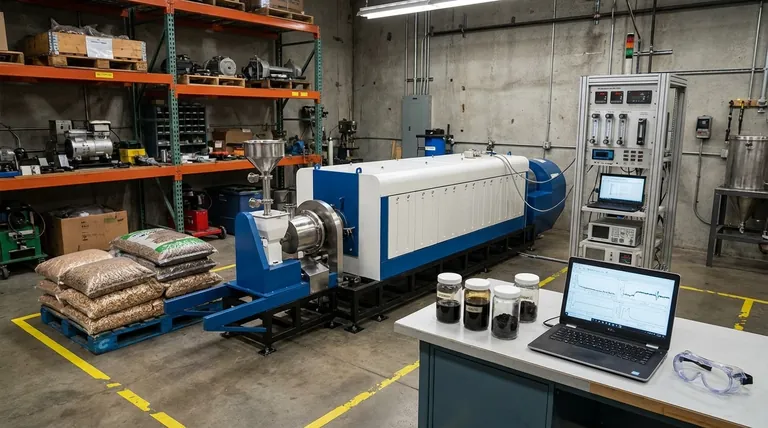
Core Reactor Designs for Pilot Scale Operations
Several fundamental reactor designs are commonly adapted for pilot-scale pyrolysis. The choice of design is the most critical decision and directly influences the data you can collect and the operational challenges you will face.
The Batch Reactor: Simplicity and Control
A batch reactor, also called a fixed-batch reactor, is a sealed vessel loaded with a specific amount of feedstock. The entire process runs from start to finish before the vessel is opened to remove the products.
Its simplicity makes it ideal for early-stage pilot work where precise control and process stability are more important than continuous throughput.
The Semi-Batch Reactor: Incremental Feeding
This design is a modification of the batch reactor. While the main process runs in a sealed vessel, it allows for reactants or additional feedstock to be introduced at specific intervals.
This is useful for testing how the process responds to changes in feedstock supply without moving to a fully continuous system.
The Fixed-Bed Reactor: Consistent Heat Transfer
In a fixed-bed reactor, the biomass or substrate material is stationary. Heat is typically applied to the vessel walls and diffuses inward, causing thermal decomposition.
These reactors have a simple design and do not require a fluidizing gas, making them mechanically straightforward and reliable for pilot-scale tests focused on fundamental heat transfer and reaction kinetics.
The Tubular Reactor: Versatility at Low Cost
A tubular reactor features a simple, cylindrical design with relatively low construction and operational costs. It can be configured to operate similarly to a fixed-bed reactor.
While capable of various pyrolysis modes, it is best suited for slow pyrolysis. Its low cost makes it a popular choice for initial pilot studies where budget is a primary constraint.
The Rotary-Kiln Reactor: Handling Difficult Feedstocks
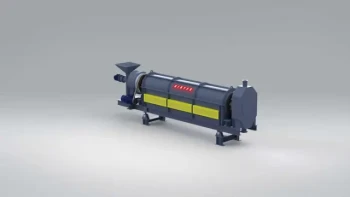
This reactor uses a rotating, inclined cylinder to tumble and mix the feedstock as it moves through the heated zone. A screw conveyor often feeds material into the kiln.
The constant motion ensures excellent heat distribution and is particularly effective for non-uniform feedstocks like shredded biomass. It is well-suited for pilot projects aiming to maximize bio-oil production and simulate continuous industrial operation.
Understanding the Trade-offs: No Single Best Solution
Every reactor design comes with inherent compromises. A successful pilot project depends on selecting the design whose trade-offs align with your research and development goals.
Simplicity vs. Scalability
Batch and fixed-bed reactors offer unmatched simplicity for controlled experiments. However, their operational mode (loading, running, unloading) does not directly translate to the continuous processes used in most large-scale industrial plants.
Heat Transfer Efficiency
Heat transfer is a critical factor in pyrolysis. The slow, inward diffusion of heat in a stationary fixed-bed reactor can lead to uneven product quality. A rotary kiln provides more uniform heating but at the cost of higher mechanical complexity.
Feedstock Flexibility
The physical form of your feedstock dictates reactor choice. A simple batch reactor works well with uniform pellets or powders. A rotary-kiln is far superior for handling bulky, wet, or irregularly shaped materials that need constant mixing.
Operational Mode: Batch vs. Continuous
Running tests in batch mode is excellent for isolating variables and producing distinct product batches for analysis. However, semi-batch or rotary-kiln reactors provide more valuable data on the challenges of continuous feeding and process stability over time, which are critical for commercial viability.
Choosing the Right Pilot Reactor for Your Goal
Your choice must be driven by a clear objective. The question is not "What is the best reactor?" but "What is the best reactor to answer my specific questions?"
- If your primary focus is foundational research and product characterization: A batch or fixed-bed reactor offers the best control and simplicity for repeatable experiments.
- If your primary focus is testing a variety of feedstocks or maximizing bio-oil yield: A rotary-kiln reactor provides excellent mixing and heat distribution for non-uniform materials.
- If your primary focus is balancing low cost with process versatility: A tubular reactor is an excellent starting point, as it's inexpensive and can be adapted for different pyrolysis speeds.
- If your primary focus is simulating a more continuous industrial process: A semi-batch or rotary-kiln reactor allows you to test feedstock feeding mechanisms and process stability over time.
Ultimately, selecting the right pilot reactor is about matching the design's strengths to the specific questions you need to answer before scaling up.
Summary Table:
| Reactor Type | Best For | Key Advantage |
|---|---|---|
| Batch / Fixed-Bed | Foundational research, product characterization | Excellent control and simplicity |
| Rotary-Kiln | Testing varied feedstocks, maximizing bio-oil yield | Superior mixing and heat distribution |
| Tubular | Low-cost initial studies, slow pyrolysis | Cost-effective and versatile |
| Semi-Batch | Simulating continuous processes, incremental feeding | Tests process stability over time |
Ready to scale up your pyrolysis process? Let KINTEK's expertise in lab equipment guide your pilot project. We provide the right reactor solutions to test your feedstocks, optimize yields, and gather critical data for a successful industrial scale-up. Contact our experts today to discuss your specific needs!
Visual Guide

Related Products
- Electric Rotary Kiln Small Rotary Furnace Biomass Pyrolysis Plant
- Electric Rotary Kiln Continuous Working Small Rotary Furnace Heating Pyrolysis Plant
- Electric Rotary Kiln Pyrolysis Furnace Plant Machine Calciner Small Rotary Kiln Rotating Furnace
- Mini SS High Pressure Autoclave Reactor for Laboratory Use
- Spark Plasma Sintering Furnace SPS Furnace
People Also Ask
- What is a rotary kiln reactor? A Guide to Industrial Thermal Processing
- What are the characteristics of the slipping, slumping, and rolling modes of bed motion? Optimize Your Rotary Process
- How are rotary kilns heated? Direct vs. Indirect Heating Methods Explained
- What are the reactors for fast pyrolysis? Choosing the Right System for Maximum Bio-Oil Yield
- What are the reactions involved in pyrolysis of biomass? Unlock the Chemistry for Tailored Bio-Products