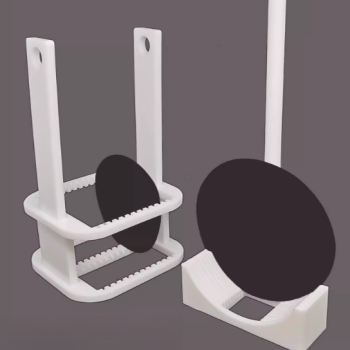
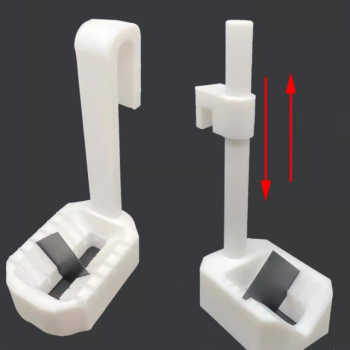
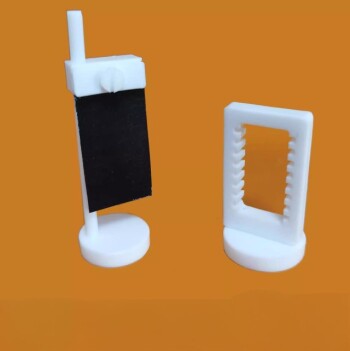
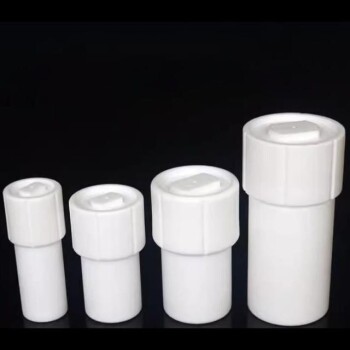
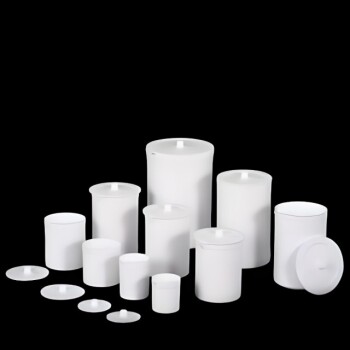
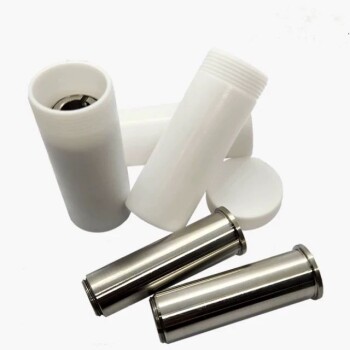
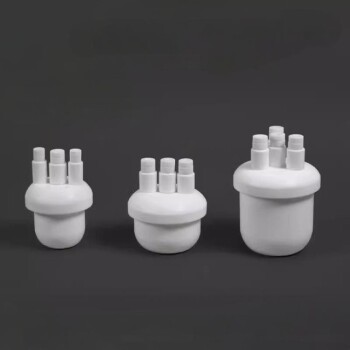
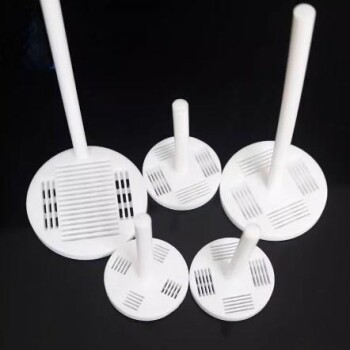
The customized PTFE cap serves as the essential mechanical anchor in Identical Location Transmission Electron Microscopy (IL-TEM) studies of copper electrocatalysts. Its primary function is to firmly press a gold (Au) TEM grid, which supports the catalyst particles, onto the surface of a glassy carbon disk within a standard rotating disk electrode (RDE) system.
The PTFE cap bridges the gap between microscopy and electrochemistry by securely integrating a delicate TEM grid into a rugged electrode setup. This ensures the catalyst experiences a realistic potential environment while remaining removable for high-resolution imaging.
The Mechanics of the Assembly
Securing the TEM Grid
The core structural challenge in IL-TEM is manipulating a fragile, microscopic grid within a macroscopic electrochemical cell.
The PTFE cap solves this by physically trapping the Au TEM grid against the glassy carbon disk. This prevents the grid from detaching during the rotation of the electrode or immersion in the electrolyte.
Facilitating Sample Transfer
Crucially, the cap allows for a non-permanent attachment.
Because the grid is clamped rather than glued or soldered, researchers can easily disassemble the setup. This facilitates the physical transfer of the catalyst sample back to the microscope for post-reaction imaging without damaging the structural integrity of the particles.
Ensuring Electrochemical Fidelity
Establishing Electrical Contact
The cap applies necessary pressure to maintain contact between the Au grid and the glassy carbon disk.
The glassy carbon acts as the current collector. By holding the grid flush against this conductive surface, the cap ensures electrons can flow freely to and from the catalyst particles.
Creating a Consistent Potential Environment
The primary reference emphasizes that the catalyst must experience a potential environment consistent with bulk electrodes.
Without the cap's secure hold, the catalyst particles on the grid might be electrically isolated. The cap ensures that the microscopic sample undergoes the exact same cathodic polarization and electrochemical treatment as a standard bulk experiment.
Critical Considerations and Trade-offs
Mechanical Pressure vs. Grid Integrity
The cap must apply enough pressure to ensure good electrical contact with the glassy carbon.
However, excessive pressure can deform the delicate Au grid. This creates a trade-off where the cap must be tightened precisely to secure the sample without altering the microscopic geometry of the support.
Material Compatibility
The use of PTFE (Polytetrafluoroethylene) is intentional.
It is chemically inert and electrically insulating. This ensures that the cap itself does not participate in the electrochemical reaction or introduce impurities, directing all electrochemical activity solely to the copper electrocatalyst on the grid.
Making the Right Choice for Your Experiment
To maximize the reliability of your IL-TEM data, consider the following based on your specific research goals:
- If your primary focus is Structural Correlation: Ensure the PTFE cap design allows for rapid disassembly to minimize the time the copper catalyst is exposed to air during transfer between the cell and the microscope.
- If your primary focus is Electrochemical Precision: Prioritize the flatness of the grid against the glassy carbon disk; the cap must ensure uniform contact to prevent voltage drops that would distort the "bulk-like" potential environment.
The PTFE cap is not merely a holder; it is the component that validates the assumption that what you see in the microscope is what actually reacted in the cell.
Summary Table:
| Feature | Function in IL-TEM | Benefit to Researcher |
|---|---|---|
| Mechanical Anchor | Presses Au TEM grid against glassy carbon disk | Prevents sample loss during electrode rotation |
| Non-Permanent Attachment | Allows easy assembly and disassembly | Facilitates damage-free sample transfer to TEM |
| Electrical Conductivity | Maintains flush contact with current collector | Ensures a consistent potential environment for catalysts |
| Material: PTFE | Chemically inert and electrically insulating | Eliminates background interference and impurities |
Elevate Your Electrocatalysis Research with KINTEK Precision
Unlock high-resolution insights into your catalyst's evolution with KINTEK’s specialized laboratory equipment and consumables. From customized PTFE products and ceramics to advanced electrolytic cells and electrodes, we provide the essential tools required for Identical Location Transmission Electron Microscopy (IL-TEM) and beyond.
Whether you need precision-engineered PTFE caps, high-purity crucibles, or sophisticated battery research tools, KINTEK ensures your experimental setup maintains the highest fidelity. Our comprehensive portfolio, including high-temperature furnaces, hydraulic presses, and cooling solutions, is designed to support the most demanding laboratory workflows.
Ready to optimize your electrode assembly? Contact us today to discover how KINTEK’s expertise can enhance your material characterization and electrochemical performance.
References
- Shikai Liu, Qian He. Alkali cation-induced cathodic corrosion in Cu electrocatalysts. DOI: 10.1038/s41467-024-49492-7
This article is also based on technical information from Kintek Solution Knowledge Base .
Related Products
- Customizable PTFE Wafer Carriers for Semiconductor and Lab Applications
- Custom PTFE Teflon Parts Manufacturer for PTFE Containers
- Custom PTFE Wafer Holders for Lab and Semiconductor Processing
- Custom PTFE Teflon Parts Manufacturer for Hydrothermal Synthesis Reactor Polytetrafluoroethylene Carbon Paper and Carbon Cloth Nano-growth
- Custom PTFE Teflon Parts Manufacturer for Sampling Filters
People Also Ask
- How is PTFE utilized for insulation in Alloy 22 corrosion setups? Ensure Signal Purity & Accuracy
- What are the specific applications of PTFE in micro-batch slug flow systems? Enhance Your Microfluidic Reaction Purity
- Is PTFE corrosion resistant? Discover the Ultimate Chemical Resistance for Your Lab
- Why are PTFE wafer fixtures used after diamond nucleation? Ensure Purity and Protect Fragile Nucleation Layers
- Why is PTFE wire used for hanging metal specimens in biodiesel corrosion tests? Ensure Pure Experimental Results