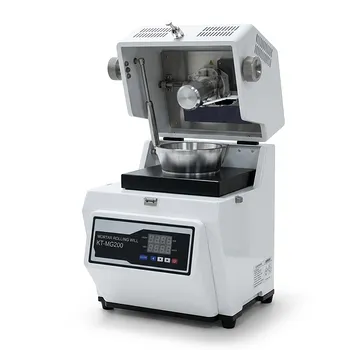
The primary function of a high-energy bead mill in the preparation of iron-based trimodal powders is the precision refinement of micrometer-scale iron oxide ($\alpha$-Fe2O3) into nanometer-scale particles. By utilizing intense shear and impact forces, the mill dramatically increases the powder's specific surface area and chemical reactivity. This mechanical activation is a critical prerequisite for achieving the targeted particle size distributions required during subsequent heat treatment and reduction processes.
Core Takeaway: The high-energy bead mill acts as a mechanical activator that transforms coarse precursors into high-energy nanostructures, ensuring the reactivity and uniformity necessary for producing specialized trimodal iron powders.
The Mechanism of Mechanical Refinement
Utilizing High-Speed Kinetic Energy
The process begins with high-speed rotation within a cylindrical vessel containing grinding media, typically zirconia beads. This rotation generates high-frequency impact and shear forces that are transferred to the iron oxide slurry.
Breaking Down Particle Scale
As the beads collide with the raw material, they provide enough energy to overcome the structural integrity of micrometer-scale particles. This reduces the powder size from microns down to tens of nanometers, a scale shift that is essential for trimodal compositions.
Achieving Atomic-Level Mixing
Beyond simple size reduction, the agitation facilitates a high degree of homogeneity. This ensures that different components or additives within the powder are mixed at an almost atomic level, preventing localized inconsistencies in the final material.
The Impact on Chemical and Physical Activity
Increasing Specific Surface Area
Reducing particles to the nanometer scale exponentially increases their specific surface area. This higher surface-to-volume ratio exposes more atoms, making the powder significantly more reactive during later processing stages.
Enhancing Solid-State Reactions
The mechanical energy stored in the refined powder during milling increases its surface energy. This lowered energy barrier facilitates faster and more complete solid-state reactions when the powder is subjected to heat.
Driving Efficient Sintering
Because the particles are highly active, they can achieve higher densities at lower sintering temperatures. This is vital for maintaining the specific "trimodal" structure, as lower temperatures help prevent unwanted grain growth.
Understanding the Trade-offs and Challenges
Contamination from Grinding Media
The intensity of high-energy milling can cause wear on the grinding beads and the mill lining. This may introduce impurities, such as zirconia, into the iron-based powder, which could alter the final material's magnetic or mechanical properties.
Heat Generation and Material Stability
The friction generated during high-speed milling produces significant heat. If not managed through cooling systems, this thermal energy can cause premature reactions or unwanted phase changes in the iron oxide precursor.
Energy Consumption and Scaling
High-energy bead milling is an energy-intensive process. While it produces superior powder quality, the operational costs and the complexity of scaling the process for mass production must be balanced against the performance requirements of the final product.
How to Optimize Milling for Your Project
Making the Right Choice for Your Goal
The application of bead milling should be tailored to the specific performance characteristics required in your final iron-based powder.
- If your primary focus is maximum chemical reactivity: Prioritize longer milling durations at high speeds to maximize the reduction of particles to the lowest possible nanometer range.
- If your primary focus is material purity: Utilize high-hardness grinding media like stabilized zirconia and implement low-temperature cooling to minimize wear and contamination.
- If your primary focus is precise trimodal distribution: Use the bead mill strictly for the "fine" fraction of your mixture, ensuring the milling parameters are calibrated to reach a specific nanometer threshold without over-processing.
By masterfully controlling the mechanical energy of the bead mill, you create the essential foundation for high-performance, specialized iron powder materials.
Summary Table:
| Aspect | Function in Trimodal Powder Prep | Key Benefit |
|---|---|---|
| Size Reduction | Refines micron iron oxide to nanometer scale | Essential for trimodal particle distribution |
| Surface Area | Drastically increases specific surface area | Boosts chemical reactivity and sintering speed |
| Homogenization | Provides atomic-level mixing of precursors | Ensures uniform chemical & physical properties |
| Mechanical Energy | Lowers the energy barrier for solid-state reactions | Enables high density at lower sintering temperatures |
Optimize Your Powder Synthesis with KINTEK Solutions
Precision at the nanoscale is the foundation of high-performance materials. KINTEK specializes in professional laboratory equipment designed to meet the rigorous demands of advanced research. Whether you are refining iron-based trimodal powders or developing next-generation energy storage, our comprehensive range of crushing and milling systems, high-temperature furnaces (muffle, vacuum, CVD), and hydraulic presses provide the reliability and control you need.
From high-hardness grinding media to specialized high-temperature high-pressure reactors and autoclaves, we empower scientists and manufacturers to achieve superior material reactivity and structural uniformity. Don't let material inconsistencies or energy inefficiency hold back your innovation.
Ready to upgrade your laboratory’s capabilities? Contact KINTEK today to explore our full portfolio of milling solutions, electrolytic cells, and thermal processing equipment tailored to your specific research goals.
References
- Heungseok Oh, Caroline Sunyong Lee. Study of solid loading of feedstock using trimodal iron powders for extrusion based additive manufacturing. DOI: 10.1038/s41598-023-32095-5
This article is also based on technical information from Kintek Solution Knowledge Base .
Related Products
- High Energy Planetary Ball Mill Milling Machine for Laboratory
- High-Energy Omnidirectional Planetary Ball Mill Milling Machine for Laboratory
- High Energy Planetary Ball Mill Milling Machine for Laboratory
- High Energy Vibratory Ball Mill for Lab Use
- Hybrid High Energy Vibratory Ball Mill for Lab Use
People Also Ask
- What is the primary function of a planetary high-energy ball mill? Master Mechanical Alloying for Nickel Nanoparticles
- Why is a high-energy planetary ball mill preferred over traditional casting for nanocrystalline HEAs?
- What is the function of a high-energy planetary ball mill? Unlock Nanoscale Precision in Powder Metallurgy
- What is the function of a high-energy planetary ball mill in preparing MAB phase precursors? Optimize MBene Synthesis
- How does a high-energy planetary ball mill achieve room-temperature reactions? Master Mechanical Alloying Efficiency