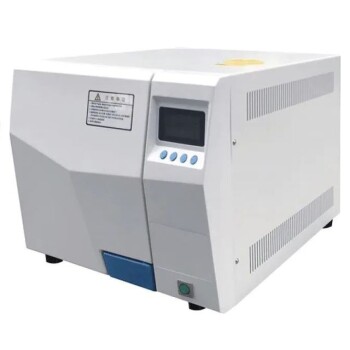
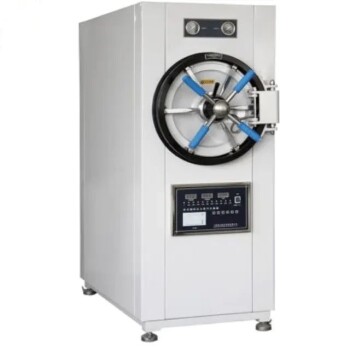
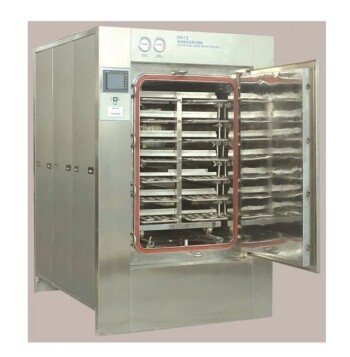
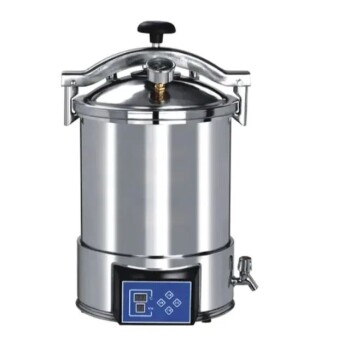
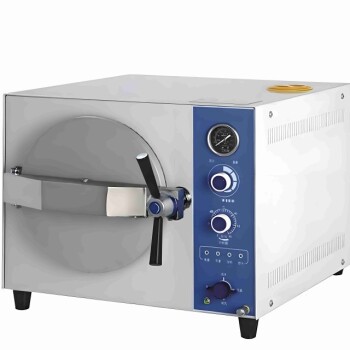
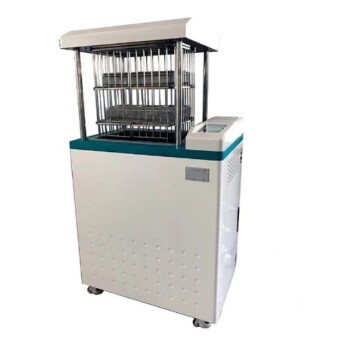
A laboratory autoclave functions as a specialized thermochemical reactor designed to overcome the natural recalcitrance of plant biomass. It creates a controlled environment of high temperature (typically 121°C) and elevated pressure (e.g., 1.1 bar) to drive dilute acid solutions into the dense lignocellulosic structure, significantly accelerating the breakdown of complex plant cell walls compared to atmospheric heating.
The autoclave utilizes a "thermochemical coupling" of heat and pressure to force acidic reagents deep into the biomass matrix. This action dissolves hemicellulose and creates an open framework, rendering the remaining cellulose accessible for enzymatic conversion into fermentable sugars.
The Mechanism of Structural Disruption
Penetrating the Biomass Matrix
Lignocellulosic biomass (such as barley straw or Pennisetum alopecuroides) possesses a dense, resistant structure. The autoclave uses high pressure to ensure the dilute acid solution effectively penetrates the deep structures of the material.
Solubilizing Hemicellulose
The primary chemical goal within the autoclave is the dissolution of hemicellulose. The high-temperature acidic environment hydrolyzes hemicellulose into soluble sugars, effectively stripping this layer away from the cellulose and lignin.
Exposing the Cellulose Core
By removing hemicellulose and disrupting lignin, the process reduces the structural recalcitrance of the biomass. This leaves behind an "open" cellulose framework that enzymes can easily attack during subsequent hydrolysis steps.
Critical Operational Conditions
Temperature Acceleration
Standard operation often targets 121°C. At this temperature, the kinetic energy accelerates the hydrolysis reaction between the acid and the lignocellulose much faster than standard boiling or atmospheric heating could achieve.
Pressure Saturation
Operating at roughly 1.1 bar prevents the reagents from evaporating despite the high heat. This maintains the liquid phase necessary to keep the biomass fully saturated in the acidic medium throughout the reaction.
Understanding the Trade-offs and Risks
The Corrosion Challenge
While effective, dilute acids (such as sulfuric, hydrochloric, or nitric acid) become extremely corrosive under the high-temperature conditions of an autoclave. Standard stainless steel vessels may degrade rapidly.
Equipment Material Requirements
To ensure safety and equipment longevity, the pressure vessel must be manufactured from corrosion-resistant materials. This is not only to prevent leaks but to avoid introducing metal impurity ions into the sample, which can inhibit downstream fermentation.
Balancing Intensity and Degradation
The environment must be carefully controlled. While high heat and pressure improve accessibility, excessive severity can lead to the formation of fermentation inhibitors or the degradation of the desired sugars.
Making the Right Choice for Your Goal
Optimizing your pretreatment strategy requires balancing structural disruption with equipment capabilities.
- If your primary focus is Process Efficiency: Ensure your autoclave can sustain 121°C at 1.1 bar to maximize hemicellulose dissolution and shorten downstream enzymatic hydrolysis times.
- If your primary focus is Sample Purity and Safety: Verify that your autoclave liner and piping are chemically compatible with your specific acid (e.g., hydrochloric vs. sulfuric) to prevent metal ion contamination.
The autoclave is not just a heating device; it is the key to unlocking the carbohydrate energy stored within resistant plant structures.
Summary Table:
| Parameter | Typical Setting | Function in Pretreatment |
|---|---|---|
| Temperature | 121°C | Accelerates hydrolysis kinetics and hemicellulose dissolution |
| Pressure | ~1.1 bar | Maintains liquid phase and forces acid into dense biomass structures |
| Reagent | Dilute Acid | Chemically breaks down cell wall components (hemicellulose) |
| Material | Corrosion-Resistant | Ensures safety and prevents metal ion contamination of samples |
Revolutionize Your Biomass Research with KINTEK
Don't let equipment corrosion or inconsistent heating stall your research. KINTEK specializes in high-performance laboratory solutions, providing the high-temperature high-pressure reactors and autoclaves essential for rigorous thermochemical pretreatments.
Whether you are processing lignocellulosic biomass or developing advanced biofuels, our corrosion-resistant systems ensure sample purity and operational safety. Beyond reactors, we offer a comprehensive range of crushing and milling systems for feedstock preparation, PTFE products and ceramics, and cooling solutions for post-reaction stability.
Ready to scale your results? Contact KINTEK today to discover how our precision-engineered equipment can enhance your laboratory's efficiency and accuracy.
References
- Ming Yang. The use of lignocellulosic biomass for fermentative butanol production in biorefining processes. DOI: 10.14214/df.202
This article is also based on technical information from Kintek Solution Knowledge Base .
Related Products
- Desktop Fast Laboratory Autoclave Sterilizer 35L 50L 90L for Lab Use
- Desktop Fast High Pressure Laboratory Autoclave Sterilizer 16L 24L for Lab Use
- Desktop Fast Laboratory Autoclave Sterilizer 20L 24L for Lab Use
- Portable High Pressure Laboratory Autoclave Steam Sterilizer for Lab Use
- Laboratory High Pressure Horizontal Autoclave Steam Sterilizer for Lab Use
People Also Ask
- What is the primary function of a laboratory autoclave in the pre-treatment of medical plastic waste for liquid fuel?
- What is an autoclave laboratory equipment? The Ultimate Guide to Steam Sterilization
- What precautions should be taken during autoclave in laboratory? A Complete Safety Guide to Prevent Burns and Explosions
- What extreme conditions does a laboratory autoclave simulate? Testing Wear Resistance of Nuclear Fuel Cladding
- Why is a laboratory autoclave necessary for Postgate Medium B (PMB)? Ensure Pure SRB Cultures & Accurate MIC Research