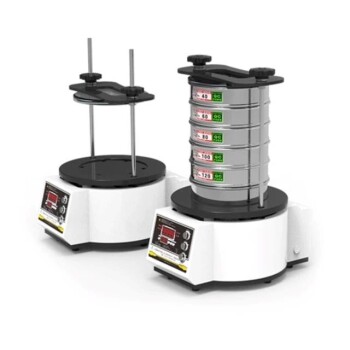
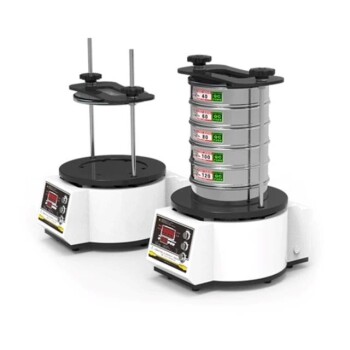
Standard sieves are the primary tool for ensuring particle size uniformity in biomass powder during material preparation. By filtering crushed material through precise mesh apertures, sieves eliminate size variances that would otherwise cause inconsistent chemical reactions, uneven heat transfer, and structural weaknesses in the final product. This process is the foundation for achieving predictable, high-performance results in biomass-derived materials.
Core Takeaway: Using standard sieves transforms raw crushed biomass into a predictable feedstock by standardizing particle size distribution. This uniformity is essential for synchronized chemical activation, stable thermal processing, and the structural integrity of molded biomass products.
Maximizing Chemical and Thermal Efficiency
Improving Specific Surface Area
Standard sieves, such as the No. 60 sieve (0.25 mm), ensure that biomass particles remain below a specific size threshold. Smaller particles provide a larger specific surface area, which is critical for ensuring uniform heating and higher heat transfer efficiency within a reactor.
Synchronizing Reaction Rates
Uniformity in particle size is vital for achieving a homogeneous mixture with chemical activators like KOH or H3PO4. When particles are consistent in size, the activation reaction occurs simultaneously across the entire batch, leading to a regular pore structure and stable performance in the final composite.
Reducing Heat and Mass Transfer Resistance
Utilizing specific ranges, such as 280 µm to 450 µm, eliminates uneven internal resistance during combustion or pyrolysis. This consistency allows researchers to isolate and study specific variables, such as temperature or atmospheric conditions, without the interference of size-induced thermal gradients.
Optimizing Physical Properties and Structural Integrity
Enhancing Packing Density and Flowability
Standardized sieving optimizes the flowability and packing density of biomass powder during the compression stage. By ensuring a consistent distribution, particles fill the mold more efficiently, which significantly increases the mechanical strength and molding stability of the resulting pellets.
Reducing Equipment Wear and Stress Points
Large, oversized particles or foreign matter can cause excessive mold wear during the pelletizing process. Sieving removes these outliers, eliminating internal stress concentration points that often lead to cracks and instability in biomass briquettes.
Ensuring Material Uniformity
For carbonized materials, selecting a narrow range—such as 75 µm to 120 µm—ensures consistent heat transfer during carbonization. This precision is the key to obtaining structural uniformity in biomass-derived carbon, which is essential for high-end technical applications.
Guaranteeing Reproducibility in Laboratory Analysis
Eliminating Kinetic Effects
In thermogravimetric analysis (TGA) and chemical extraction, particle size variations can introduce kinetic effects where larger particles take longer to react or extract. Standard laboratory sieves (e.g., 0.25 to 1.0 mm) eliminate these inconsistencies, ensuring that experimental data is reproducible and accurate.
Standardizing Feedstock Specifications
Using standard analysis sieves allows laboratories to meet predefined specifications, such as a 100 mesh requirement. This standardization ensures that different batches of biomass are comparable, which is critical for validating research results and industrial scaling.
Understanding the Trade-offs
Sieve Blinding and Processing Time
While finer sieving improves reactivity, it also increases the risk of sieve blinding, where moist or resinous biomass particles clog the mesh. This requires more frequent cleaning and can extend the material preparation timeline.
Material Yield and Waste
Strictly controlling particle size to a narrow range can lead to significant material loss if the initial grinding process is not well-calibrated. Producers must balance the need for extreme uniformity against the economic cost of discarding particles that fall outside the target specification.
How to Apply This to Your Project
Standard sieving should be viewed as a quality-control gate that directly impacts the success of your downstream processes.
- If your primary focus is Activated Carbon Production: Use precise analytical sieves to ensure synchronized chemical activation and a highly regular pore structure.
- If your primary focus is Biomass Pelletizing or Briquetting: Prioritize sieves that remove oversized particles to reduce mold wear and enhance the mechanical strength of the final product.
- If your primary focus is Thermal Analysis (TGA): Utilize a controlled size range (typically 0.25–1.0 mm) to eliminate kinetic variations and ensure that results accurately reflect material chemistry.
By standardizing particle size through professional sieving, you eliminate the primary source of variability in biomass material preparation.
Summary Table:
| Benefit Category | Key Impact on Biomass Processing | Recommended Sieve/Range |
|---|---|---|
| Chemical Efficiency | Synchronizes reaction rates and ensures regular pore structure. | No. 60 Sieve (0.25 mm) |
| Thermal Performance | Reduces mass transfer resistance and ensures uniform heating. | 280 µm to 450 µm |
| Physical Integrity | Optimizes packing density and reduces internal stress points. | Process-specific range |
| Lab Reproducibility | Eliminates kinetic effects in TGA and chemical extraction. | 0.25 mm to 1.0 mm |
| Equipment Longevity | Removes oversized particles to prevent mold and press wear. | Scalp sieving |
| Material Quality | Ensures structural uniformity for high-end carbon applications. | 75 µm to 120 µm |
Elevate Your Biomass Research with KINTEK Precision
Consistency is the foundation of breakthrough material science. KINTEK specializes in high-performance laboratory equipment and consumables designed to eliminate variables in your material preparation. Whether you are optimizing activated carbon or scaling biomass pellet production, our comprehensive range provides the precision you need:
- Preparation & Processing: Advanced crushing and milling systems, high-accuracy sieving equipment, and durable hydraulic presses (pellet, hot, isostatic).
- Thermal Treatment: A full suite of high-temperature furnaces (muffle, vacuum, CVD, PECVD) and high-temperature high-pressure reactors.
- Analysis & Storage: Electrolytic cells, cooling solutions (ULT freezers, freeze dryers), and essential consumables like PTFE and ceramics.
Ready to standardize your results? Contact our technical experts today to find the perfect sieving and processing solution for your laboratory’s unique requirements.
References
- Xifeng Lv, Fang Wang. Waste Plastic Polypropylene Activated Jujube Charcoal for Preparing High-Performance Phase Change Energy Storage Materials. DOI: 10.3390/nano13030552
This article is also based on technical information from Kintek Solution Knowledge Base .
Related Products
- Custom PTFE Teflon Parts Manufacturer for PTFE Mesh F4 Sieve
- Laboratory Test Sieves and Sieving Machines
- Vibratory Sieve Shaker Machine Dry Three-Dimensional Vibrating Sieve
- Laboratory Vibratory Sieve Shaker Machine Slap Vibrating Sieve
- Three-dimensional electromagnetic sieving instrument
People Also Ask
- What are the primary reasons for selecting PTFE as a matrix? Enhance Composites with Carbon Nanotube Reinforcement
- How is PTFE utilized for insulation in Alloy 22 corrosion setups? Ensure Signal Purity & Accuracy
- Is PTFE corrosion resistant? Discover the Ultimate Chemical Resistance for Your Lab
- What are the specific applications of PTFE in micro-batch slug flow systems? Enhance Your Microfluidic Reaction Purity
- What is the mesh size of a sieve? A Guide to Particle Size and Sieve Selection