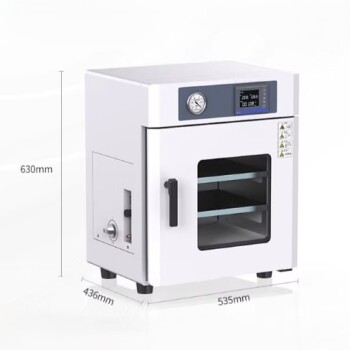
The use of a vacuum drying oven is a mandatory pretreatment step for metal powders like V-4.9Ti-4.8Cr and 17Cr-12Ni-Fe to guarantee the structural integrity of your final composite.
By treating these powders at temperatures between 150-200 °C in a vacuum, you effectively eliminate adsorbed moisture and volatile impurities from particle surfaces. This specific method allows you to apply necessary heat to the materials without exposing them to oxygen, preventing the very defects you are trying to avoid.
Core Takeaway This process is not merely about drying; it is a critical quality assurance mechanism. By removing moisture in a vacuum environment, you simultaneously ensure the powder flows correctly during manufacturing and prevent the formation of gas pores and oxidation defects in the final cladding layers.
Eliminating Surface Contaminants
Before you can process these alloys, you must ensure the raw material is chemically pure and physically stable.
Removing Adsorbed Moisture
Metal powders have a high surface area and naturally adsorb moisture from the surrounding environment.
If left untreated, this moisture interferes with the composite preparation. Vacuum drying effectively strips this water away, ensuring the base material is pristine.
Clearing Volatile Impurities
Beyond water, powders often retain residues from previous processing steps, such as solvents or hydroxyl (OH) groups.
Subjecting the powder to heat under vacuum pressure drives off these volatiles. This prevents them from reacting chemically during later high-temperature stages.
Ensuring Process Stability
The physical behavior of your powder during manufacturing is just as important as its chemical composition.
Optimizing Powder Flowability
Moisture acts like a glue, causing fine metal particles to agglomerate or clump together.
Vacuum drying ensures the particles remain loose and distinct. This improves flowability, which is critical for operations like laser additive manufacturing where the powder must be spread uniformly.
Preventing Gas Pore Formation
If moisture remains on the powder, it will vaporize instantly when hit by a high-energy source like a laser.
This trapped gas creates voids or gas pores within the melted material. These pores become permanent structural weaknesses in the final composite layer.
The Specific Advantage of Vacuum Environments
You might ask why a standard drying oven is insufficient. The answer lies in the reactivity of the metals.
Preventing Secondary Oxidation
Metals like Titanium (Ti) and Vanadium (V) found in your specific alloy are highly reactive to oxygen, especially when heated.
A standard oven would dry the powder but oxidize the metal surface in the process. A vacuum oven reduces the oxygen partial pressure, allowing you to heat the powder to dry it without causing secondary oxidation.
Preserving Material Purity
This low-oxygen environment is essential for maintaining the purity of the raw materials.
It ensures that no new oxide inclusions are introduced into the matrix. This is vital for achieving high-performance mechanical properties in the final steel or alloy composite.
Understanding the Trade-offs
While vacuum drying is technically superior for these materials, it introduces specific operational constraints.
Batch Processing Limitations
Vacuum drying is typically a batch process, which can limit throughput compared to continuous drying methods.
You must account for the time required to pump down the chamber and cool the material under vacuum to prevent oxidation upon exit.
Equipment Complexity
Vacuum systems require rigorous maintenance of seals and pumps to ensure the environment remains contaminant-free.
A failure in the vacuum seal during the heating phase can ruin an entire batch of powder by exposing hot metal to air.
Making the Right Choice for Your Goal
The specific parameters you choose should align with your primary manufacturing objective.
- If your primary focus is Layer Uniformity: Prioritize drying to ensure maximum flowability, preventing clumping that disrupts powder bed spreading.
- If your primary focus is Mechanical Strength: Focus on the vacuum integrity to prevent oxidation and gas pores, which act as crack initiation sites in the final part.
- If your primary focus is Chemical Purity: Ensure the drying temperature is sufficient (150-200 °C) to remove all volatile residues without exceeding the sintering point of the powder.
By controlling the atmosphere and temperature during pretreatment, you secure the foundation for a defect-free, high-performance composite material.
Summary Table:
| Feature | Impact on Metal Powders | Benefit for Composite Preparation |
|---|---|---|
| Moisture Removal | Eliminates adsorbed water & OH groups | Prevents gas pore formation & structural voids |
| Vacuum Environment | Reduces oxygen partial pressure | Prevents secondary oxidation of Ti and V alloys |
| Volatile Stripping | Removes chemical residues/solvents | Ensures chemical purity of the cladding layer |
| Agglomeration Control | Prevents particle clumping | Optimizes powder flowability for laser processing |
| Temperature (150-200°C) | Targeted thermal drying | Effectively dries without reaching sintering points |
Elevate Your Material Integrity with KINTEK
Don’t let moisture and oxidation compromise your high-performance alloys. KINTEK specializes in precision vacuum drying ovens and a comprehensive range of laboratory equipment—including high-temperature furnaces, crushing and milling systems, and hydraulic presses—designed specifically for demanding metallurgy and battery research.
Whether you are processing V-Ti-Cr alloys or 17Cr-12Ni-Fe steel, our solutions ensure maximum powder flowability and defect-free manufacturing. Contact KINTEK today to optimize your pretreatment process and secure the mechanical strength of your final composites.
References
- T. V. Dement, Natalia Karakchieva. Structure and phase composition of material based on vanadium alloy V-4.9Ti-4.8Cr and ferrite steel 17Cr-12Ni-Fe. DOI: 10.1051/matecconf/201824300019
This article is also based on technical information from Kintek Solution Knowledge Base .
Related Products
- 56L Vertical Laboratory Vacuum Drying Oven
- 23L Laboratory Vacuum Drying Oven
- Laboratory Scientific Electric Heating Blast Drying Oven
- Benchtop Laboratory Vacuum Freeze Dryer
- Dental Porcelain Zirconia Sintering Ceramic Vacuum Press Furnace
People Also Ask
- Why is a laboratory vacuum drying oven recommended for rice straw residues? Protect Your Biomass Integrity
- What role does a laboratory vacuum drying oven play in the preparation of modified multi-walled carbon nanotubes?
- What is the importance of using a laboratory vacuum drying oven? Preserving Slow-Release Microcapsule Integrity
- Why is a Laboratory Vacuum Drying Oven recommended for PBAT microspheres? Protect Sensitive Polymer Integrity
- What role does a laboratory vacuum drying oven play in processing nanoparticle powder samples? Protect Sample Integrity