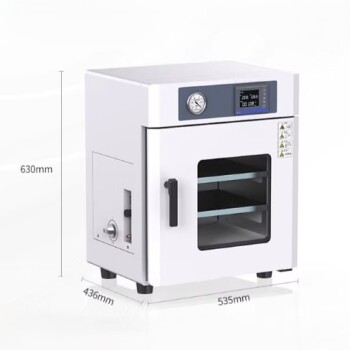
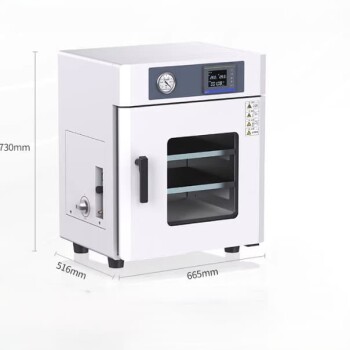
The electrothermal constant temperature blast drying oven serves as the critical thermal reactor for the solvothermal synthesis of Covalent Organic Framework (COF) materials. Rather than simply drying materials, it provides a stable, sustained high-temperature environment (typically around 120°C) for extended periods, which is the primary driver for the chemical reactions required to build these complex materials.
Core Insight: In this context, the oven acts as a thermodynamic regulator, not a dehydrator. It supplies the continuous thermal energy necessary to drive Schiff base condensation, ensuring the transformation of raw precursors into ordered, high-crystallinity porous frameworks.
The Thermodynamic Requirement for COF Synthesis
To understand the oven's role, you must look beyond the equipment's name and focus on the thermodynamic needs of the chemical reaction.
Sustaining Reaction Energy
COF synthesis is rarely instantaneous. It requires a specific thermal profile maintained over a long duration—often up to three days.
The electrothermal constant temperature blast drying oven ensures that the thermal energy supplied to the reaction vessels remains constant throughout this extended period.
Driving the Chemical Mechanism
The specific reaction utilized in this synthesis is Schiff base condensation.
This reaction occurs between donor molecules (such as TAPP) and acceptor linkers. The sustained heat provided by the oven is the external force that pushes this reaction forward.
Achieving Structural Integrity
The difference between a failed experiment and a successful COF material lies in the arrangement of the molecules.
From Amorphous to Crystalline
Without precise thermal control, the reaction would likely result in an amorphous solid—a disordered mess of molecules with no defined structure.
The constant temperature provides the necessary conditions for the material to self-assemble into an ordered lattice. This results in high-crystallinity porous framework structures, which are the defining characteristic of functional COF materials.
Uniformity Through Air Circulation
The "blast" feature of the oven refers to forced air circulation.
This ensures that heat is distributed evenly throughout the chamber, preventing "hot spots" or "cold spots" that could lead to inconsistent reaction rates across different synthesis vessels.
Understanding the Trade-offs
While the blast drying oven is essential for the synthesis phase, it is vital to distinguish its role from other laboratory thermal processes.
Synthesis vs. Precursor Drying
It is important not to confuse the synthesis phase with the precursor drying phase.
As noted in comparative processes (such as Pyr-IHF synthesis), a vacuum drying oven is often preferred for drying raw precursors to remove solvents like ethanol. Vacuum ovens operate at lower temperatures (e.g., 80°C) to prevent oxidation.
The Oxidation Risk
The blast oven typically circulates ambient air.
Therefore, for solvothermal synthesis, the reaction mixture is usually contained within sealed vessels (like autoclaves or ampoules) placed inside the oven. This utilizes the oven's heat while protecting the chemicals from the oxidation that might occur if they were exposed directly to the circulating air.
Making the Right Choice for Your Goal
Selecting the right thermal equipment depends entirely on which stage of the fabrication process you are executing.
- If your primary focus is driving the COF reaction: Use the electrothermal blast oven to maintain high temperatures (120°C) for days to ensure Schiff base condensation and high crystallinity.
- If your primary focus is preparing sensitive precursors: Use a vacuum drying oven at lower temperatures to remove solvents while preventing powder oxidation and agglomeration.
Ultimately, the electrothermal blast oven acts as the architect of the material, converting raw thermal energy into precise structural order.
Summary Table:
| Feature | Role in COF Synthesis | Benefit to Material |
|---|---|---|
| Sustained Heat | Drives Schiff base condensation for 3+ days | Ensures complete reaction conversion |
| Temperature Stability | Maintains a constant thermal profile (e.g., 120°C) | Promotes ordered self-assembly & crystallinity |
| Forced Air Blast | Ensures uniform heat distribution in the chamber | Eliminates hot spots for consistent batch quality |
| Thermodynamic Control | Acts as a reactor environment rather than a dehydrator | Transforms amorphous precursors into porous frameworks |
Precision is paramount in COF synthesis. KINTEK provides the high-performance laboratory equipment needed to master your thermodynamic reactions. From electrothermal blast ovens and high-temperature high-pressure reactors for solvothermal synthesis to vacuum drying ovens and isostatic presses for precursor preparation, we empower researchers to achieve superior material crystallinity. Contact KINTEK today to discover how our advanced furnaces, crushing systems, and cooling solutions can optimize your laboratory’s workflow and experimental accuracy.
Related Products
- Laboratory Scientific Electric Heating Blast Drying Oven
- 23L Laboratory Vacuum Drying Oven
- 56L Vertical Laboratory Vacuum Drying Oven
- High Temperature Muffle Oven Furnace for Laboratory Debinding and Pre Sintering
People Also Ask
- How does a laboratory electric drying oven contribute to the formation of the initial coating? Expert Insights
- What role does a precision laboratory drying oven play in the synthesis of GO-PANI nanocomposites? Protect Material Integrity
- What role does a laboratory drying oven play in the preparation of zinc oxide nanoparticle precursors?
- What is the necessity of using a laboratory drying oven when processing MoO3/GO composite nanopowders? Find out here.
- What is the role of a laboratory drying oven in cellulose citrate production? Ensure Material Stability & Purity