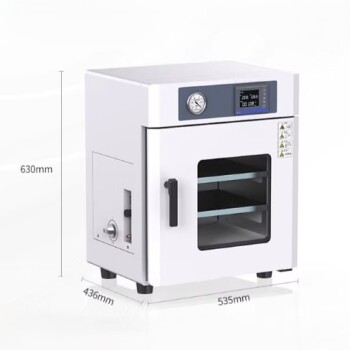
In the context of W18Cr4V steel preparation, the laboratory oven serves a critical preservation function by maintaining a constant temperature of 60°C to rapidly dry samples immediately after cleaning. Its primary purpose is to eliminate residual surface moisture effectively, ensuring the steel remains chemically stable and free from corrosion prior to further testing.
The oven is not merely a drying tool; it is a contamination control device. By removing moisture immediately, it prevents secondary oxidation that would otherwise compromise the accuracy of metallographic polishing and X-ray diffraction (XRD) results.
The Critical Role of Moisture Control
Preventing Secondary Oxidation
After the initial cleaning process, W18Cr4V steel samples retain microscopic amounts of water on their surface. If left to air dry, this moisture can react with the iron and alloying elements in the steel.
The laboratory oven accelerates evaporation to remove this moisture before it can cause secondary oxidation. This ensures that the surface composition remains authentic to the sample's original state.
Ensuring Analytical Accuracy
Microstructural analysis relies on the purity of the sample surface. If oxidation occurs during storage or drying, the resulting rust layer effectively hides the true microstructure.
This is particularly critical for X-ray diffraction (XRD) and metallographic polishing. The oven ensures the sample is completely dry, preventing oxide artifacts from skewing diffraction patterns or interfering with abrasive polishing steps.
Operational Specifics
The 60°C Standard
The oven is specifically set to a constant temperature of 60 degrees Celsius. This specific temperature is chosen to balance efficiency with material safety.
It is high enough to induce rapid evaporation of water. However, it is low enough to ensure the drying process does not thermally alter the steel's microstructure.
Storage Stability
Samples are rarely analyzed immediately after cutting and cleaning. There is often a lag time between preparation and analysis.
By thoroughly drying the sample in the oven, you stabilize it for storage. This allows you to queue samples for analysis without fear of environmental degradation over time.
Understanding the Trade-offs
Temperature Limits and Microstructure
While drying is essential, the specific temperature of 60°C is a calculated constraint. W18Cr4V is a high-speed steel often subject to specific heat treatments.
Using a significantly higher temperature to dry the sample faster could inadvertently act as a low-temperature tempering cycle. This would subtly alter the microstructure you are trying to measure. Adhering strictly to 60°C avoids this pitfall.
The Risk of Ambient Drying
One might be tempted to skip the oven and allow samples to air dry to save energy. This is a false economy in high-precision analysis.
Ambient drying is slow and uncontrolled, giving oxidation ample time to set in. The time saved in equipment setup is lost later when samples must be re-polished to remove surface rust.
Making the Right Choice for Your Goal
To ensure your microstructural data is valid, strict adherence to drying protocols is required.
- If your primary focus is Long-Term Storage: Ensure the sample is dried at 60°C immediately after cleaning to prevent atmospheric corrosion during the waiting period.
- If your primary focus is XRD Analysis: Use the oven to guarantee the surface is free of water-induced oxides that would appear as noise or false peaks in your diffraction data.
Proper drying is the silent guardian of analytical precision.
Summary Table:
| Feature | Specification/Requirement | Impact on W18Cr4V Steel |
|---|---|---|
| Temperature Setting | Constant 60°C | Rapid evaporation without altering microstructure |
| Primary Goal | Moisture Removal | Prevents secondary oxidation and surface rust |
| Analytical Benefit | Surface Purity | Ensures clean XRD diffraction and accurate polishing |
| Storage Strategy | Post-Cleaning Drying | Maintains chemical stability for long-term storage |
| Risk Factor | Ambient Air Drying | Causes slow oxidation and unreliable analytical data |
Precision in metallurgy starts with the right equipment. KINTEK provides top-tier laboratory ovens and high-temperature furnaces designed to meet the rigorous demands of material science. From preparing steel samples for XRD to advanced heat treatment, our comprehensive range—including muffle, vacuum, and tube furnaces, as well as crushing systems and hydraulic presses—ensures your research remains accurate and contamination-free. Enhance your lab's performance with KINTEK's expert solutions. Contact our specialists today to find the perfect fit for your research!
References
- Xiaogang Fu, Shasha Lv. A Study on the Aging Behavior of Nitrided W18Cr4V Steel in High-Temperature Sodium. DOI: 10.3390/met14030357
This article is also based on technical information from Kintek Solution Knowledge Base .
Related Products
- Laboratory Scientific Electric Heating Blast Drying Oven
- 56L Vertical Laboratory Vacuum Drying Oven
- 23L Laboratory Vacuum Drying Oven
- 1200℃ Muffle Furnace Oven for Laboratory
- 1700℃ Muffle Oven Furnace for Laboratory
People Also Ask
- How does a laboratory electric drying oven contribute to the formation of the initial coating? Expert Insights
- What role does a precision laboratory drying oven play in the synthesis of GO-PANI nanocomposites? Protect Material Integrity
- What role does a laboratory drying oven play in the preparation of zinc oxide nanoparticle precursors?
- What is the necessity of using a laboratory drying oven when processing MoO3/GO composite nanopowders? Find out here.
- What is the role of a laboratory drying oven in cellulose citrate production? Ensure Material Stability & Purity