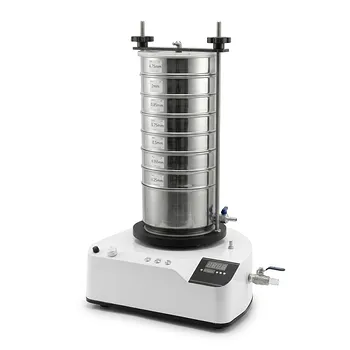
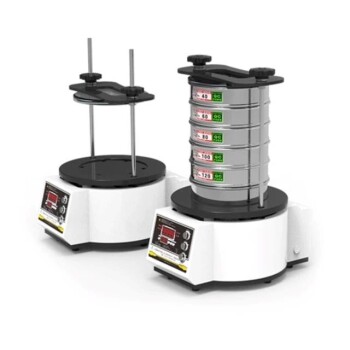
The primary purpose of using stainless steel test sieves in the pretreatment of biosolids and cardboard is to achieve precise control over particle size distribution. By narrowing raw materials into specific ranges—such as 355–710 µm—researchers ensure consistent heat transfer and predictable diffusion paths during the subsequent pyrolysis process. This standardization is a mandatory prerequisite for accurately studying how different operational parameters influence the physical properties and quality of the resulting biochar.
Core Takeaway: Stainless steel test sieves serve as a high-precision calibration tool that eliminates particle size as a variable. This ensures that any observed changes in biochar quality are the result of controlled process parameters rather than inconsistencies in the raw feedstock.
Optimizing the Thermochemical Environment
Ensuring Uniform Heat Transfer
During pyrolysis, heat must penetrate from the surface of the biosolid or cardboard particle to its core. Consistent particle sizing prevents the uneven heating that occurs when smaller particles over-process (flash pyrolysis) while larger particles remain under-processed.
Facilitating Predictable Mass Diffusion
As biomass decomposes, gases must escape from the interior of the particle to the surrounding environment. Uniform diffusion paths created by standardized sizing ensure that these volatile compounds are released at a consistent rate, leading to a more homogenous final product.
Standardizing Adsorption Surface Area
The effectiveness of biochar often depends on its surface area and pore structure. By using sieves to maintain a consistent particle size distribution, researchers can eliminate variations in adsorption capacity that would otherwise be caused by a random mix of large and small granules.
Enhancing Experimental Integrity and Repeatability
Isolating Operational Variables
In a laboratory setting, the goal is often to test how temperature or residence time affects the biochar. Using precision-grade stainless steel sieves allows researchers to "lock" the particle size variable, ensuring that the data collected is scientifically valid and not skewed by feedstock irregularities.
Meeting International Standards
Stainless steel sieves often comply with ASTM or ISO standards, which provides a universal language for researchers. This compliance ensures that an experiment conducted on biosolids in one facility can be accurately replicated and verified by another laboratory anywhere in the world.
Improving Analytical Accuracy
Beyond the pyrolysis process itself, sieves are used for powder and particle analysis to determine impurity content and solid-to-liquid ratios. This granular data helps in identifying contaminants or byproducts that could affect the efficiency of the pretreatment phase.
Understanding the Trade-offs and Limitations
The Challenge of Particle Shape
Sieving operates on the assumption that particles are perfect spheres, which is rarely the case with fibrous cardboard or irregular biosolids. Long, needle-like particles may pass through a mesh vertically even if their length exceeds the nominal aperture size, leading to slight variations in volume.
Maintenance and Mesh Blinding
Biosolids can be inherently "sticky" or moist, which often leads to mesh blinding, where particles plug the openings of the sieve. To maintain accuracy, these instruments require frequent ultrasonic cleaning and regular calibration to ensure the mesh has not been stretched or damaged.
Material Attrition
The physical act of shaking or vibrating material through a sieve stack can cause particle attrition, where more fragile materials break down into smaller pieces during the process itself. This can result in a higher percentage of "fines" than were present in the original raw sample, slightly altering the distribution data.
Selecting the Right Approach for Your Application
How to Apply This to Your Project
- If your primary focus is scientific research and publication: Use ASTM-certified stainless steel sieves in a stacked configuration with a mechanical shaker to ensure maximum data repeatability.
- If your primary focus is industrial scale-up of biochar: Focus on identifying the broadest acceptable size range that still maintains product quality to minimize the energy costs associated with over-milling and fine-sieving.
- If your primary focus is equipment longevity: Implement a multi-stage sieving process to remove oversized contaminants early, protecting downstream pyrolysis reactors from potential blockages or uneven wear.
By mastering particle size distribution through precise sieving, you transform raw waste into a standardized technical feedstock capable of producing high-value, consistent biochar.
Summary Table:
| Key Benefit | Technical Impact | Result |
|---|---|---|
| Particle Size Control | Narrowing raw materials to specific ranges (e.g., 355–710 µm) | Consistent heat transfer and diffusion |
| Heat Uniformity | Prevents flash pyrolysis in fines and under-processing in large particles | Homogenous biochar quality |
| Experimental Integrity | Isolates particle size as a controlled variable | Scientifically valid and repeatable data |
| Standard Compliance | Meets ASTM and ISO international standards | Global comparability of research results |
Elevate Your Biochar Research with KINTEK Precision
Consistency in pretreatment is the foundation of high-quality biochar. KINTEK provides the high-precision laboratory tools you need to standardize your feedstock and optimize your thermochemical processes. From ASTM-certified stainless steel sieving equipment and crushing and milling systems to advanced high-temperature furnaces (muffle, vacuum, and tube) and high-pressure reactors, we offer a comprehensive portfolio designed for experimental excellence.
Ready to achieve superior particle distribution and process control? Contact our experts today to find the perfect solution for your lab!
References
- Shifa Zuhara, Gordon McKay. Pyrolysis of biosolids with waste cardboard: effect of operating parameters, feedstock size and blending ratio. DOI: 10.1007/s13762-023-04963-0
This article is also based on technical information from Kintek Solution Knowledge Base .
Related Products
- Custom PTFE Teflon Parts Manufacturer for PTFE Mesh F4 Sieve
- Laboratory Test Sieves and Sieving Machines
- Battery Lab Equipment 304 Stainless Steel Strip Foil 20um Thick for Battery Test
- Laboratory Test Sieves and Vibratory Sieve Shaker Machine
- Laboratory Vibratory Sieve Shaker Machine Slap Vibrating Sieve
People Also Ask
- What are the primary reasons for selecting PTFE as a matrix? Enhance Composites with Carbon Nanotube Reinforcement
- How is PTFE utilized for insulation in Alloy 22 corrosion setups? Ensure Signal Purity & Accuracy
- Is PTFE corrosion resistant? Discover the Ultimate Chemical Resistance for Your Lab
- What are the specific applications of PTFE in micro-batch slug flow systems? Enhance Your Microfluidic Reaction Purity
- What is the mesh size of a sieve? A Guide to Particle Size and Sieve Selection