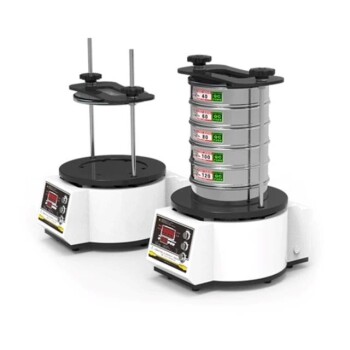
The primary purpose of a 200-mesh sieve in biochar processing is to provide a precise physical barrier that intercepts micron-sized particles while allowing washing liquids to pass through. This ensures a high recovery rate of modified biochar and the thorough removal of unreacted reagents, which is essential for maintaining the purity of the sample for subsequent drying and performance testing.
The use of a 200-mesh sieve serves as a critical bridge between chemical modification and physical characterization. It optimizes the balance between material retention and the rapid filtration of residual solutions to ensure chemical consistency.
Maximizing Material Recovery and Chemical Purity
Efficient Particle Retention
A 200-mesh sieve features openings of approximately 75 microns, which is the ideal threshold for capturing micron-sized biochar particles, such as those derived from walnut shells. By acting as a high-precision filter, the sieve prevents the loss of valuable modified material during the high-volume rinsing required after chemical treatment.
Rapid Removal of Residual Reagents
The sieve structure allows excess modification solutions and washing liquids to pass through rapidly and efficiently. This speed is vital for performing repeated rinsing cycles, which effectively flush out unreacted reagents that could otherwise skew experimental results or interfere with the biochar's chemical stability.
Preliminary Separation of Impurities
Beyond capturing the target biochar, the sieve serves as a tool to filter out coarse residual fibers or unreacted solid biomass that may remain after hydrolysis. This preliminary step ensures that the resulting liquid or slurry is relatively clear, which is necessary to protect downstream analytical equipment, such as HPLC columns, from damage.
Ensuring Scientific Integrity in Characterization
Standardization of Particle Size
Using a standard 200-mesh sieve ensures that the finished biochar product has a high degree of uniformity. Consistent particle size is foundational for achieving predictable mass transfer rates and fluid dynamic characteristics during industrial applications and laboratory adsorption experiments.
Optimization of Specific Surface Area
In studies involving adsorption kinetics, the specific surface area is directly influenced by the particle size. By grading the biochar to a 200-mesh specification, researchers can maximize the effective contact area between the biochar and the target medium, leading to more accurate and reproducible kinetic data.
Enhancing Thermal and Reaction Stability
For applications involving combustion or gasification, a uniform 200-mesh particle size ensures even heat conduction and eliminates internal mass transfer resistance. This uniformity allows the reaction to proceed synchronously throughout the material bed, providing more representative ignition and burnout data during thermogravimetric analysis (TGA).
Understanding the Trade-offs
The Conflict Between Retention and Flow Rate
While a finer mesh (such as 500-mesh) would capture even smaller particles, it significantly decreases the filtration speed. The 200-mesh sieve is generally chosen as the "sweet spot" that maximizes sample recovery without causing excessive bottlenecks in the washing workflow.
Risk of Sieve Blinding
During the filtration of modified biochar, extremely fine "fines" or viscous residual reagents can cause sieve blinding, where the mesh openings become clogged. This requires careful, incremental washing techniques to maintain the sieve's effectiveness and prevent sample loss due to overflow.
Optimizing Your Biochar Filtration Strategy
How to Apply This to Your Project
- If your primary focus is high chemical purity: Use the 200-mesh sieve in conjunction with vacuum-assisted filtration to accelerate the removal of stubborn residual reagents.
- If your primary focus is adsorption kinetic accuracy: Ensure that 100% of your sample passes through or is retained by the 200-mesh threshold to maintain a strict specific surface area profile.
- If your primary focus is protecting analytical hardware: Use the sieve as a pre-filter to remove larger particulates before the sample enters sensitive stages like magnetic separation or chromatography.
By precisely controlling particle size and purity through 200-mesh filtration, you establish the rigorous material foundation necessary for reliable and scalable biochar performance.
Summary Table:
| Key Feature | Specification | Primary Benefit |
|---|---|---|
| Aperture Size | 75 Microns (200 Mesh) | Captures micron-sized particles while allowing liquid flow |
| Material Recovery | High-Precision Barrier | Prevents loss of valuable modified biochar during rinsing |
| Chemical Purity | Rapid Filtration | Efficiently flushes unreacted reagents and residual fibers |
| Data Integrity | Size Standardization | Ensures consistent surface area for adsorption kinetics |
Elevate Your Biochar Research with Precision Lab Equipment
Achieving consistent chemical consistency and high material recovery starts with the right tools. KINTEK specializes in high-performance laboratory equipment designed for the most demanding material science applications.
Whether you are processing biochar, developing advanced catalysts, or performing complex thermal analysis, we provide the reliable hardware you need:
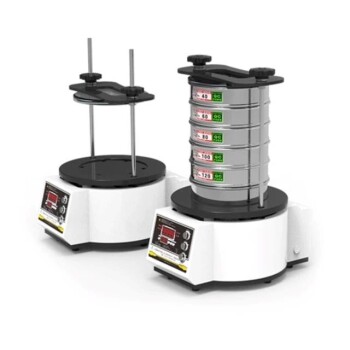
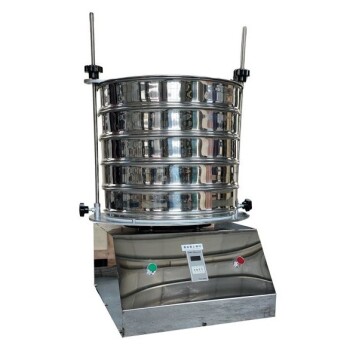
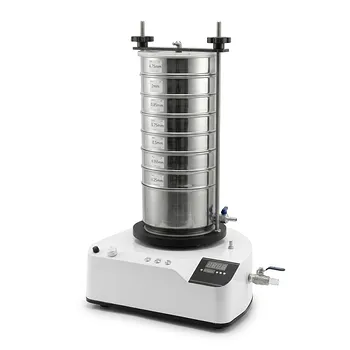
- Sieving & Milling: High-precision sieving equipment, crushing systems, and planetary ball mills for perfect particle size control.
- Thermal Processing: A comprehensive range of high-temperature furnaces (muffle, tube, vacuum, and CVD) for carbonization and activation.
- Material Preparation: Hydraulic pellet presses, high-pressure reactors, and autoclaves for advanced modification workflows.
Ensure scientific integrity in every sample. Contact KINTEK today to discuss your project requirements and discover how our specialized laboratory solutions can optimize your research outcomes.
References
- Jiankun Chen, Jianan Wang. Synthesis of Modified Walnut Shell Biochar and Its Performance of Cadmium Adsorption. DOI: 10.4236/gep.2023.119020
This article is also based on technical information from Kintek Solution Knowledge Base .
Related Products
- Vibratory Sieve Shaker Machine Dry Three-Dimensional Vibrating Sieve
- Laboratory Vibratory Sieve Shaker Machine Slap Vibrating Sieve
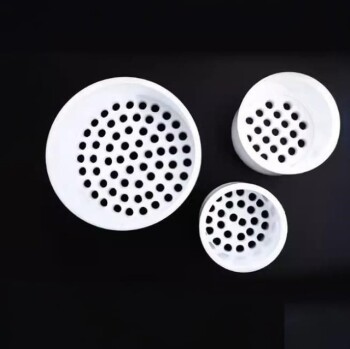
- Custom PTFE Teflon Parts Manufacturer for PTFE Mesh F4 Sieve
- Three-dimensional electromagnetic sieving instrument
- Laboratory Test Sieves and Sieving Machines
People Also Ask
- How is a vibratory sieve shaker used in the particle size analysis of mechanically alloyed powders? Expert Guide
- Why use a vibratory sieve shaker for PET powder? Achieve Precise Particle Size Control for Chemical Research
- What is the principle of vibratory sieve shaker? Achieve Accurate Particle Size Analysis
- What is the function of a vibratory sieve shaker? Achieve Precise Particle Size Analysis
- What is the use of vibratory sieve shaker? Achieve Precise Particle Size Analysis for Your Lab