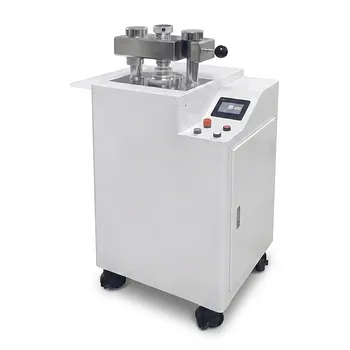
The high-pressure reactor is the foundational tool for creating high-performance NiFe-H electrodes. It provides a sealed environment that exceeds the standard boiling point of water, enabling the controlled growth of metal salt precursors directly onto nickel substrates. This pressurized, high-temperature setting is essential for achieving the specific nano-array structures and high crystallinity required for efficient and stable seawater electrolysis.
The hydrothermal autoclave acts as a precision growth chamber, utilizing high pressure and temperature to force the dissolution and recrystallization of precursors. This process ensures the formation of vertically aligned nanosheets with optimized crystal planes, which are critical for maximizing the surface area and durability of the catalytic electrode.
The Mechanics of Hydrothermal Synthesis
Overcoming Solubility Barriers
In a standard open-air environment, many metal precursors are difficult to dissolve or combine effectively. The sealed, high-pressure environment of the reactor allows the liquid medium to reach temperatures well above 100°C without boiling, significantly accelerating the dissolution and recrystallization processes.
Inducing Precision Nucleation
The reactor facilitates heterogeneous nucleation, where the catalytic material begins to grow directly on the surface of the nickel substrate rather than floating freely in the solution. This ensures a strong mechanical bond between the catalyst and the electrode base, which is vital for long-term operational stability.
Controlling Crystal Orientation
By precisely regulating the internal pressure and temperature, the autoclave allows researchers to influence the preferred growth direction of the nanocrystals. This control often induces the exposure of specific crystal planes (such as the 100 plane), which are more active for the Oxygen Evolution Reaction (OER).
Morphological Engineering on the Substrate
Building Vertical Nano-Array Structures
The reactor provides the constant temperature and pressure necessary for metal ions to grow into vertically aligned nanosheet arrays on 3D skeletons like nickel foam. This architecture creates a high specific surface area, providing more active sites for chemical reactions to occur.
Creating Complex Pore Structures
Under hydrothermal conditions, the reorganization of structures leads to the formation of complex pore networks. These pores facilitate better mass transport, allowing reactants to reach active sites more easily and helping gas bubbles escape more efficiently during electrolysis.
Establishing Atomic-Scale Interfaces
High-pressure environments can induce the formation of tight heterojunction interfaces at the atomic scale. This results in band bending and the creation of built-in electric fields, which enhance the electronic conductivity and overall efficiency of the NiFe-H electrode.
Understanding the Trade-offs
Technical Complexity and Safety
Operating high-pressure reactors requires rigorous safety protocols due to the risks of thermal expansion and pressure buildup. Improper sealing or temperature control can lead to inconsistent crystal growth or equipment failure.
Scalability vs. Precision
While hydrothermal synthesis produces superior electrode structures at a laboratory scale, scaling the process for industrial production is challenging. Large-scale high-pressure vessels are expensive to build and maintain compared to atmospheric-pressure coating methods.
Time-Intensive Processing
The dissolution and recrystallization process within an autoclave is inherently slow, often requiring several hours or days to complete. This makes the preparation of NiFe-H electrodes more time-consuming than rapid electrodeposition techniques.
How to Apply This to Your Project
Making the Right Choice for Your Goal
- If your primary focus is Maximum Catalytic Activity: Utilize the hydrothermal autoclave to induce specific crystal plane exposure and create vertically aligned nanosheets that maximize active sites.
- If your primary focus is Long-term Durability: Prioritize the high-pressure environment to ensure strong heterogeneous nucleation and high crystallinity, which prevents the catalyst from peeling off the substrate during electrolysis.
- If your primary focus is Rapid Prototyping: Consider alternative methods like electrodeposition, as the hydrothermal process requires significant time for heating, reaction, and cooling cycles.
The high-pressure reactor remains the gold standard for researchers seeking to push the boundaries of electrode efficiency and structural integrity in harsh environments like seawater electrolysis.
Summary Table:
| Mechanism | Role in Hydrothermal Synthesis | Impact on NiFe-H Electrode |
|---|---|---|
| High-Pressure Environment | Allows temperatures >100°C without boiling | Accelerates dissolution & recrystallization |
| Heterogeneous Nucleation | Growth occurs directly on the nickel substrate | Ensures strong mechanical bond & durability |
| Crystal Orientation | Regulates preferred growth directions | Exposes active crystal planes (e.g., 100 plane) |
| Morphological Control | Forms vertically aligned nanosheet arrays | Increases specific surface area & active sites |
| Interface Engineering | Induces atomic-scale heterojunctions | Enhances electronic conductivity & OER efficiency |
Elevate Your Catalytic Research with KINTEK
Precision is the key to unlocking the full potential of NiFe-H catalytic electrodes. KINTEK specializes in high-performance laboratory equipment, offering the high-temperature high-pressure reactors and autoclaves essential for achieving the specific nano-array structures and high crystallinity your research demands.
Beyond hydrothermal synthesis, our comprehensive portfolio supports your entire workflow—from crushing and milling systems and hydraulic presses for sample preparation to muffle, vacuum, and CVD furnaces for advanced heat treatments. We also provide essential electrolytic cells, electrodes, and ceramic crucibles designed to withstand rigorous laboratory conditions.
Ready to optimize your electrolysis efficiency? Contact KINTEK today to discuss how our specialized equipment and technical expertise can accelerate your material science breakthroughs.
References
- Sixie Zhang, Zhiyi Lu. Concerning the stability of seawater electrolysis: a corrosion mechanism study of halide on Ni-based anode. DOI: 10.1038/s41467-023-40563-9
This article is also based on technical information from Kintek Solution Knowledge Base .
Related Products
- Stainless High Pressure Autoclave Reactor Laboratory Pressure Reactor
- High Pressure Laboratory Autoclave Reactor for Hydrothermal Synthesis
- Mini SS High Pressure Autoclave Reactor for Laboratory Use
- Customizable High Pressure Reactors for Advanced Scientific and Industrial Applications
- Customizable Laboratory High Temperature High Pressure Reactors for Diverse Scientific Applications
People Also Ask
- Why is a laboratory high-pressure reactor used in the hydrothermal synthesis of hydroxyapatite catalysts?
- What role does a laboratory high-pressure reactor play in the leaching process of spent cathode materials? Optimize Recovery
- Why is a laboratory high-pressure reactor necessary for synthesizing fly ash-based zeolite? Achieve Pure Crystallization
- What conditions do laboratory high-pressure reactors provide for HTC? Optimize Your Biochar Production Processes
- What is the function of a high-pressure reactor autoclave? Enhancing Cu/N Co-Doped Carbon Catalyst Synthesis