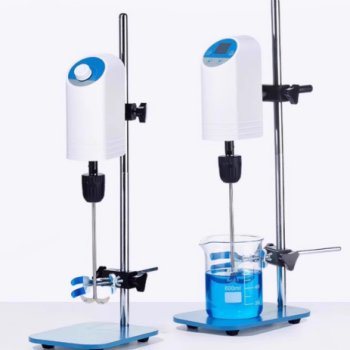
A pressure reactor equipped with an internal stirrer serves as the critical processing vessel for the effective solvent pretreatment of red oak. It creates a sealed environment capable of sustaining 120°C while using continuous agitation to force interaction between the wood particles and a solvent mixture of tetrahydrofuran (THF), water, and sulfuric acid.
The core mechanism at play is "continuous dynamic mixing." This mechanical action drives mass transfer efficiency, ensuring the solvent penetrates the biomass to dissolve lignin and hemicellulose, ultimately exposing the cellulose structure.
The Mechanics of the Pretreatment Process
Creating the Reaction Environment
The pressure reactor provides a sealed, high-temperature setting essential for the chemical reactions to occur.
To effectively treat red oak, the system must maintain a specific temperature of 120°C. This thermal energy, combined with the pressurized containment, allows the solvent mixture to remain in a liquid phase and interact aggressively with the wood fibers.
The Critical Role of the Internal Stirrer
Passive soaking is insufficient for this process; the system relies on continuous dynamic mixing.
The internal stirrer keeps the biomass particles in constant motion within the THF, water, and sulfuric acid mixture. This movement maximizes the surface area contact between the solid wood and the liquid solvent.
Enhancing Mass Transfer
The primary technical benefit of the stirrer is the enhancement of mass transfer efficiency.
By reducing boundary layers around the particles, the stirrer ensures that fresh solvent constantly replaces saturated solvent at the wood's surface. This facilitates a faster and more complete reaction than static methods would allow.
Impact on Biomass Components
Removal of Lignin and Hemicellulose
The combined effect of heat, pressure, and mixing leads to the efficient dissolution of hemicellulose and removal of lignin.
These components act as the "glue" and protective coating in the plant structure. Their removal is the primary objective of the pretreatment phase.
Opening the Structural Framework
Once the lignin and hemicellulose are stripped away, the physical structure of the red oak changes.
The process opens the structural framework of the biomass. This exposure is vital because it leaves the cellulose accessible for subsequent conversion steps.
Operational Considerations
The Necessity of Dynamic Interaction
A common pitfall in biomass pretreatment is underestimating the need for mechanical agitation.
Without the internal stirrer, the reaction would likely suffer from localized saturation. The solvent immediately surrounding the wood particles would become spent, halting the extraction of lignin even if the temperature remained correct.
Temperature and Pressure Dependency
The efficiency described is strictly tied to the 120°C operating point within a sealed vessel.
Operating below this temperature or without a sealed pressure environment would likely result in incomplete fractionation, regardless of how well the mixture is stirred.
Making the Right Choice for Your Goal
To maximize the yield of your red oak conversion, focus on the interplay between temperature and agitation.
- If your primary focus is Lignin Removal: Ensure the internal stirrer is set to a speed that prevents particle settling to maintain maximum solvent contact at 120°C.
- If your primary focus is Cellulose Accessibility: Verify that the residence time in the reactor allows for the full dissolution of hemicellulose to unblock the cellulose framework.
The pressure reactor is not just a heating vessel; it is a dynamic mixing chamber that dictates the efficiency of the entire downstream conversion process.
Summary Table:
| Feature | Function in Red Oak Pretreatment | Benefit to Process |
|---|---|---|
| Pressure Vessel | Sustains 120°C in a sealed environment | Keeps THF/Water/Acid solvents in liquid phase |
| Internal Stirrer | Continuous dynamic mixing and agitation | Maximizes surface area contact and mass transfer |
| Thermal Energy | Provides 120°C reaction temperature | Drives chemical dissolution of lignin and hemicellulose |
| Mass Transfer | Reduces boundary layers around wood particles | Prevents localized saturation for faster reactions |
Maximize Your Biomass Research Potential with KINTEK
Achieve precise control over your chemical processing with KINTEK’s industry-leading laboratory solutions. Whether you are optimizing lignin removal or enhancing cellulose accessibility, our high-temperature high-pressure reactors and autoclaves are engineered to deliver the mechanical agitation and thermal stability required for complex solvent pretreatments.
Our comprehensive portfolio includes:
- Advanced High-Temperature High-Pressure Reactors for dynamic mixing.
- Precision Crushing, Milling, and Sieving systems for biomass preparation.
- Durable Ceramics, Crucibles, and PTFE products for harsh chemical environments.
- Specialized Cooling Solutions and ULT Freezers for post-reaction stability.
Partner with KINTEK to access the high-performance tools and consumables essential for cutting-edge material science and battery research.
Contact KINTEK Today to Enhance Your Lab's Efficiency!
References
- Arpa Ghosh, Robert C. Brown. Tetrahydrofuran-based two-step solvent liquefaction process for production of lignocellulosic sugars. DOI: 10.1039/d0re00192a
This article is also based on technical information from Kintek Solution Knowledge Base .
Related Products
- Stainless High Pressure Autoclave Reactor Laboratory Pressure Reactor
- Customizable High Pressure Reactors for Advanced Scientific and Industrial Applications
- Customizable Laboratory High Temperature High Pressure Reactors for Diverse Scientific Applications
- Mini SS High Pressure Autoclave Reactor for Laboratory Use
- High Pressure Laboratory Autoclave Reactor for Hydrothermal Synthesis
People Also Ask
- Why is a laboratory high-pressure reactor used in the hydrothermal synthesis of hydroxyapatite catalysts?
- Why is a laboratory high-pressure reactor necessary for synthesizing fly ash-based zeolite? Achieve Pure Crystallization
- What role does a laboratory high-pressure reactor play in the leaching process of spent cathode materials? Optimize Recovery
- What conditions do laboratory high-pressure reactors provide for HTC? Optimize Your Biochar Production Processes
- How are high-pressure reactors used to prepare metaphosphate electrocatalysts? Master In-Situ Precursor Growth