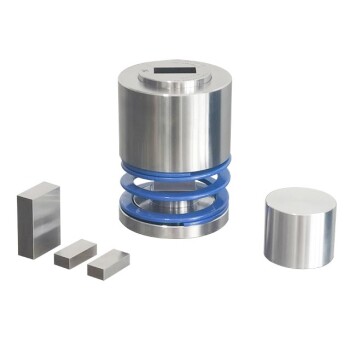
High-pressure reactors act as the fundamental simulation environment required to study alloy behavior in supercritical water. By physically containing and sustaining temperatures above 374°C and pressures exceeding 22.1 MPa, these reactors prevent water from undergoing phase changes. This precise control allows researchers to isolate the specific mechanisms of oxidation, ensuring that observed corrosion behaviors are the result of supercritical fluid interactions rather than standard liquid or steam exposure.
The core value of a high-pressure reactor lies in its ability to stabilize the supercritical state, transforming water into a highly aggressive solvent to reveal oxidation pathways and material failure points that do not exist under atmospheric conditions.
Simulating Extreme Service Conditions
Establishing the Supercritical State
The primary function of the reactor is to breach the critical point of water.
Standard vessels cannot contain the energy required to reach 22.1 MPa and 374°C. High-pressure reactors provide the enclosed, robust architecture necessary to reach and maintain these parameters safely.
Ensuring Fluid Homogeneity
In this environment, water is neither liquid nor gas, but a supercritical fluid.
The reactor ensures the fluid remains in this single phase. This prevents the separation of phases that would otherwise skew data regarding how alloys react to the density and transport properties specific to supercritical water.
Analyzing Oxidation and Degradation Mechanisms
Observing Oxide Film Formation
The reactor allows for the direct assessment of oxide layers on alloy surfaces.
Researchers can observe how these films nucleate and grow. This is critical for determining if a material will form a protective barrier or a porous, non-protective scale.
Tracking Elemental Diffusion
High-pressure environments accelerate diffusion processes.
The reactor setup enables the analysis of how elements within the alloy migrate outward and how oxygen penetrates inward. This helps identify which alloying elements are depleted during exposure to highly oxidative media.
Identifying Chemical Reaction Pathways
The unique properties of supercritical water alter standard chemical kinetics.
Reactors allow scientists to map specific reaction pathways. This includes understanding the influence of dielectric constants, which change drastically in supercritical conditions and affect solvent properties.
Assessing Long-Term Stability
Evaluating Passivation Films
Beyond initial formation, the reactor tests the durability of protective layers.
It serves as a testing ground to see if passivation films remain stable or break down over time. This is essential for predicting the lifespan of materials in industrial applications like power generation.
Investigating Cracking Behavior
The reactor environment facilitates the study of stress corrosion cracking.
By controlling the concentration of anions, researchers can observe how chemical variances influence the cracking susceptibility of alloys under extreme physical stress.
Understanding the Challenges
The Necessity of Precise Control
The benefits of these reactors are entirely dependent on stability.
Because the transition between phases can happen rapidly near the critical point, the reactor must offer precise and stable control. Any fluctuation in temperature or pressure can cause the fluid to drop out of the supercritical state, invalidating the oxidation data.
The Aggressivity of the Medium
The environment created is intentionally destructive.
While necessary for testing, the highly oxidative media creates a difficult testing scenario. The reactor allows for the observation of degradation, but the extreme conditions require rigorous monitoring to distinguish between material failure and experimental anomalies.
Applying This to Your Research
If your primary focus is Material Selection: Focus on using the reactor to assess the stability of passivation films and the formation of protective oxide layers to predict component lifespan.
If your primary focus is Failure Analysis: Utilize the reactor's ability to control anion concentrations to study cracking behavior and identify specific elemental diffusion weaknesses.
If your primary focus is Fundamental Chemistry: Leverage the precise temperature controls to analyze how changes in dielectric constants and reaction pathways alter the corrosion process.
High-pressure reactors are the only viable method for turning theoretical supercritical physics into observable, actionable materials science data.
Summary Table:
| Function | Role in Alloy Oxidation Study |
|---|---|
| Phase Control | Maintains water above 374°C and 22.1 MPa to prevent phase changes. |
| Oxide Analysis | Enables observation of oxide film nucleation and growth on surfaces. |
| Kinetic Mapping | Tracks elemental diffusion and chemical reaction pathways in aggressive media. |
| Stability Testing | Evaluates the durability of passivation films and stress corrosion cracking. |
| Environment Tuning | Adjusts dielectric constants and anion levels to simulate industrial stress. |
Accelerate Your Materials Research with KINTEK Precision
Elevate your study of alloy durability and chemical kinetics in extreme environments. KINTEK specializes in laboratory equipment and consumables, offering industry-leading high-temperature high-pressure reactors and autoclaves designed to maintain precise supercritical conditions.
Whether you are analyzing oxide film formation, tracking elemental diffusion, or investigating stress corrosion cracking, our robust systems provide the stability and safety your research demands. Beyond reactors, explore our comprehensive range of muffle furnaces, crushing systems, and specialized consumables like PTFE and ceramics.
Ready to optimize your simulation environment? Contact us today to find the perfect solution for your lab!
References
- Shuwei Guo, Shuzhong Wang. Oxidation Processes and Involved Chemical Reactions of Corrosion-Resistant Alloys in Supercritical Water. DOI: 10.1021/acs.iecr.0c01394
This article is also based on technical information from Kintek Solution Knowledge Base .
Related Products
- Customizable Laboratory High Temperature High Pressure Reactors for Diverse Scientific Applications
- Customizable High Pressure Reactors for Advanced Scientific and Industrial Applications
- Stainless High Pressure Autoclave Reactor Laboratory Pressure Reactor
- Visual High-Pressure Reactor for In-Situ Observation
- Mini SS High Pressure Autoclave Reactor for Laboratory Use
People Also Ask
- How do high-pressure and high-temperature reactors ensure the effective treatment of lignocellulosic wastewater in WAO?
- What equipment is required for high-pressure high-temperature reactions? Master Extreme Chemistry Safely
- How do you control high pressure in a reactor? A Guide to Safe & Stable Operation
- Why is argon better than nitrogen for inert atmosphere? Ensure Absolute Reactivity & Stability
- How does initial oxygen pressure affect the wet oxidation of pharmaceutical sludge? Master Your Oxidation Depth