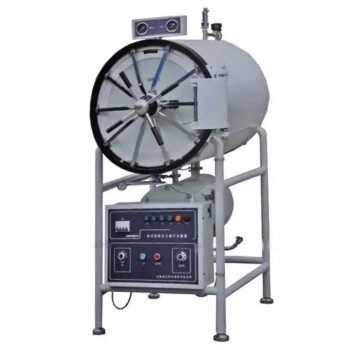
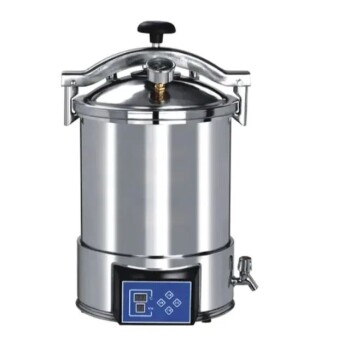
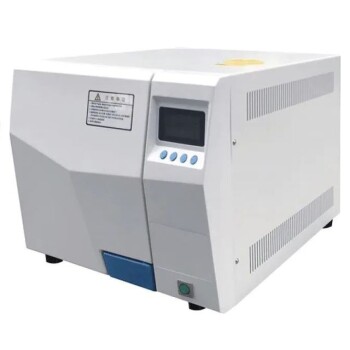
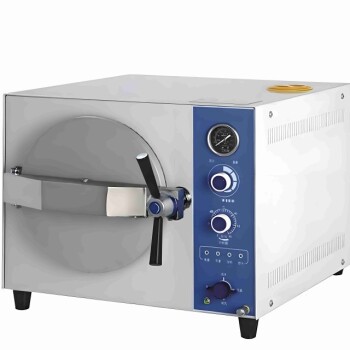
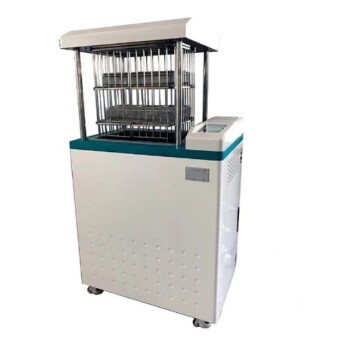
High-temperature and high-pressure autoclaves act as the essential thermodynamic vessels for creating MFI-type zeolite membranes. By maintaining a sealed environment, these reactors allow the synthesis solution to generate autogenous pressure at elevated temperatures. This specific combination of heat and pressure overcomes kinetic energy barriers, enabling silica sources to structurally rearrange and cross-link into the MFI crystalline topology.
The autoclave provides a closed thermodynamic system where heat drives the generation of internal pressure. This high-energy environment forces silica precursors and structure-directing agents (like TPA+) to overcome natural resistance, organizing into a dense, continuous MFI framework rather than remaining as an amorphous gel.
The Mechanics of the Hydrothermal Environment
Generating Autogenous Pressure
The autoclave creates a strictly sealed hydrothermal environment. As the temperature rises, the liquid solvents inside vaporize within the confined space, generating high internal pressure—known as autogenous pressure—without the need for external compression.
Overcoming Kinetic Barriers
Standard atmospheric conditions are insufficient for the complex chemistry of zeolitization. The high-pressure environment provides the necessary energy to overcome kinetic barriers, forcing the chemical reaction to proceed where it otherwise would not.
Facilitating Precursor Gelation
Under these specific thermodynamic conditions, the aluminosilicate or silica precursor gel undergoes critical changes. The environment induces dissolution and gelation, preparing the chemical components for structural rearrangement.
Structural Formation and Topology
Ordered Crystallization
Inside the reactor, silica sources do not just precipitate; they organize. The environment allows for ordered crystallization and cross-linking, shifting the material from a disordered state into a structured lattice.
The Role of Structure-Directing Agents
The formation of the specific MFI topology is not random. The autoclave environment enables structure-directing agents, such as TPA+, to effectively influence the silica framework, guiding it into the correct crystalline configuration.
Membrane Growth on Supports
Nucleation and Film Continuity
For membranes, the goal is a layer, not just loose powder. The autoclave conditions are essential for inducing zeolite crystal nucleation directly on the surface of a porous support.
Creating a Dense Barrier
The sustained high pressure promotes the growth of a continuous, dense thin film. This density is required for the membrane to function effectively as a separation barrier.
Ensuring Purity via Thermal Uniformity
The quality of the final crystal depends on consistency. The autoclave ensures a uniform thermal field throughout the solution, which is critical for ensuring the purity and pore regularity of the resulting zeolite structure.
Understanding the Trade-offs
The "Black Box" Limitation
Because the autoclave must remain sealed to maintain pressure, the synthesis process effectively happens in a "black box." You cannot monitor or adjust chemical concentrations in real-time once the reaction begins.
Sensitivity to Initial Conditions
The success of the process is heavily dependent on the initial setup. Slight errors in the precursor stoichiometry or temperature ramp cannot be corrected mid-synthesis and will result in impurities or defects in the membrane layer.
Making the Right Choice for Your Goal
To optimize your MFI zeolite synthesis, consider which aspect of the autoclave's function aligns with your specific objectives:
- If your primary focus is Membrane Integrity: Prioritize the stability of the temperature and pressure seal to ensure the continuous, dense film growth required to prevent defects or cracks on the support.
- If your primary focus is Crystal Purity: Focus on the precise ratio of structure-directing agents (TPA+) and ensuring a uniform thermal field to guarantee the correct MFI topology forms without competing phases.
The autoclave is not merely a container; it is the thermodynamic engine that forces chaotic chemicals into an ordered, functional MFI structure.
Summary Table:
| Role in Synthesis | Impact on MFI Membrane |
|---|---|
| Autogenous Pressure | Overcomes kinetic barriers for silica cross-linking |
| Sealed Environment | Enables dissolution and gelation of precursors |
| Structural Direction | Facilitates TPA+ agents to guide MFI topology |
| Thermal Uniformity | Ensures phase purity and pore regularity |
| Interfacial Growth | Promotes dense nucleation for defect-free films |
Elevate Your Materials Synthesis with KINTEK Precision
Unlock the full potential of your research with KINTEK’s high-temperature high-pressure reactors and autoclaves. Our equipment is engineered to provide the precise thermal uniformity and reliable pressure seals required for the complex hydrothermal synthesis of MFI-type zeolite membranes and advanced crystalline structures.
Whether you are focusing on membrane integrity or crystal purity, KINTEK offers a comprehensive range of laboratory solutions, including:
- High-Pressure Reactors & Autoclaves for flawless hydrothermal environments.
- Muffling & Tube Furnaces for post-synthesis calcination.
- Ceramics & Crucibles for specialized material handling.
Ready to achieve superior film density and crystalline purity? Contact our laboratory specialists today to find the perfect reactor configuration for your research goals.
References
- Hamdi Chaouk, Khaled Younes. Investigating the Physical and Operational Characteristics of Manufacturing Processes for MFI-Type Zeolite Membranes for Ethanol/Water Separation via Principal Component Analysis. DOI: 10.3390/pr12061145
This article is also based on technical information from Kintek Solution Knowledge Base .
Related Products
- High Pressure Laboratory Autoclave Reactor for Hydrothermal Synthesis
- Stainless High Pressure Autoclave Reactor Laboratory Pressure Reactor
- Mini SS High Pressure Autoclave Reactor for Laboratory Use
- Laboratory High Pressure Horizontal Autoclave Steam Sterilizer for Lab Use
- Portable High Pressure Laboratory Autoclave Steam Sterilizer for Lab Use
People Also Ask
- What role does a high-pressure reactor (autoclave) play in the synthesis of NiCuFe-LDH? Master Hydrothermal Growth
- What Role Does a High-Pressure Reactor or Autoclave Play in HA Catalyst Synthesis? Achieve High Surface Area Materials
- What equipment is required for hydrothermal synthesis of Ga0.25Zn4.67S5.08? Optimize Your Semiconductor Production
- What is the function of a high-pressure reactor in the hydrothermal synthesis of boehmite? Expert Process Insights
- What role does an autoclave play in the synthesis of MnO2 nanofibers? Mastering Hydrothermal Growth