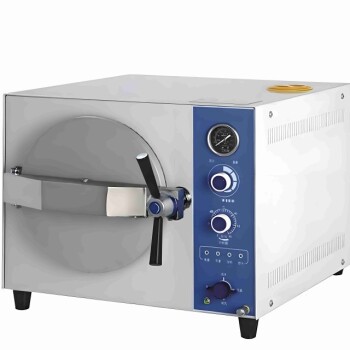
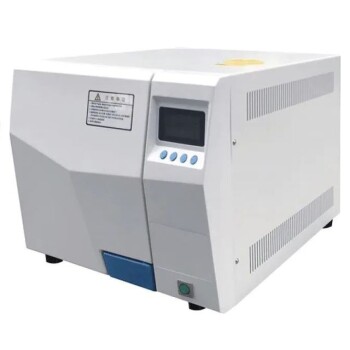
The critical role of high-pressure autoclaves in preparing bio-based polyamide curing agents is to rigorously control the amidation reaction environment. By subjecting the mixture of plant-oil-derived dimeric acid and excess polyamines to high pressure and temperature, the equipment actively removes reaction byproducts, specifically water. This removal is the key mechanism that drives the chemical reaction to completion, ensuring the final material achieves the necessary structural and performance characteristics.
By effectively removing water byproducts under controlled pressure, the autoclave facilitates the complete growth of polyamide chains. This directly results in a curing agent that offers high viscosity, low toxicity, and the flexibility required for high-performance adhesives.
The Mechanics of the Reaction
Driving the Amidation Process
The core chemical process involves an amidation reaction between dimeric acid and polyamines. For this reaction to succeed, the system must overcome the natural equilibrium that occurs when water is produced.
Managing Reaction Byproducts
High-pressure autoclaves are designed to remove water generated during synthesis. Eliminating this water prevents the reaction from stalling or reversing.
Ensuring Chain Completeness
By continuously removing water, the process forces the complete growth of polyamide chains. Without this pressure-assisted environment, the polymer chains would likely remain short and underdeveloped.
Impact on Material Performance
Structural Integrity and Viscosity
The full development of polymer chains results in a product with high viscosity. This physical property is a direct indicator of the molecular weight and structural integrity of the curing agent.
Operational Safety and Usability
Properly synthesized curing agents exhibit low toxicity and a long pot life. These features are vital for industrial applications, ensuring the material is safe for workers and remains workable for extended periods.
Mechanical Durability
Complete amidation grants the final adhesive excellent flexibility and toughness. These mechanical properties are essential for bio-based adhesives that must endure stress without cracking or failing.
Understanding the Trade-offs
Operational Complexity
While autoclaves yield superior materials, they introduce significant operational demands. The requirement for high pressure necessitates robust safety protocols and specialized maintenance that atmospheric vessels do not.
Process Sensitivity
The quality of the final product is heavily dependent on maintaining precise conditions. Slight deviations in pressure or temperature during water removal can disrupt chain growth, leading to inconsistent batches.
Optimizing for High-Performance Adhesives
To successfully leverage bio-based sources for industrial curing agents, you must align your processing equipment with your performance goals.
- If your primary focus is mechanical toughness: Prioritize the water removal phase in the autoclave to ensure maximum chain elongation, which directly correlates to flexibility and durability.
- If your primary focus is processing safety: Ensure the reaction is driven to absolute completion under pressure to minimize toxicity and maximize the useful pot life of the mixture.
Mastering the high-pressure environment is the definitive step in converting raw bio-based acids into reliable, high-grade adhesive components.
Summary Table:
| Feature | Impact of High-Pressure Autoclaves | Resulting Material Property |
|---|---|---|
| Water Removal | Eliminates byproducts to drive equilibrium | Complete polyamide chain growth |
| Pressure Control | Maintains optimal reaction environment | High viscosity & structural integrity |
| Reaction Completion | Minimizes unreacted monomers | Low toxicity & long pot life |
| Mechanical Optimization | Facilitates molecular elongation | Excellent flexibility & toughness |
Elevate Your Bio-Based Material Research with KINTEK
Transitioning from raw dimeric acid to high-performance adhesives requires precision-engineered pressure environments. KINTEK specializes in advanced high-temperature high-pressure reactors and autoclaves designed specifically for demanding amidation and polymerization processes.
Our equipment ensures rigorous control over water removal and chain growth, delivering the structural integrity your research demands. Beyond autoclaves, we provide a full suite of laboratory solutions—from high-temperature furnaces and crushing systems to PTFE consumables and cooling solutions.
Ready to optimize your synthesis process? Contact us today to discuss your project requirements!
References
- Conan Chen. Sustainable Bio-Based Epoxy Technology Progress. DOI: 10.3390/pr13041256
This article is also based on technical information from Kintek Solution Knowledge Base .
Related Products
- Mini SS High Pressure Autoclave Reactor for Laboratory Use
- High Pressure Laboratory Autoclave Reactor for Hydrothermal Synthesis
- Stainless High Pressure Autoclave Reactor Laboratory Pressure Reactor
- Desktop Fast High Pressure Laboratory Autoclave Sterilizer 16L 24L for Lab Use
- Laboratory High Pressure Horizontal Autoclave Steam Sterilizer for Lab Use
People Also Ask
- Why use high-pressure reactors for molecular sieve synthesis? Unlock Superior Crystallinity and Framework Control
- What is the function of a high-pressure reactor autoclave? Enhancing Cu/N Co-Doped Carbon Catalyst Synthesis
- What are the advantages of using a high-pressure reactor like an autoclave? Maximize Liquefaction Speed & Yield
- Why are high-pressure reactors or autoclaves necessary for the synthesis of new functional materials? Unlock Precision.
- How are high-pressure reactors used to prepare metaphosphate electrocatalysts? Master In-Situ Precursor Growth