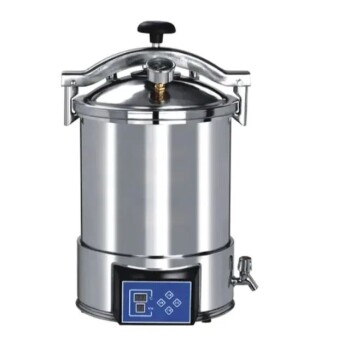
The high-temperature and high-pressure autoclave serves as the foundational "microcosm" for validating nuclear materials.
It plays the critical role of creating a controlled laboratory environment that precisely replicates the primary circuit conditions of a Pressurized Water Reactor (PWR). By maintaining an experimental solution at extreme physical set points—typically around 330°C and 150 bar—the autoclave allows engineers to subject materials (such as Alloy 690TT) to the exact thermal, mechanical, and chemical stresses they will face during reactor operation, without the radiological risks of an active core.
Core Takeaway The autoclave is not merely a heating vessel; it is a dynamic simulation chamber that validates material longevity. By sustaining precise heat, pressure, and water chemistry for extended periods (e.g., 500+ hours), it reveals how components will resist oxidation, corrosion, and cracking under realistic service stresses.
Recreating the Reactor Core Environment
To accurately predict how materials will behave inside a nuclear reactor, an autoclave must control three specific variables: physical stress, chemical composition, and time.
Precise Thermal and Pressure Regulation
The defining characteristic of a PWR is that water is kept under such high pressure that it remains liquid even at temperatures far above boiling. The autoclave mimics this by maintaining:
- Temperatures: Typically between 310°C and 360°C.
- Pressures: Ranging from 150 bar (15 MPa) to 200 bar (20 MPa).
This environment is essential for testing cladding materials like stainless steel and nickel-based alloys, ensuring they maintain structural integrity under thermal stress.
Complex Water Chemistry Simulation
Simulating the physical pressure is insufficient if the chemical environment is incorrect. Industrial autoclaves integrate solution circulation systems to maintain specific water chemistries found in PWRs.
- Chemical Additives: The system controls concentrations of boron and lithium (for reactivity control simulation) and zinc (for corrosion inhibition).
- Gas Control: It regulates Dissolved Hydrogen (DH) levels and oxygen content. This is critical for studying the "electrochemical potential," which dictates how fast oxide films grow or how easily stress corrosion cracking (SCC) initiates.
Accelerated Durability Testing
Materials in a reactor must last for decades. Autoclaves simulate this endurance through continuous exposure experiments, often lasting from 500 to over 8,000 hours.
- Oxidation Behavior: Researchers observe the growth rate and stability of oxide films on materials like Alloy 690TT.
- Adhesion and Integrity: Dynamic autoclaves evaluate how protective coatings adhere under compressive stress and fluid flow.
Static vs. Dynamic Simulation
The role of the autoclave changes slightly depending on whether the system is static or dynamic.
Static Immersion
In a static setup, the fluid is largely stationary. This is primarily used for studying the chemical kinetics of oxide film growth and long-term passive corrosion rates. It is ideal for baseline material screening.
Dynamic Circulation
A dynamic autoclave typically includes pumps and flow loops. This simulates the flow of coolant through the reactor.
- It is critical for evaluating flow-assisted corrosion and the integrity of coatings under shear stress.
- It allows for precise control of conductivity and pH in real-time, preventing the stagnation that can occur in static tests.
Critical Trade-offs and Limitations
While autoclaves are the industry standard for PWR testing, understanding their limitations is vital for interpreting data correctly.
Vessel Contamination
The autoclave walls are subjected to the same harsh conditions as the test specimen.
- The Risk: If the autoclave body corrodes, it can release metal ions into the test solution, altering the chemistry and invalidating results.
- The Solution: High-quality autoclaves use chemically inert materials like Hastelloy for the reaction vessel. This ensures high purity and prevents the vessel itself from interfering with the corrosion testing of the target material (e.g., 304 stainless steel).
Simulation vs. Reality
An autoclave simulates the environment of a reactor, but usually not the radiation.
- Most standard autoclave tests are "out-of-pile," meaning they do not account for neutron irradiation embrittlement.
- Engineers must correlate autoclave data with separate irradiation studies to build a complete material profile.
Making the Right Choice for Your Goal
Select your experimental approach based on the specific failure mode you are investigating.
- If your primary focus is Oxidation Kinetics: Prioritize a setup with precise Dissolved Hydrogen (DH) control to study how oxide films evolve on alloys like 690TT under static, long-term exposure (500+ hours).
- If your primary focus is Stress Corrosion Cracking (SCC): Use a dynamic autoclave system capable of regulating electrochemical potential and applying mechanical load to the specimen during exposure.
- If your primary focus is Purity and Trace Accuracy: Ensure your autoclave vessel is constructed of Hastelloy or similar inert alloys to prevent vessel corrosion from contaminating your water chemistry.
The autoclave is the bridge between theoretical metallurgy and operational safety, proving that a material can survive the reactor before it ever enters one.
Summary Table:
| Parameter | PWR Simulation Requirement | Autoclave Capability |
|---|---|---|
| Temperature | 310°C to 360°C | Precise regulation up to 400°C+ |
| Pressure | 150 bar to 200 bar | High-pressure containment (up to 20 MPa) |
| Chemistry | Boron, Lithium, Zinc additives | Integrated solution circulation systems |
| Gas Control | Dissolved H2/O2 regulation | Real-time electrochemical potential monitoring |
| Test Duration | Decades of service | Accelerated exposure (500 to 8,000+ hours) |
Elevate Your Nuclear Material Research with KINTEK
Precision is non-negotiable when simulating extreme reactor environments. KINTEK specializes in advanced laboratory solutions, offering high-performance high-temperature high-pressure reactors and autoclaves engineered from inert materials like Hastelloy to ensure zero contamination during your critical corrosion and SCC studies.
Whether you are testing Alloy 690TT or developing next-generation cladding, our comprehensive portfolio—from crushing and milling systems to high-temperature furnaces (muffle, vacuum, CVD)—provides the reliability your lab demands.
Ready to achieve superior simulation accuracy? Contact our technical experts today to find the perfect autoclave system for your PWR research.
References
- Soon-Hyeok Jeon, Do Haeng Hur. Effects of Hydrogen Contents on Oxidation Behavior of Alloy 690TT and Associated Boron Accumulation within Oxides in High-Temperature Water. DOI: 10.1155/2018/7845176
This article is also based on technical information from Kintek Solution Knowledge Base .
Related Products
- High Pressure Laboratory Autoclave Reactor for Hydrothermal Synthesis
- Stainless High Pressure Autoclave Reactor Laboratory Pressure Reactor
- Mini SS High Pressure Autoclave Reactor for Laboratory Use
- Laboratory High Pressure Horizontal Autoclave Steam Sterilizer for Lab Use
- Portable High Pressure Laboratory Autoclave Steam Sterilizer for Lab Use
People Also Ask
- What role does a high-pressure reactor (autoclave) play in the synthesis of NiCuFe-LDH? Master Hydrothermal Growth
- What Role Does a High-Pressure Reactor or Autoclave Play in HA Catalyst Synthesis? Achieve High Surface Area Materials
- What equipment is required for hydrothermal synthesis of Ga0.25Zn4.67S5.08? Optimize Your Semiconductor Production
- What is the function of a high-pressure reactor in the hydrothermal synthesis of boehmite? Expert Process Insights
- What role does an autoclave play in the synthesis of MnO2 nanofibers? Mastering Hydrothermal Growth