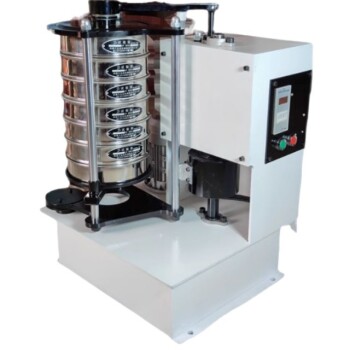
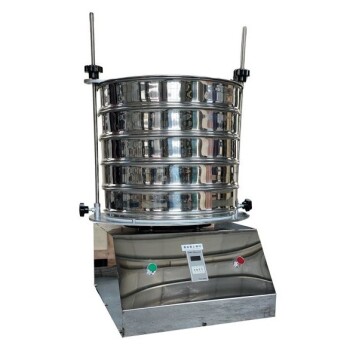
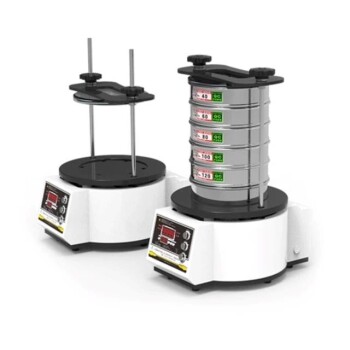
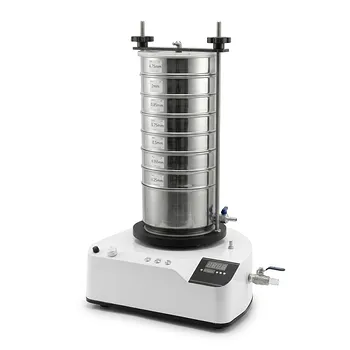
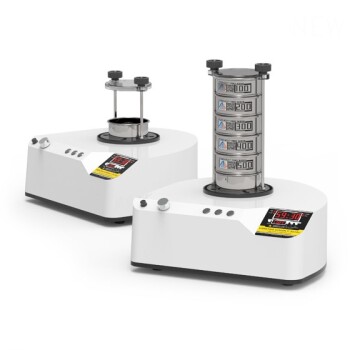
The use of a 200-mesh standard experimental sieve is essential for producing a uniform powder with a particle size of approximately 75μm. This standardization maximizes the specific surface area of the Modified Soybean Straw Activated Carbon (M-SSAC), directly enhancing its adsorption efficiency for pollutants like methylene blue while ensuring the physical consistency required for accurate experimental modeling.
To achieve high-performance adsorption and reproducible data, particle size must be strictly controlled. The 200-mesh sieve ensures the adsorbent has a optimized surface-to-volume ratio and eliminates size-based variables that could skew experimental results.
Maximizing Adsorption Performance
Enhancing Specific Surface Area
Finer particles obtained through a 200-mesh sieve provide significantly more active sites per unit of mass. This increase in the specific surface area allows for a greater number of pollutant molecules to be captured on the carbon surface simultaneously.
Accelerating Adsorption Kinetics
Small, uniform particles reduce the internal diffusion path that pollutants must travel to reach the internal pore structure. By limiting the particle size to 75μm, the rate at which substances like methylene blue are adsorbed is greatly increased, leading to faster equilibrium times.
Optimizing Pore Structure Development
Standardizing particle size before activation ensures that chemical reagents and heat penetrate the soybean straw evenly. This uniformity leads to a more consistent pore distribution, which is critical for the carbon's ability to filter specific molecular weights of contaminants.
Ensuring Scientific Rigor and Reproducibility
Validity in Response Surface Methodology (RSM)
Experimental designs like RSM rely on the precise control of variables to model the interaction between different factors. Using a 200-mesh sieve ensures that physical consistency is maintained across all samples, preventing particle size from becoming an unintended confounding variable.
Eliminating Influence on Diffusion Rates
In adsorption kinetics studies, varying particle dimensions can lead to inconsistent diffusion data. By unifying the particle size, researchers can isolate the effects of chemical modifications and ensure that the resulting data is both scientifically accurate and reproducible.
Removing Agglomerates and Impurities
The sieving process effectively removes large particles or agglomerates that may have formed during the drying or crushing stages. This ensures that only high-purity, micron-sized biochar enters the final characterization and testing phases.
Understanding the Trade-offs
Material Recovery and Processing Time
While 200-mesh sieving provides superior performance, it can result in significant material loss if the initial crushing process is inefficient. Achieving such a fine grade requires more intensive mechanical energy and longer processing times compared to coarser sieves.
Handling and Filtration Challenges
Extremely fine powders like those at 75μm can be difficult to handle in large-scale applications due to dusting and clumping. Furthermore, recovering the spent activated carbon from treated water may require more advanced filtration or centrifugation compared to granular activated carbon.
Applying Sieve Standards to Your Project
Consistent particle sizing is the foundation of high-quality carbon synthesis and reliable experimental data.
- If your primary focus is Maximum Adsorption Capacity: Utilize the 200-mesh sieve to maximize the available specific surface area and active site density.
- If your primary focus is Kinetic Modeling: Ensure all samples pass through the 200-mesh standard to eliminate size-related diffusion variables and obtain accurate rate constants.
- If your primary focus is Thermal Carbonization Uniformity: Use standardized sieving to ensure even heat transfer, which prevents localized under-activation or over-carbonization of the biomass.
Precision in particle size classification is the critical link between raw biomass waste and a high-performance, scientifically validated adsorbent.
Summary Table:
| Key Parameter | Impact of 200-Mesh Sieve (75μm) | Research & Practical Benefit |
|---|---|---|
| Particle Size | Uniform 75μm diameter | Ensures physical consistency for RSM modeling |
| Surface Area | Maximized active site density | Significantly higher pollutant adsorption capacity |
| Adsorption Kinetics | Shortened internal diffusion paths | Faster equilibrium times and increased reaction rates |
| Pore Structure | Even penetration of activation agents | Consistent pore distribution across all samples |
| Data Integrity | Elimination of size-based variables | Validates scientific reproducibility and accuracy |
| Quality Control | Removal of agglomerates/impurities | Ensures high-purity micron-sized biochar for testing |
Optimize Your Carbon Research with KINTEK Precision
Elevate your material science experiments with KINTEK’s industry-leading laboratory solutions. Whether you are developing Modified Soybean Straw Activated Carbon or advanced catalysts, our high-precision standard experimental sieves, crushing and milling systems, and high-temperature furnaces (muffle, vacuum, and atmosphere) provide the exact control needed for superior adsorption performance.
From achieving perfect 75μm particle uniformity to scaling production with our hydraulic presses and high-pressure reactors, KINTEK delivers the reliability and scientific rigor your research demands.
Ready to enhance your lab's efficiency and data accuracy? Contact our experts today to find the perfect equipment tailored to your specific application!
References
- Rurong Jiang, Yonglian Yao. Optimization of The Modified Soybean StrawActivated Carbon for Adsorption of MethyleneBlue Dye by Response Surface Methodology. DOI: 10.15244/pjoes/166348
This article is also based on technical information from Kintek Solution Knowledge Base .
Related Products
- Laboratory Vibratory Sieve Shaker Machine Slap Vibrating Sieve
- Laboratory Test Sieves and Sieving Machines
- Vibratory Sieve Shaker Machine Dry Three-Dimensional Vibrating Sieve
- Laboratory Test Sieves and Vibratory Sieve Shaker Machine
- Laboratory Vibratory Sieve Shaker Machine for Dry and Wet Three-Dimensional Sieving
People Also Ask
- How does a laboratory vibratory sieve shaker facilitate the microstructural study of gas-atomized alloy powders?
- What role does a laboratory vibrating sieve shaker play in the LiFePO4 powder processing workflow? Ensure Batch Quality
- What are laboratory sieves used for? Measure Particle Size for Quality Control & R&D
- What are the uses of sieve in laboratory? Essential Guide to Particle Size Analysis
- What are the sieve used in laboratory? A Guide to Choosing the Right Sieve for Accurate Particle Analysis