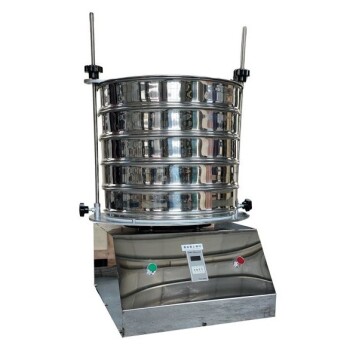
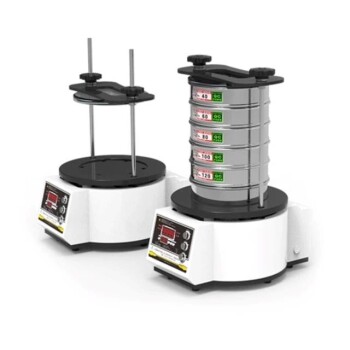
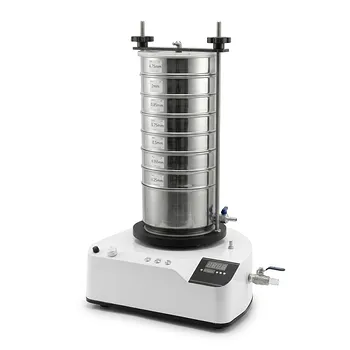
Standard sieves are the primary tool for ensuring particle size uniformity in biochar production. Using these instruments allows producers to achieve a consistent material foundation, which is essential for predictable mass transfer rates and reliable fluid dynamic characteristics. This standardization is critical for both laboratory accuracy and the industrial performance of the final product.
The use of standard sieves in biochar grading transforms a heterogeneous byproduct into a standardized technical material. This uniformity is the fundamental prerequisite for predictable performance in adsorption, composite reinforcement, and soil amendment applications.
Enhancing Predictive Accuracy and Reproducibility
Predictable Mass Transfer and Fluid Dynamics
Maintaining a consistent particle size is essential for achieving predictable mass transfer rates during adsorption processes. When particle sizes are uniform, fluid dynamic characteristics become stable, providing the necessary data for establishing accurate predictive models.
Ensuring Experimental Comparability
Standardized sieving, such as using a 100-mesh sieve, eliminates variations in surface area caused by size discrepancies. This ensures that any differences observed in adsorption performance are due to the material's properties rather than physical irregularities, guaranteeing the comparability of kinetic studies.
Facilitating Reliable Data Synthesis
In scientific research, high material homogenization is achieved through rigorous sieving. This allows for the reproducibility of leaching and passivation experiments, ensuring that results can be verified across different laboratories and study conditions.
Optimizing Material Performance for Specific Applications
Maximizing Surface Area for Adsorption
Sieving biochar to a fine and uniform size, often following ball-milling, maximizes the contact area between the adsorbent and the target solution. This efficiency is critical for industrial wastewater treatment where high-throughput adsorption is required.
Improving Mechanical Properties in Composites
Using a 150 μm standard sieve removes oversized particles and hard agglomerates that could cause stress concentration points. In rubber or polymer composites, this narrow particle size distribution significantly improves the tensile strength and toughness of the final material.
Preventing Flow Path Issues in Industrial Columns
Consistent particle size helps in the formation of a uniform packed bed within adsorption columns. This prevents the phenomenon of gas short-circuiting and minimizes the pressure drop across the bed, which is vital for energy-efficient industrial operations.
Facilitating Uniform Chemical and Biological Reactions
Consistent Impregnation and Modification
Uniform particle sizes facilitate the even impregnation of chemical agents, such as iron salt solutions, during modification processes. This results in products like magnetic biochar that possess a stable structure and a controllable specific surface area.
Homogenization in Soil and Compost
Standard 2mm mesh sieves are frequently used to ensure biochar blends uniformly with cattle manure or soil. This standardization is fundamental for accurately evaluating water holding capacity and porosity during the composting process.
Understanding the Trade-offs
The Cost of High Precision
Achieving extreme uniformity often requires multiple stages of grinding and sieving, which increases operational costs and energy consumption. Producers must balance the need for precision with the economic reality of the target application.
Material Waste and Yield Loss
Sieving inherently removes a portion of the material that does not meet the specified size range. Unless there is a secondary market for these "fines" or oversized particles, this can result in significant yield loss and waste management challenges.
Physical Limitations of Sieve Analysis
Sieves measure the smallest cross-section of a particle, which can be misleading for needle-like or irregular biochar fragments. In highly sensitive applications, sieving may need to be supplemented with laser diffraction to fully characterize particle morphology.
Strategic Implementation of Sieving Standards
Making the Right Choice for Your Goal
- If your primary focus is adsorption kinetics: Use 100-mesh or 200-mesh sieves to eliminate surface area variables and ensure the accuracy of your predictive models.
- If your primary focus is structural reinforcement: Employ a 150 μm sieve to remove large agglomerates that could compromise the tensile strength of your composite materials.
- If your primary focus is soil amendment or composting: Utilize 2mm standard sieves to ensure a homogeneous mix and reliable measurements of water retention and porosity.
Standardizing biochar particle size through precision sieving is the bridge between raw biomass carbonization and the creation of a high-value technical commodity.
Summary Table:
| Application Focus | Recommended Sieve Range | Key Significance & Benefit |
|---|---|---|
| Adsorption Kinetics | 100 - 200 Mesh | Ensures predictable mass transfer and accurate predictive models. |
| Material Composites | < 150 μm | Eliminates oversized particles to improve tensile strength and toughness. |
| Soil & Composting | 2 mm Standard | Facilitates uniform blending and reliable porosity measurements. |
| Industrial Columns | Uniform Grading | Prevents gas short-circuiting and minimizes pressure drops. |
| Chemical Modification | Consistent Fine Mesh | Achieves even impregnation for stable magnetic or modified structures. |
Elevate Your Biochar Precision with KINTEK
Transform your raw biomass into high-value technical materials with KINTEK’s premium laboratory solutions. Whether you are focusing on adsorption kinetics, structural reinforcement, or soil science, achieving the perfect particle size distribution is non-negotiable.
KINTEK specializes in the essential tools for biochar excellence, including:
- Precision Sieving Equipment: For reliable grading and material homogenization.
- Crushing & Milling Systems: To prepare samples for high-surface-area applications.
- High-Temperature Furnaces: From muffle to vacuum and rotary furnaces for optimal carbonization.
- Hydraulic Presses & Reactors: For advanced composite research and high-pressure modifications.
Don't let inconsistent particle sizes compromise your research or industrial yield. Contact KINTEK today to discover how our comprehensive range of equipment and consumables can ensure the reproducibility and performance of your finished products.
References
- Wei Zhang, Yong Sik Ok. Machine learning based prediction and experimental validation of arsenite and arsenate sorption on biochars. DOI: 10.1016/j.scitotenv.2023.166678
This article is also based on technical information from Kintek Solution Knowledge Base .
Related Products
- Custom PTFE Teflon Parts Manufacturer for PTFE Mesh F4 Sieve
- Laboratory Test Sieves and Sieving Machines
- Vibratory Sieve Shaker Machine Dry Three-Dimensional Vibrating Sieve
- Laboratory Vibratory Sieve Shaker Machine Slap Vibrating Sieve
- Three-dimensional electromagnetic sieving instrument
People Also Ask
- What are the primary reasons for selecting PTFE as a matrix? Enhance Composites with Carbon Nanotube Reinforcement
- How is PTFE utilized for insulation in Alloy 22 corrosion setups? Ensure Signal Purity & Accuracy
- Is PTFE corrosion resistant? Discover the Ultimate Chemical Resistance for Your Lab
- What are the specific applications of PTFE in micro-batch slug flow systems? Enhance Your Microfluidic Reaction Purity
- What is the mesh size of a sieve? A Guide to Particle Size and Sieve Selection