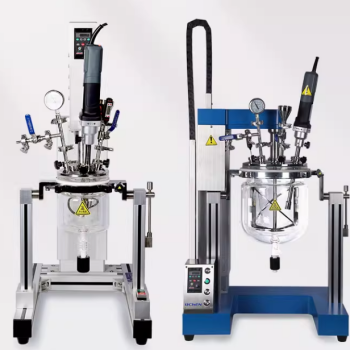
High-energy crushing equipment and homogenizers act as the primary mechanical catalyst for processing Miscanthus x giganteus. By subjecting the plant material to intense mechanical shearing forces, these devices effectively deconstruct the macroscopic structure of the plant tissue. This creates a foundational physical change—increasing the surface area-to-volume ratio—that makes all subsequent processing steps viable.
Core Takeaway The mechanical breakdown of biomass is not merely about size reduction; it is a critical enabling step that exposes the internal lignocellulosic matrix. Without this increase in surface area, solvents cannot penetrate the biomass effectively, rendering downstream subcritical water extraction inefficient and incomplete.
The Mechanics of Biomass Pretreatment
Applying Mechanical Shearing
The primary function of high-energy crushing equipment is the application of mechanical shearing forces. This physical stress tears apart the rigid plant tissues that naturally resist chemical degradation.
By disrupting the macroscopic structure, you move the material from a raw, resistant state to a processed state ready for extraction.
Increasing Surface Area-to-Volume Ratio
The most quantifiable impact of this equipment is the drastic increase in the surface area-to-volume ratio of the biomass particles.
This metric is the defining factor for reaction kinetics in solid-liquid extraction. A higher ratio ensures that a greater percentage of the biomass is directly exposed to the surrounding environment.
Optimizing Extraction Efficiency
Enabling Rapid Solvent Penetration
The effectiveness of extraction depends entirely on the solvent's ability to reach the target compounds.
High-energy homogenization ensures that solvents can rapidly penetrate the complex lignocellulosic matrix. Without this mechanical opening, solvents would face significant diffusion resistance, slowing down the entire process.
Enhancing Component Separation
This pretreatment is specifically critical when utilizing subcritical water extraction.
By ensuring deep solvent infiltration, the equipment facilitates improved component separation. This leads to higher yields and a more efficient recovery of the desired bio-products from the Miscanthus fiber.
Operational Considerations and Trade-offs
The Necessity of Uniformity
While the primary goal is reducing size, the secondary goal is achieving particle consistency.
Supplementary data suggests that processing biomass into specific size ranges (e.g., 0.43 mm to 1.02 mm) facilitates more uniform chemical reactions.
Balancing Size and Process Stability
If particles are too large, the core of the biomass remains untouched by reagents.
However, the crushing process must be controlled to produce a standardized reduction, ensuring that the penetration of chemical reagents is thorough and predictable across the entire batch.
Making the Right Choice for Your Goal
To maximize the efficiency of your Miscanthus processing:
- If your primary focus is Extraction Speed: Prioritize high-energy shearing to maximize the surface area-to-volume ratio, allowing for immediate solvent uptake.
- If your primary focus is Reaction Consistency: Utilize sieving systems post-crushing to target a specific particle range (e.g., roughly 0.4 mm to 1.0 mm) to ensure uniform chemical penetration.
Effective pretreatment transforms Miscanthus from a raw crop into a reactive substrate, serving as the deciding factor in the efficiency of your extraction workflow.
Summary Table:
| Feature | Mechanical Impact | Process Benefit |
|---|---|---|
| Structural Deconstruction | Applies intense mechanical shearing forces | Breaks down rigid plant tissues for processing |
| Surface Area Optimization | Increases surface area-to-volume ratio | Boosts reaction kinetics and extraction yields |
| Solvent Access | Opens lignocellulosic matrix | Enables rapid penetration for subcritical water extraction |
| Particle Consistency | Standardizes particle size (e.g., 0.4-1.0mm) | Ensures uniform chemical reactions and stability |
Transform Your Biomass Research with KINTEK’s Precision Solutions
Maximize the efficiency of your Miscanthus x giganteus processing by leveraging KINTEK’s advanced laboratory technology. Our high-performance crushing and milling systems and homogenizers are engineered to deliver the precise shearing forces and uniform particle sizes essential for superior extraction yields.
Whether you are refining pretreatment protocols or scaling up subcritical water extraction, KINTEK provides the comprehensive tools you need—from high-pressure reactors and sieving equipment to durable ceramic crucibles. Partner with us to achieve consistent, repeatable results in your renewable energy and material science workflows.
Ready to optimize your lab’s throughput? Contact KINTEK today to find the perfect equipment for your application!
References
- Arielle Muniz Kubota, Tim W. Overton. A biorefinery approach for fractionation of Miscanthus lignocellulose using subcritical water extraction and a modified organosolv process. DOI: 10.1016/j.biombioe.2018.01.019
This article is also based on technical information from Kintek Solution Knowledge Base .
Related Products
- Lab Sterile Slapping Type Homogenizer for Tissue Mashing and Dispersing
- High Performance Lab Homogenizer for Pharma Cosmetics and Food R&D
People Also Ask
- How does a laboratory automatic masticator or homogenizer facilitate the processing of biofilm samples? Optimize Accuracy
- How do lab stirrers & homogenizers ensure uniform distribution? Optimize Your Complex Multiphase Chemical Mixing
- What role does a laboratory homogenizer play in radioactive cesium detection? Ensure Accuracy in Wildlife Sampling
- How does a homogenizer affect the quality of electrode slurry? Master Battery Consistency with High-Shear Mixing
- Why is maintaining nanoparticle dispersion critical for photocatalytic reactors? Maximize Your Reaction Efficiency